TDEE Calculator for Beginners: Step-by-Step Calorie Guide
Learn how to budget daily calories with our TDEE calculator for beginners. Set healthy deficit targets, avoid common mistakes, and lose fat steadily.
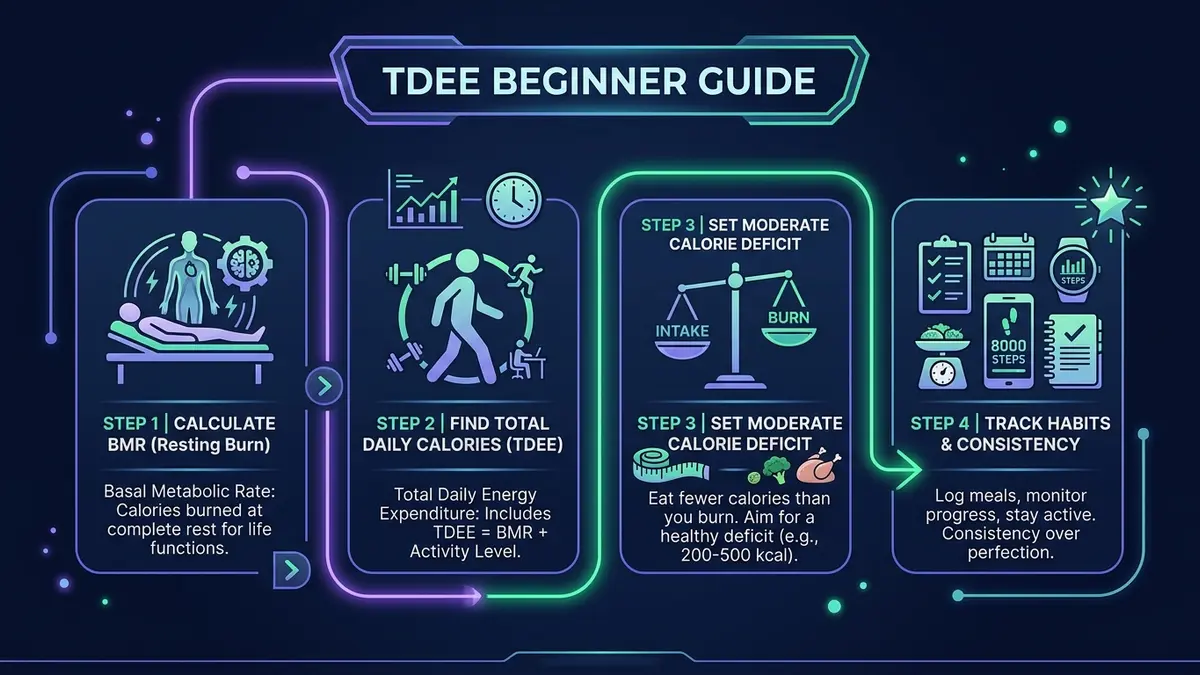
⚡ Quick Summary and Key Takeaways
Learn how to budget daily calories with our TDEE calculator for beginners. Set healthy deficit targets, avoid common mistakes, and lose fat steadily.
If you have spent any time researching weight loss, fat loss, or muscle building on social media, you have likely encountered acronyms like TDEE, BMR, CICO, and Macros.
Using an evidence-based TDEE calculator for beginners cuts through conflicting fitness advice that can feel paralyzing. Influencers preach keto, carnivore, intermittent fasting, or clean eating, while fitness forums tell you to simply “eat in a deficit.”
Here is the liberating truth: All successful diets work through the exact same scientific principle: energy balance.
This beginner’s guide explains how to use a Free TDEE Calculator to take total control of your body composition in simple, stress-free steps.
Step 1: CICO Basics in a TDEE Calculator for Beginners
CICO stands for Calories In, Calories Out. It is the practical application of the First Law of Thermodynamics to human metabolism:
- Calories In: The energy you consume from foods, beverages, and supplements.
- Calories Out (TDEE): The total energy your body burns across 24 hours just living, breathing, walking, digesting, and exercising.
• Calories In = Calories Out -> Weight stays the same (Maintenance)
• Calories In < Calories Out -> Weight drops (Caloric Deficit / Fat Loss)
• Calories In > Calories Out -> Weight rises (Caloric Surplus / Muscle or Fat Gain)
No food is inherently “fattening” or “slimming.” A calorie of olive oil contains the same thermodynamic energy as a calorie of ice cream or chicken breast. While food quality directly impacts health, hunger, and longevity, your total calorie balance dictates your weight change.
Step 2: Using a TDEE Calculator for Beginners
Before you can decide how much to eat, you must know your baseline expenditure.
Open our TDEE Calculator and input:
- Age, Sex, Height, and Current Weight: These determine your Basal Metabolic Rate (the calories burned keeping your organs alive).
- Activity Level: Be conservative! If you work an office desk job and lift weights 3 times a week, select Lightly Active. (See our Activity Level Guide for help).
Your output will show your Maintenance Calories. If the calculator reports 2,200 calories per day, that is your daily break-even point.
Step 3: Choosing Goals on a TDEE Calculator for Beginners
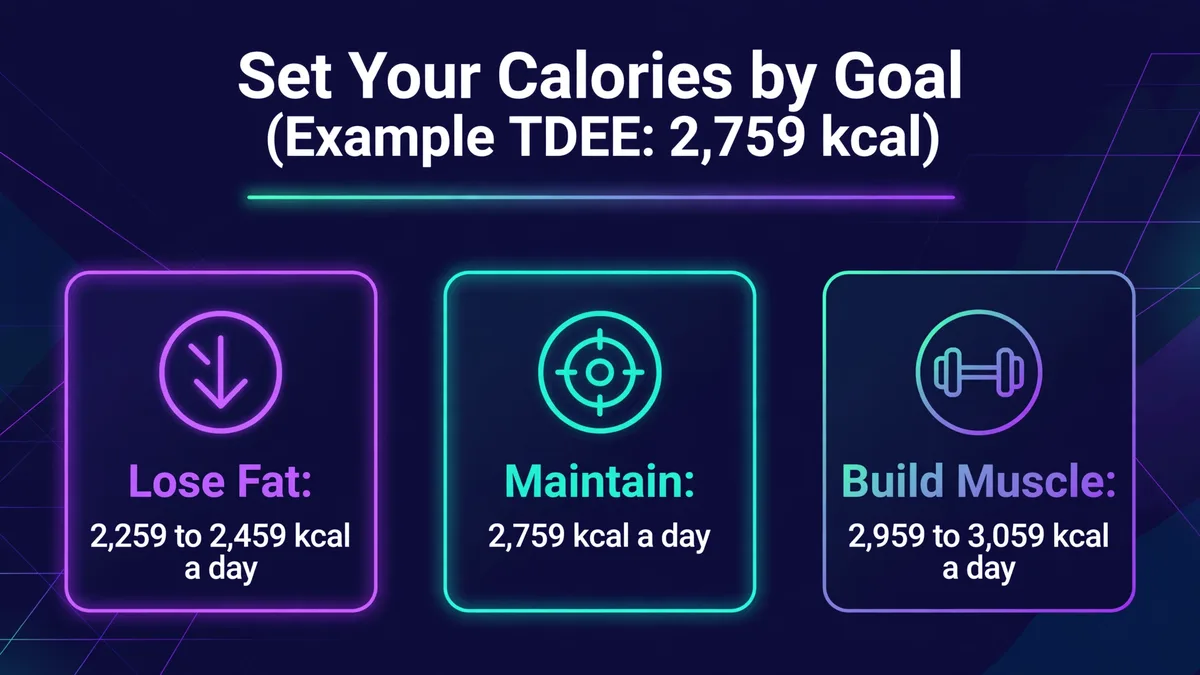
Once you know your maintenance line, determine your target intake:
Goal A: Sustainable Fat Loss (Recommended)
Subtract 300 to 500 calories from your TDEE.
- Example:
2,200 TDEE - 500 = 1,700 calories/day - Projected loss: about 1 pound (0.45 kg) per week
- You can fine-tune your specific targets using the Calorie Deficit Calculator.
Warning for Beginners: Do not slash 1,000+ calories immediately! Aggressive crash diets cause extreme hunger, muscle loss, lethargy, and almost guarantee rebound weight gain. Slow and steady wins permanently.
Goal B: Lean Muscle Hypertrophy
Add 200 to 300 calories to your TDEE while resistance training 3 to 5 days per week.
- Example:
2,200 TDEE + 250 = 2,450 calories/day - Projected gain: about 0.5 pounds per week of mostly lean tissue
Step 4: Setting Macros with a TDEE Calculator for Beginners
Not all calories are processed identically by your body. Protein is the king of macronutrients during a fat loss phase:
- Muscle Preservation: Protein prevents your body from breaking down your own skeletal muscle for amino acids during a deficit.
- Satiety: Protein triggers the release of fullness hormones like peptide YY (PYY) and suppresses ghrelin (the hunger hormone).
- High TEF: Your body burns 20% to 30% of protein calories just digesting them!
The Golden Protein Target: Aim for 0.7 to 1.0 grams of protein per pound of target body weight (1.6 to 2.2 grams per kg).
Fill the remainder of your calories with carbohydrates (for training energy) and healthy fats (for hormonal health). You can generate your exact gram breakdown with our Macro Calculator.
The Hidden Calories Trap: Oils, Condiments, and Liquids
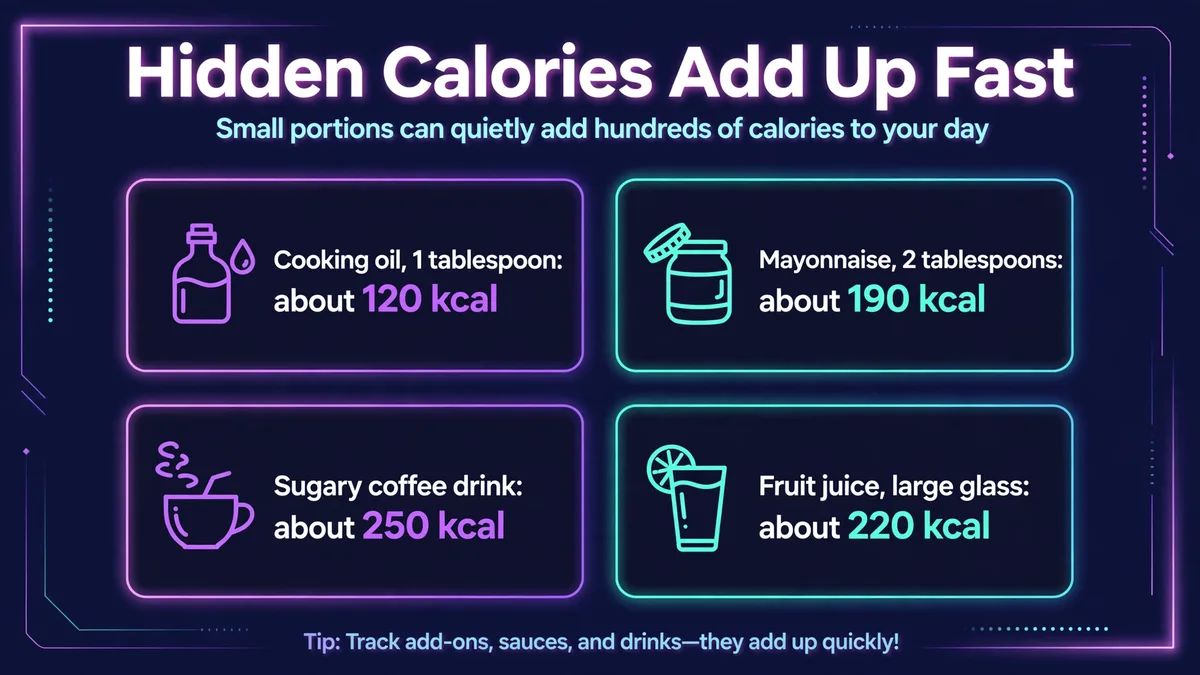
The single most frequent reason why beginners believe “CICO does not work for me” is untracked invisible calories. Consider these common oversights:
- Cooking Oils: Pouring an unmeasured “glug” of olive oil into a skillet adds 15 to 20 grams of lipid, equating to 135 to 180 calories.
- Salad Dressings: Two tablespoons of ranch or vinaigrette dressing add 140 to 200 calories, turning a healthy leafy salad into a calorie-dense meal.
- Liquid Calories: Sweetened coffee creamers, fruit smoothies, soda, and evening glasses of wine contribute hundreds of calories without producing digestive satiety.
- Spoonfuls of Nut Butters: A rounded spoonful of peanut butter often weighs 35 to 40 grams instead of the standard 16-gram serving, adding an unlogged 150 calories.
By using a digital food scale to weigh these items for the first two weeks, you gain complete awareness of your true caloric intake.
Navigating Weekends and Social Dining
A common frustration for beginners is executing a perfect 500-calorie deficit from Monday through Thursday, only to erase the entire weekly deficit with weekend socializing:
- Deficit Monday to Thursday: 500 cal x 4 days = 2,000 calorie deficit.
- Friday Night & Saturday: Two beers, pizza, restaurant appetizers, and dessert = plus 2,200 calories over maintenance.
- Net Result: A zero weekly deficit, causing scale weight to remain stagnant.
To avoid this trap, use the Weekly Calorie Banking Strategy. If you know you have a Saturday dinner planned, you can reduce your intake by an additional 150 calories on Monday through Friday. This creates an extra 750-calorie buffer for your weekend meal while keeping your weekly deficit intact.
The Scale vs Real Fat Loss: Understanding Water Weight
When you begin your calorie deficit, do not let day-to-day scale fluctuations discourage you. Scale weight does not reflect pure body fat:
- Sodium Intake: Consuming a salty restaurant meal causes temporary cellular water retention that can spike morning scale weight by 2 to 4 pounds without adding an ounce of fat.
- Intramuscular Glycogen: Each gram of stored carbohydrate binds approximately 3 to 4 grams of water. Low-carb days flush water, while higher-carb days replenish it.
- Hormones and Stress: Elevated cortisol from hard workouts or poor sleep prompts the kidneys to retain fluid.
Always look at your 7-day rolling average scale weight rather than individual daily numbers. If your weekly average decreases over a 3-week span, you are successfully losing fat.
3 Tools to Pair with a TDEE Calculator for Beginners
You do not need expensive coaching or exotic superfoods. You only need three affordable tools:
- A Digital Food Scale ($12 to $15): Measuring cups and spoons are notoriously inaccurate. Weighing portions in grams removes all guesswork.
- A Free Tracking App (Cronometer, MyFitnessPal, or MacroFactor): Log everything that crosses your lips for the first 30 days. It will open your eyes to portion sizes and nutrient balances.
- A Digital Bathroom Scale: Weigh yourself every morning upon waking, after urination, before breakfast. Track your weekly average to smooth out natural daily fluctuations.
Take Action Today with Our TDEE Calculator for Beginners
Do not wait for Monday. Relying on our TDEE calculator for beginners gives you the science and roadmap. Head over to our Free TDEE Calculator now, find your baseline number, and start your journey with absolute confidence!
This calculator is for informational and educational purposes only and does not constitute medical, nutritional, or health advice. Information presented in this guide is for educational purposes only and should not replace personalized evaluation from a physician or registered dietitian. Always consult your doctor before making substantial changes to your diet or exercise regimen. Read full disclaimer
Calculate Your Accurate Daily Calorie Burn
Stop guessing your metabolic numbers. Use our free, peer-reviewed multi-formula calculator to discover your exact TDEE, BMR, and macronutrient targets in 30 seconds.
🔥 Calculate My TDEE Now →Free Companion Health Calculators
Frequently Asked Questions
How many calories should a beginner cut from their TDEE?
Beginners should start with a modest 300 to 500 calorie daily deficit below their TDEE. This yields approximately 0.5 to 1 pound of sustainable fat loss per week without extreme hunger, mood swings, or energy loss.
Do I have to stop eating carbs or sugar to lose weight with TDEE?
No. The First Law of Thermodynamics dictates that total energy balance (calories in vs. calories out) determines body weight. You can enjoy carbs, bread, and occasional treats as long as you stay within your daily caloric target and hit your minimum protein goals.
How often should a beginner recalculate their TDEE?
Recalculate your TDEE every 10 to 15 pounds of weight loss, or whenever your scale weight plateaus for 3 consecutive weeks despite consistent calorie logging.