⚡ Quick Summary: Understanding Basal Metabolic Rate (BMR)
Basal Metabolic Rate (BMR) is the baseline caloric energy your body burns across 24 hours at complete rest to sustain vital organs (liver, brain, skeletal muscle, heart, and kidneys). It accounts for 60% to 75% of your total daily calorie burn. To determine your total maintenance calories, multiply your BMR by your physical activity multiplier (1.2 to 1.9). You should never diet below your BMR, as doing so triggers rapid muscle proteolysis and metabolic slowdown.
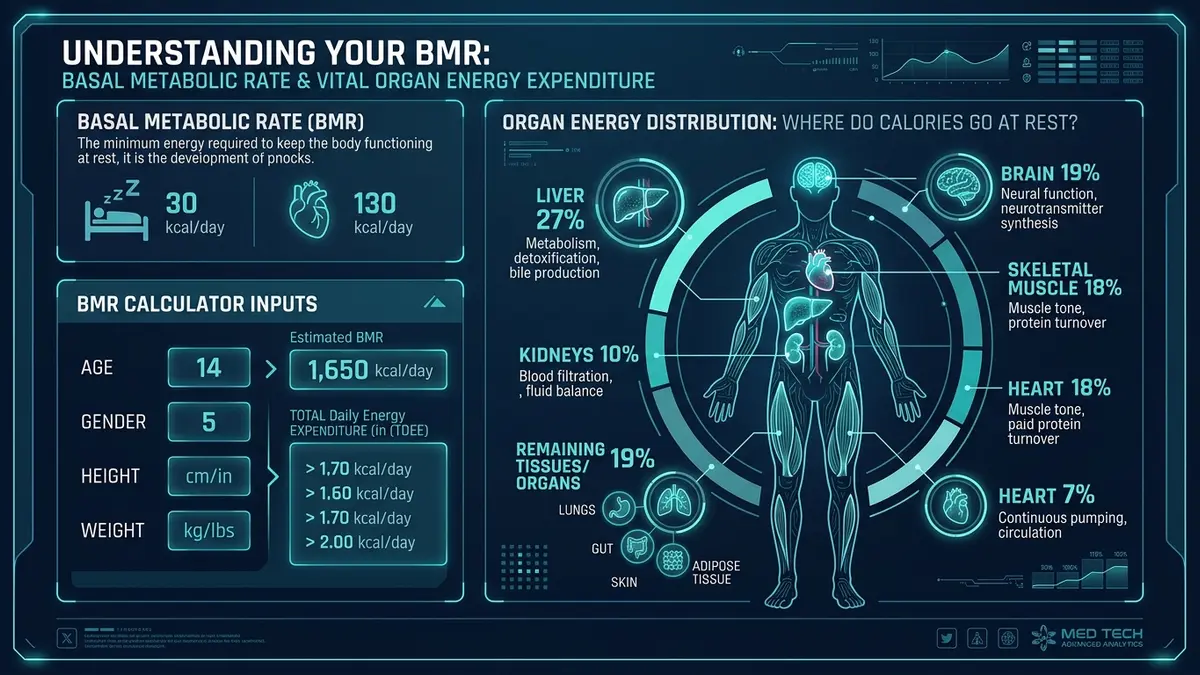
What is BMR and How Does a BMR Calculator Work?
Your Basal Metabolic Rate (BMR) represents the precise quantity of energy, measured in kilocalories, that your body expends every 24 hours solely to sustain vital biological life. If you were to lie motionless in bed in a state of complete physical, mental, and digestive repose in a climate-controlled room, your BMR is the caloric baseline needed to keep your internal organs operating, your cells dividing, and your brain functioning.
For the average sedentary adult, BMR accounts for 60% to 75% of all daily energy expenditure. While popular culture often equates metabolism with the calories burned during intensive gym workouts or cardio sessions, the reality of human biology is that the vast majority of our daily caloric burn is dedicated to invisible, involuntary autonomic physiology.
Calories burned in a vegetative state at absolute rest. Powers cellular transport, cardiovascular pumping, and respiration with zero movement.
BMR multiplied by your physical movement (occupational walking, workouts, digestion). Always calculate deficits from TDEE, never BMR.
The Internal Metabolic Distribution: Where Do Resting Calories Go?
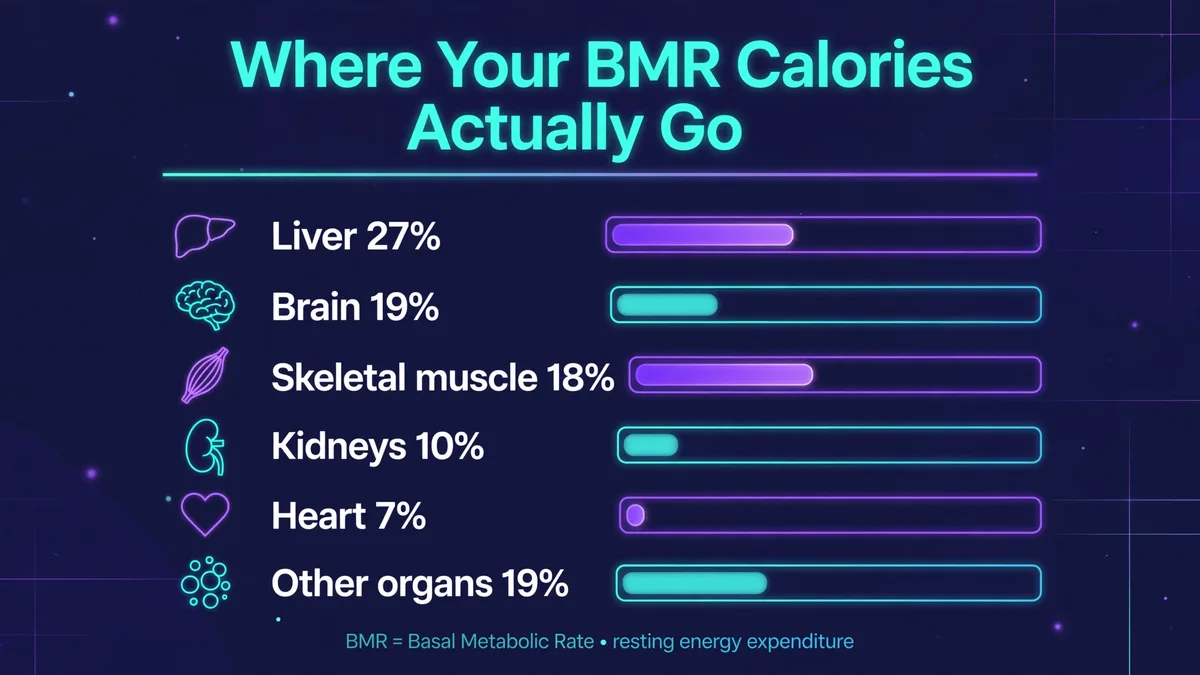
Many fitness enthusiasts using a BMR calculator assume skeletal muscle tissue consumes the overwhelming majority of resting calories. However, clinical organ-level calorimetry reveals a different physiological reality: active visceral organs account for the lion's share of baseline expenditure:
Continuously synthesizes essential plasma proteins, conjugates toxins, manages bile production, and conducts gluconeogenesis around the clock.
Consumes roughly one-fifth of your resting energy, sustaining continuous electrical neuronal membrane active transport and ion gradients.
At complete rest, burns roughly 13 kcal per kg (6 kcal/lb) daily. Its aggregate mass makes it a prime driver of total resting metabolic output.
Filters hundreds of liters of arterial blood daily, reabsorbing electrolytes and regulating extracellular fluid pH balance.
Beating approximately 100,000 times per day without rest, continuous mechanical myocardial contraction demands constant ATP turnover.
Gastrointestinal enterocytes, adipose lipid stores, cutaneous skin cells, and connective tissues comprise the remaining resting baseline.
BMR vs RMR: Understanding the Clinical Distinction
In fitness literature, the terms Basal Metabolic Rate (BMR) and Resting Metabolic Rate (RMR) are frequently used interchangeably, yet they possess distinct clinical definitions:
The strictest clinical measurement. Requires waking overnight in a specialized metabolic laboratory under a ventilated canopy hood in a 12-hour fasted, thermoneutral state with zero prior physical movement.
The practical clinical equivalent. Measured while resting in a reclined posture for 30 minutes after light travel to a clinic. Due to subtle prior movement and thermal signaling, RMR is typically 5% to 10% higher than true BMR.
The Biological Determinants of Your Basal Metabolic Rate
Why do two people of identical weight often exhibit different resting metabolic rates? Several biological variables analyzed by our BMR calculator dictate your resting cellular energy consumption:
1. Body Composition (Fat-Free Mass vs Adipose Mass)
Fat-Free Mass is the primary variable in any advanced BMR calculator, burning between 13 and 30 kcal per kilogram daily, whereas adipose fat tissue burns only about 4.5 kcal per kilogram. Consequently, a lean individual with substantial muscular development possesses a naturally elevated resting metabolic rate.
2. Biological Sex
Sex differences factored into our BMR calculator reflect that males typically possess 5% to 10% higher resting rates, driven by sexual dimorphism in skeletal muscle mass and lower essential body fat percentages.
3. Chronological Age
Age-related metabolic decline is scaled continuously in our BMR calculator to prevent overestimating baseline burn. This decline is largely caused by age-related muscle loss (sarcopenia) and reduced movement, which can be strongly counteracted by lifelong strength training.
4. Endocrine Regulation & Thyroid Function
Thyroid hormones dictate cellular oxygen consumption, which directly affects real-world numbers compared to a BMR calculator. Active thyroid hormones (T3 and T4) directly regulate cellular mitochondrial respiration. In hypothyroidism, BMR can drop by 20% to 40%, whereas hyperthyroidism elevates resting burn.
Mathematical Comparison of Validated BMR Formulas
Our free BMR calculator provides instant access to three of the most validated clinical equations for resting burn:
Mifflin-St Jeor Equation (1990) - Clinical Gold Standard
Recommended by the Academy of Nutrition and Dietetics as the most accurate formula for standard adults. Learn more in our Mifflin-St Jeor Equation Guide.
Men: BMR = (10 x weight in kg) + (6.25 x height in cm) - (5 x age in years) + 5
Women: BMR = (10 x weight in kg) + (6.25 x height in cm) - (5 x age in years) - 161
Revised Harris-Benedict Equation (1984)
Recalibrated by Roza and Shizgal, widely referenced in academic clinical dietetics:
Men: BMR = 88.362 + (13.397 x kg) + (4.799 x cm) - (5.677 x age)
Women: BMR = 447.593 + (9.247 x kg) + (3.098 x cm) - (4.330 x age)
Katch-McArdle Equation (Lean Body Mass Method)
Directly targets Lean Body Mass, delivering exceptional accuracy for muscular athletes and bodybuilders who know their body fat percentage:
BMR = 370 + (21.6 x Lean Body Mass in kg)
Why You Should Never Diet Below Your BMR Baseline
One of the most dangerous misconceptions in weight loss is that cutting calories drastically below your BMR accelerates healthy fat loss. In reality, eating below your BMR triggers acute biological defense mechanisms:
- Severe Adaptive Thermogenesis: The body senses starvation, down-regulating active thyroid hormone T3 and increasing reverse T3 to depress mitochondrial energy output.
- Elevated Skeletal Muscle Proteolysis: Lacking adequate calories to sustain vital organs, your body breaks down its own muscular tissue via gluconeogenesis to fuel the nervous system.
- Reproductive & Endocrine Disruption: Severe energy deprivation suppresses gonadotropin-releasing hormone, causing hormonal imbalances, chronic fatigue, and elevated cortisol.
To lose body fat effectively and sustainably, always set your caloric deficit relative to your Total Daily Energy Expenditure (TDEE), keeping your caloric intake at or above your BMR floor.