⚡ Quick Summary: The Science of Intermittent Fasting
Our intermittent fasting calculator structures your daily feeding and fasting intervals to maximize metabolic flexibility. is an evidence-based meal timing strategy that alternates between designated fasting windows and eating windows (such as 16:8 or 18:6). While fasting does not change your underlying Total Daily Energy Expenditure (TDEE), it significantly boosts insulin sensitivity, enhances lipolysis (fat oxidation), activates cellular autophagy after 16 hours, and facilitates effortless caloric deficit adherence without continuous snacking.
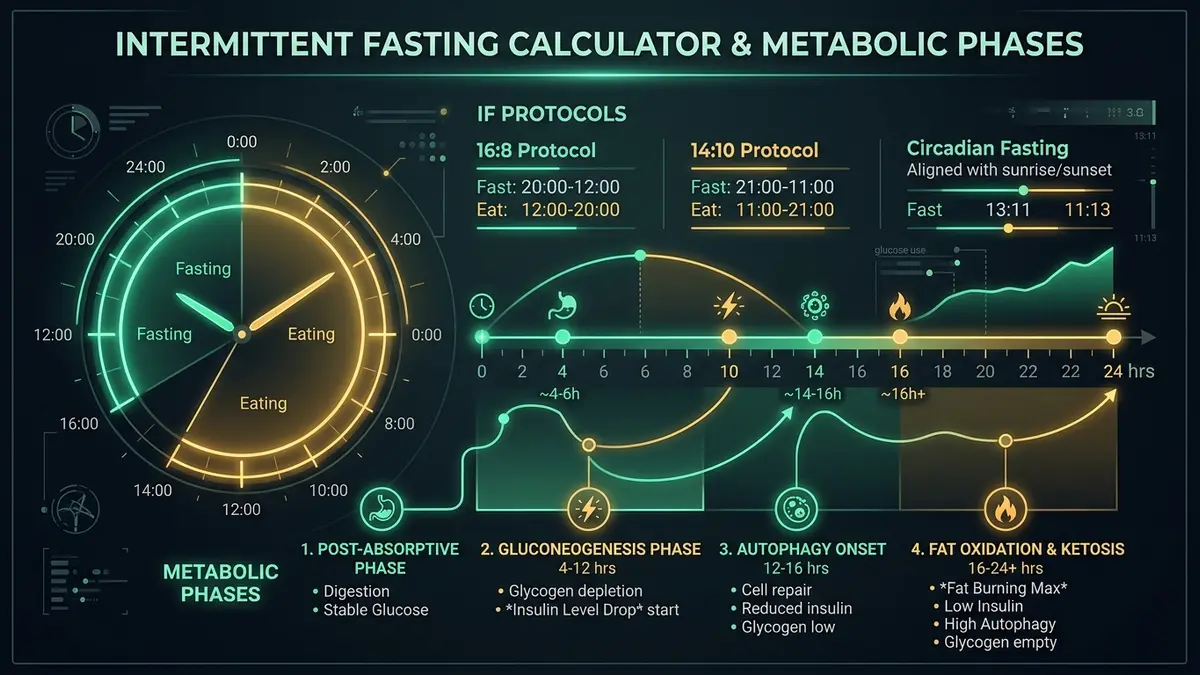
The Physiological Science of Intermittent Fasting
Intermittent fasting (IF) modeled by our intermittent fasting calculator is not a dietary fad or food elimination program. Rather, it is a structured chronobiological framework that cycles between designated periods of voluntary fasting and designated eating windows. While conventional diets dictate what foods you eat, our intermittent fasting calculator governs when nutrients enter your system.
To understand why intermittent fasting exerts profound metabolic effects, one must examine the human body's transition through three distinct physiological and endocrine phases:
Pancreas secretes insulin to transport glucose and amino acids into cells. Intracellular lipolysis is completely inhibited because circulating insulin suppresses hormone-sensitive lipase (HSL).
Nutrient absorption completes and insulin drops to baseline. The pancreas secretes glucagon, and the liver breaks down stored hepatic glycogen to maintain stable central nervous system blood glucose.
Hepatic glycogen diminishes substantially. Adipose tissue accelerates lipolysis, mobilizing free fatty acids. The liver converts these into ketone bodies to fuel brain cognition while sparing glucose.
Autophagy Promoted by an Intermittent Fasting Calculator
One of the most celebrated biological mechanisms associated with intermittent fasting is autophagy (derived from the Greek words meaning "self-eating"). Awarded the Nobel Prize in Physiology or Medicine in 2016 through the groundbreaking work of cell biologist Yoshinori Ohsumi, autophagy is the body's intracellular purification system.
When nutrients are continuously abundant, the intracellular sensor mechanistic target of rapamycin (mTOR) remains active, suppressing autophagy. However, when nutrients are absent for 16 to 24 hours, cellular AMP-activated protein kinase (AMPK) activates. This triggers specialized autophagosomes to engulf damaged mitochondria, misfolded proteins, and intracellular pathogens, delivering them to acidic lysosomes for enzymatic degradation into reusable amino acids.
Intermittent Fasting Calculator and Thermodynamics
A widespread misunderstanding addressed by our intermittent fasting calculator is that time-restricted feeding bypasses the laws of energy balance, enabling unlimited caloric indulgence during the feeding window.
Your Total Daily Energy Expenditure (TDEE) governs whether you lose, maintain, or gain body weight. If your TDEE is 2,200 calories and you consume 2,700 calories during an 8-hour window, you will store the excess 500 calories as body fat. The proven efficacy of intermittent fasting for fat loss stems from behavioral appetite control: by restricting feeding to a compressed window, individuals naturally eliminate late-night mindless snacking and spontaneously create a 300 to 500 calorie deficit without feeling chronically deprived.
Comprehensive Breakdown of Popular Fasting Protocols
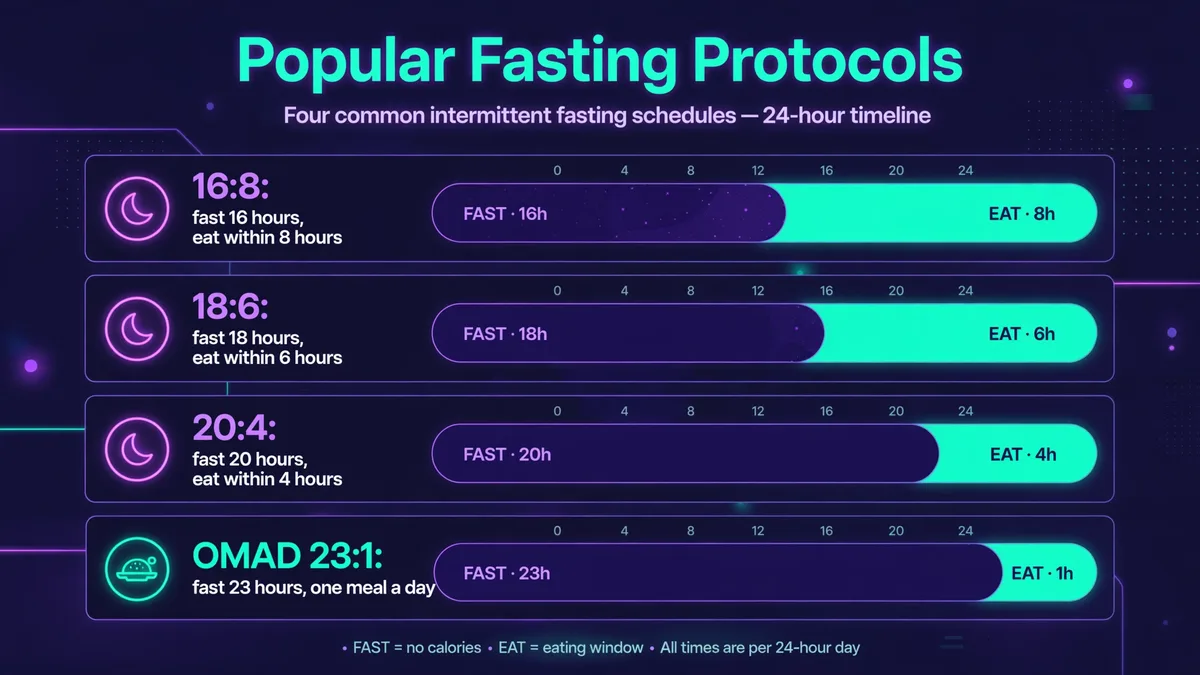
Our intermittent fasting calculator allows you to customize and schedule the five most scientifically validated fasting models:
Popularized in sports nutrition by Martin Berkhan, the 16:8 protocol is the undisputed standard for sustainable lifestyle integration. Dieters fast for 16 hours and consume all daily nutrition across an 8-hour window (for instance, 12:00 PM to 8:00 PM). It allows two to three full meals, supports heavy resistance training, and causes minimal social disruption.
An intermediate approach where the daily fast is extended to 18 hours, leaving a 6-hour eating window (for example, 1:00 PM to 7:00 PM). This model delivers longer periods of suppressed insulin and higher rates of beta-oxidation while still allowing trainees to consume two complete, satisfying meals.
Originally formulated by Ori Hofmekler, the 20:4 protocol involves 20 hours of under-eating followed by a 4-hour evening feast. It requires discipline and is typically structured as one large 1,500 to 2,000 calorie evening meal accompanied by a smaller snack.
Pioneered by Dr. Michael Mosley, this method does not alter your daily hours. Instead, you eat at your normal maintenance TDEE for five days of the week, and on two non-consecutive days, you restrict total daily calories to 500 kcal for women or 600 kcal for men.
What Breaks a Fast on an Intermittent Fasting Calculator?
Knowing what compounds maintain or interrupt your fasted state is crucial for success:
- Pure spring water and sparkling mineral water
- Black coffee (zero milk, zero cream, zero sugar)
- Unsweetened green tea, black tea, and herbal teas
- Calorie-free electrolytes (sodium, potassium, magnesium)
- Milk, half-and-half, and coffee creamers
- Collagen peptides and bone broths
- Branched-chain amino acids (BCAAs) and protein powders
- Fruit juices and sugar-sweetened beverages
Non-nutritive artificial sweeteners like sucralose and aspartame contain zero calories. However, some clinical studies show that sweet tastes on oral lingual receptors can trigger a mild cephalic phase insulin response in certain individuals. For strict cellular autophagy benefits, stick exclusively to black coffee, unsweetened tea, and water.
Fasting and Lean Muscle Preservation: The Science
Can you build or preserve lean skeletal muscle while intermittent fasting? Decades of clinical trials in resistance-trained athletes demonstrate that intermittent fasting preserves 100% of lean muscle mass provided two critical variables are controlled:
Hit your aggregate target of 1.6 to 2.2 grams of protein per kilogram of body weight inside your eating window. Daily aggregate intake remains the primary driver of nitrogen balance.
Rather than grazing constantly, split your daily protein into two or three robust boluses containing at least 30 to 45 grams of protein each. This ensures each meal surpasses the leucine threshold necessary to stimulate muscular protein synthesis via the mTOR pathway.