⚡ Quick Summary: Calculating TDEE with Daily Steps
Calculating your TDEE based on steps replaces vague activity dropdowns with empirical pedometer data. Every 10,000 steps burns approximately 350 to 500 kcal depending on your body weight and stride length. While smartwatch calorie burn estimates exhibit high error rates (27% to 93% according to Stanford Medicine research), their underlying step accelerometers are over 95% accurate, providing the most reliable real-world measure of your Non-Exercise Activity Thermogenesis (NEAT).
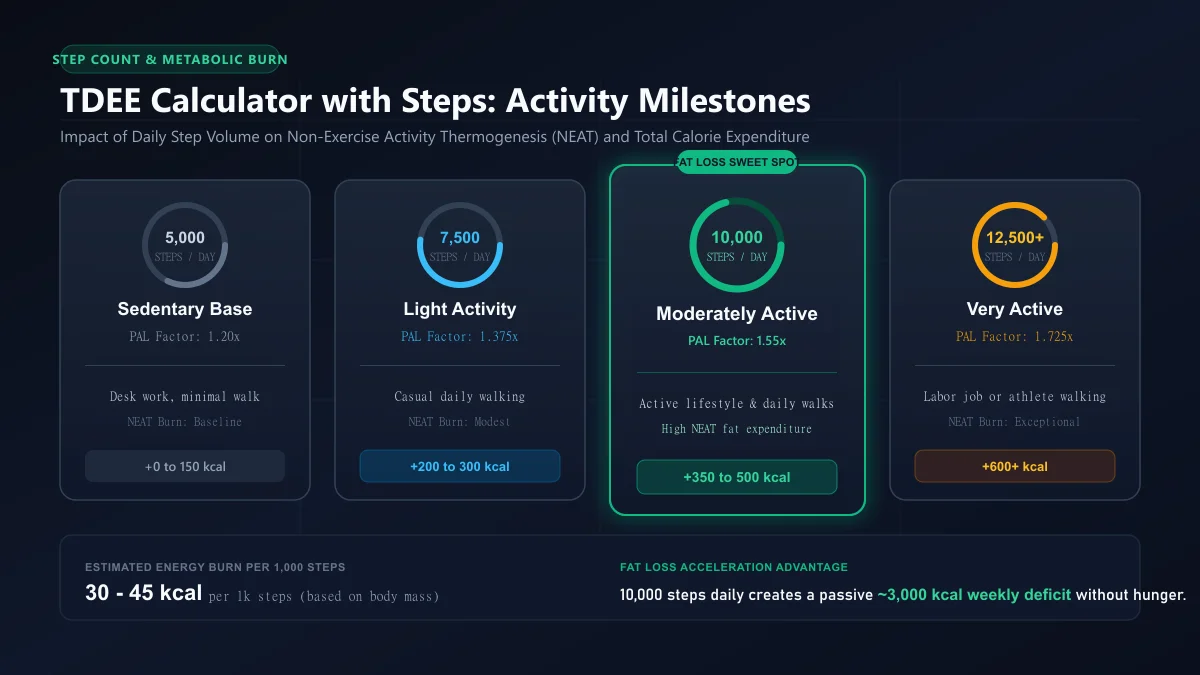
The Biomechanics Behind Our TDEE Calculator with Steps
The most vulnerable point of failure solved by our TDEE calculator with steps is the arbitrary "Physical Activity Level" dropdown. Fitness enthusiasts routinely encounter options such as "Lightly Active" or "Moderately Active" without clear operational criteria. A desk-bound corporate employee who performs 45 minutes of moderate weightlifting four days per week often selects "Moderately Active," unaware that sitting stationary for the remaining 15 waking hours categorizes their total 24-hour physiology as largely sedentary.
By calculating your Total Daily Energy Expenditure (TDEE) based on real-world pedometer steps, you eliminate subjective ambiguity. Daily steps serve as an objective biometric measure of your Non-Exercise Activity Thermogenesis (NEAT), which metabolic researchers recognize as the most dynamic and variable component of human energy expenditure.
Dieters consistently overestimate calorie burn by 300 to 700 kcal per day, selecting high multipliers despite spending 90% of waking hours seated at desks.
Accelerometers measure actual physical displacement. Step volume directly correlates with mechanical work performed and NEAT energy output.
The Biomechanics and Mathematics of Step Caloric Burn
In our TDEE calculator with steps, walking is evaluated as fundamental bipedal locomotion that displaces center of mass forward against gravity. The mechanical work performed is directly proportional to two variables:
- Body Mass (Weight in Kilograms): Moving an 80-kilogram body across a mile requires substantially more kinetic work than moving a 55-kilogram body across the exact same distance.
- Displacement Distance (Step Count and Stride Length): Taller individuals possess longer biomechanical stride lengths, meaning they cover slightly more ground per step than shorter individuals.
Exercise physiology research establishes that the energy cost of horizontal walking averages approximately 0.04 to 0.05 kilocalories per kilogram of body weight per 1,000 steps:
Step Burn (kcal) = Body Weight (kg) × 0.048 kcal × (Daily Steps / 1,000)
- 60 kg (132 lbs): 60 × 0.048 × 10 = ~290 kcal burned per 10,000 steps
- 80 kg (176 lbs): 80 × 0.048 × 10 = ~384 kcal burned per 10,000 steps
- 100 kg (220 lbs): 100 × 0.048 × 10 = ~480 kcal burned per 10,000 steps
Why Wearables Fall Short of Our TDEE Calculator with Steps
Modern consumer smartwatches such as the Apple Watch, Garmin Forerunner, Whoop Band, and Fitbit are exceptional devices for biometric telemetry. However, trusting their active calorie burn readouts to set your dietary intake is a recipe for stalled weight loss.
In a landmark clinical study conducted by researchers at the Stanford University School of Medicine, seven popular consumer wearable devices were evaluated against laboratory indirect calorimetry gold standards. While the devices demonstrated acceptable accuracy in tracking heart rate and step counts, not a single device had an active energy expenditure error rate below 27%, with some devices overestimating calories burned by up to 93%.
Wearables rely on proprietary photoplethysmography algorithms that misinterpret stress-induced heart rate spikes or temperature shifts as intense athletic calorie burn. In contrast, the mechanical accelerometer that records physical footsteps is highly precise. By taking your device's 7-day average step count and plugging it into an evidence-based metabolic formula, you get an accurate TDEE estimate.
Daily Step Activity Tiers and Metabolic Classifications
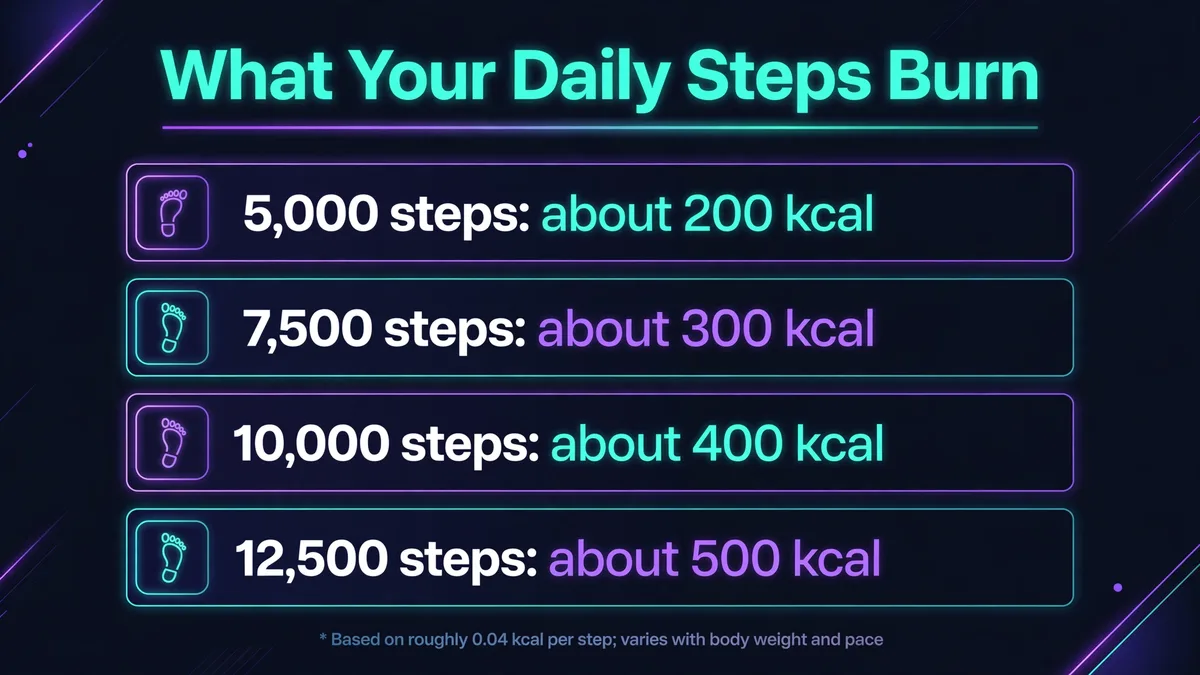
In our TDEE calculator with steps, epidemiological researchers classify lifestyle activity levels based on average daily pedometer volume:
Characterized by prolonged seated desk time and vehicular transit. Decreases systemic insulin sensitivity and suppresses lipoprotein lipase activity.
The benchmark for active fitness enthusiasts. Burning 350 to 500 calories through daily walking in our TDEE calculator with steps makes maintaining a calorie deficit comfortable without excessive dietary cuts.
Why Steps Are Superior to High-Intensity Cardio for Fat Loss
When dieters decide to accelerate fat loss, our TDEE calculator with steps highlights why low-impact walking offers distinct physiological advantages over exhaustive spin classes:
Low-intensity walking does not accumulate systemic muscular or neural fatigue, allowing you to train with maximum intensity in your resistance workouts without compromising recovery.
Intense anaerobic cardio frequently stimulates surges in circulating ghrelin, triggering post-workout hunger and binge eating. Low-intensity walking suppresses stress hormones without rebound hunger.
At low intensities (under 50% VO2 max), skeletal muscle fibers rely almost exclusively on free fatty acid beta-oxidation rather than stored intramuscular glycogen.
Practical Strategies to Hit 10,000 Steps with a Sedentary Job
If you work a desk-bound job, reaching the active tier in our TDEE calculator with steps requires deliberate daily habits:
Taking a 10-minute walk immediately following breakfast, lunch, and dinner accumulates roughly 3,500 steps and activates GLUT4 glucose transporters, blunting blood sugar spikes.
Compact flat treadmills placed beneath a standing desk allow walking at 1.5 to 2.0 mph while answering emails, adding 3,000 to 4,000 steps per hour without disrupting productivity.
Transform telephone conversations and remote meetings into active movement sessions. A single 30-minute conference call easily yields 2,500 additional steps.
Step Periodization and NEAT Preservation During Weight Loss
During extended weight loss phases, our TDEE calculator with steps prevents stalled progress caused by subconscious NEAT reduction. As dietary calories drop, your brain attempts to conserve energy by making you sit more, lean against walls, and move less throughout the day. By tracking your daily steps, you turn an involuntary biological process into an intentional, measurable metric.
Instead of continuously slashing food intake when fat loss slows, use Step Periodization:
- Weeks 1 to 4: Maintain a baseline of 8,000 steps per day alongside your moderate calorie deficit.
- Weeks 5 to 8: Increase your daily target to 10,000 steps per day. This adds roughly 100 to 150 calories of daily energy burn without reducing food portions or elevating cortisol.
- Weeks 9 to 12: Progress to 12,000 steps per day if necessary to maintain consistent weekly fat loss while keeping your dietary calories high enough to support muscle preservation and micronutrient sufficiency.