TDEE vs BMR: Which Metric Should You Use for Fat Loss?
Compare the differences in TDEE vs BMR to optimize your diet. Learn why basal metabolism is your safety floor while total expenditure guides calories.
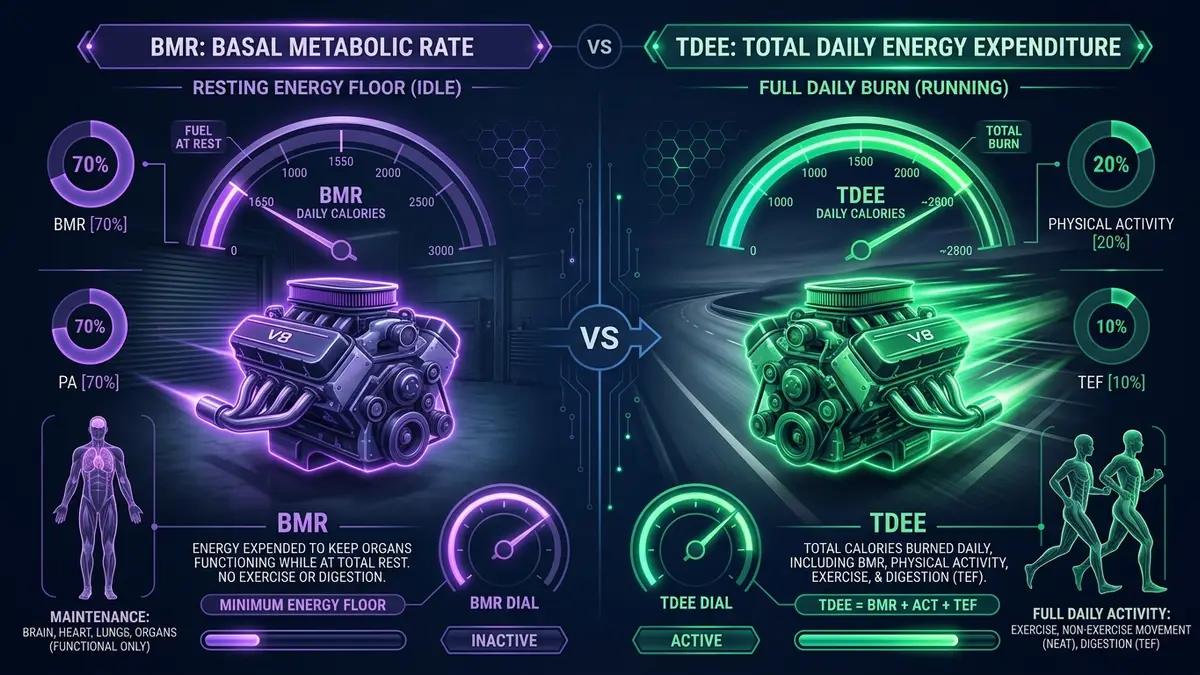
⚡ Quick Summary and Key Takeaways
Compare the differences in TDEE vs BMR to optimize your diet. Learn why basal metabolism is your safety floor while total expenditure guides calories.
One of the most widespread points of confusion in health, fitness, and nutrition is the difference between BMR (Basal Metabolic Rate) and TDEE (Total Daily Energy Expenditure).
When comparing TDEE vs BMR on fitness forums, thousands of beginners ask which number they should actually follow:
“My calculator says my BMR is 1,450 and my TDEE is 2,050. Which number am I supposed to eat to lose weight?”
Confusing these two metrics can lead to either severe chronic under-eating (which triggers metabolic slowdown, hormone disruption, and intense rebound bingeing) or under-estimating your required deficit (leading to frustrating weight loss plateaus).
In this definitive guide, we break down the physiological distinctions, explain the mathematics connecting them, and give you an actionable roadmap for using both figures correctly.
At a Glance: TDEE vs BMR Comparison
| Metric | Full Name | Definition | Includes Exercise & Movement? | Role in Diet Planning |
|---|---|---|---|---|
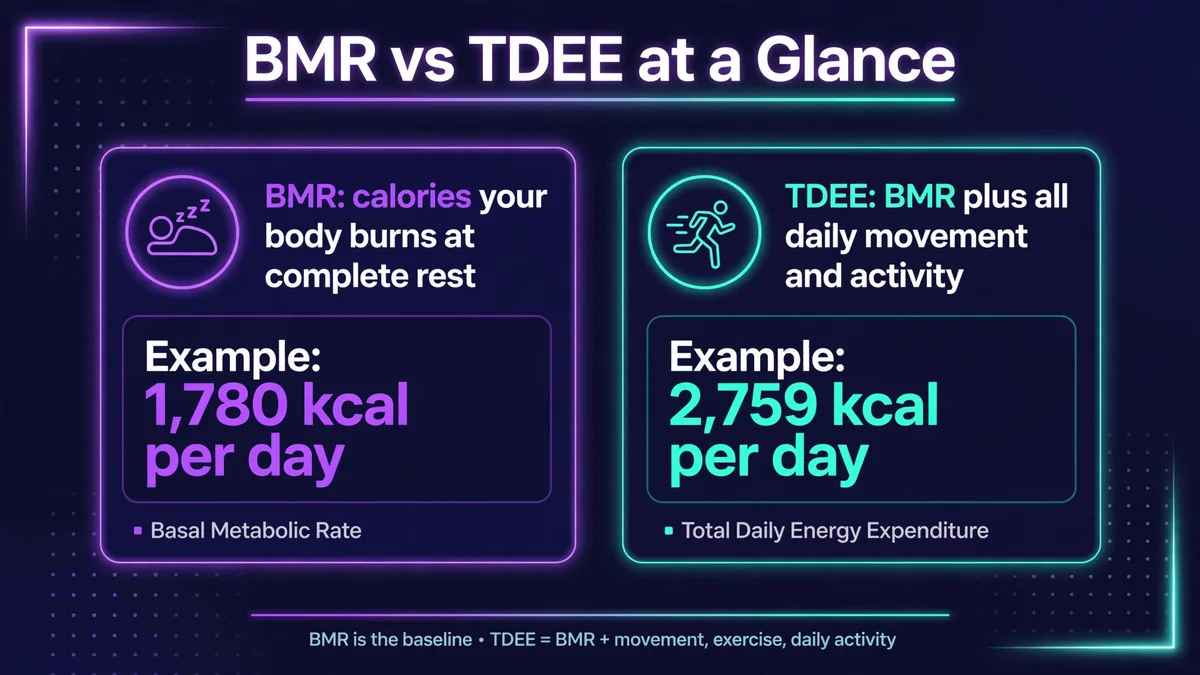
| BMR | Basal Metabolic Rate | Calories burned to sustain basic biological life at complete rest | No (Zero activity) | Your absolute physiological floor; do not chronically eat below this |
| TDEE | Total Daily Energy Expenditure | Total calories burned across 24 hours including all movement & digestion | Yes (Full 24-hour day) | Your maintenance line; subtract 300 to 500 cal for fat loss, add 200 to 400 cal for muscle |
What is BMR (Basal Metabolic Rate) in TDEE vs BMR?
Your BMR is the foundational energy currency required by your vital internal organs:
- Your heart pumping approximately 100,000 times per day
- Your lungs expanding and contracting to oxygenate tissues
- Your brain transmitting billions of neuro-electrical signals
- Your kidneys filtering blood and removing metabolic waste
- Your liver executing hundreds of critical enzymatic functions
- Cellular mitosis, ion exchange, and continuous protein synthesis
Think of BMR as the idle fuel consumption of a parked car with the engine running. Even if you do not drive an inch, fuel is being consumed every second to keep the electrical systems alive.
You can calculate your exact baseline using our dedicated BMR Calculator or explore how the formula works in our Mifflin-St Jeor Equation Guide.
What is TDEE in the Context of TDEE vs BMR?
If BMR is your car idling in neutral, TDEE is the total fuel consumed driving throughout the entire day.
TDEE includes your idle engine (BMR) plus every single tap on the gas pedal:
- Getting out of bed and walking around your home
- Showering, brushing your teeth, and getting dressed
- Commuting to work, walking up stairs, fidgeting at your desk (NEAT)
- Digesting your breakfast, lunch, and dinner (TEF)
- Running 3 miles or lifting weights at the gym (EAT)

Mathematically, your TDEE is derived directly from your BMR by multiplying it by your Physical Activity Level (PAL):
TDEE = BMR x Activity Multiplier
Because human beings must move, breathe, and digest food to exist, your TDEE is always higher than your BMR. Typically, TDEE is anywhere from 20% to 90% higher than BMR, depending on how active you are.
The Common Trap: Avoiding BMR Deficits in TDEE vs BMR
A dangerous mistake made by enthusiastic dieters is assuming that to lose weight quickly, they should eat below their BMR.
For example, a woman with a BMR of 1,450 kcal and a TDEE of 2,000 kcal might adopt an extreme 1,100-calorie crash diet. While she will lose weight rapidly for the first 10 days (mostly water glycogen and lean muscle), her body will rapidly initiate aggressive defensive mechanisms:
- Downregulation of Thyroid Hormones: Active triiodothyronine (T3) drops, reducing baseline mitochondrial energy output.
- Reproductive & Endocrine Disruption: In women, prolonged energy availability below BMR causes hypothalamic amenorrhea (cessation of menstrual cycles) and bone density reduction. In men, circulating testosterone plunges.
- Severe NEAT Suppression: Without conscious awareness, you stop fidgeting, sit down more often, move more sluggishly, and skip spontaneous daily movements, cutting your daily burn by hundreds of calories.
- Elevated Ghrelin & Cortisol: Hunger hormones spike uncontrollably, making severe bingeing almost psychologically inevitable.
Golden Rule of Sustainable Fat Loss:
Always set your daily calorie target relative to your TDEE, not your BMR. Your target should sit in the healthy bracket between your BMR (the physiological floor) and your TDEE (the maintenance ceiling).
Real-World Example: Setting Up a Safe Deficit Using TDEE vs BMR
Let us illustrate how to apply both metrics with a real-world subject:
- Name: Marcus, 32 years old
- Height: 5’10” (178 cm)
- Weight: 190 lbs (86.2 kg)
- Occupation: Office accountant (sedentary work)
- Exercise: 3 lifting sessions/week (Lightly Active)
Step 1: Calculate BMR (Mifflin-St Jeor)
BMR = (10 x 86.2) + (6.25 x 178) - (5 x 32) + 5
BMR = 862 + 1,112.5 - 160 + 5
BMR = 1,819.5 kcal ≈ 1,820 kcal
Marcus requires 1,820 calories per day simply to sustain life while lying completely still in bed.
Step 2: Calculate TDEE (Activity Multiplier)
Since Marcus works a desk job but lifts weights 3 times per week, his activity level is Lightly Active (multiplier 1.375):
TDEE = 1,820 x 1.375 = 2,502 kcal ≈ 2,500 kcal
Marcus burns 2,500 calories per day on average.
Step 3: Determine His Weight Loss Target
Marcus wants to lose 1 lb of fat per week (which requires approximately a 500-calorie daily deficit):
- Maintenance (TDEE): 2,500 calories
- Fat Loss Target:
2,500 - 500 = 2,000 calories/day
Notice how his target (2,000 kcal) is comfortably above his BMR (1,820 kcal)! Marcus will lose fat steadily while providing his vital organs with adequate energy, preserving muscle mass, and preventing metabolic crashes.
How Metabolic Adaptation Impacts Both BMR and TDEE Over Time
As you progress through a fat loss journey, neither your BMR nor your TDEE remains fixed in stone. When Marcus drops from 190 pounds down to 170 pounds, two biological shifts occur:
- His BMR Decreases Proportionately: A 170-pound body possesses less tissue mass to oxygenate and maintain than a 190-pound body. His baseline BMR will naturally drop by approximately 100 to 140 calories per day.
- His Energy Cost of Movement Declines: Carrying a 20-pound lighter frame means every step Marcus takes expends fewer calories. Moving 170 pounds across 8,000 daily steps requires less kinetic work than moving 190 pounds.
As a result, his maintenance TDEE will decline from 2,500 calories to approximately 2,250 calories. If Marcus continues eating his initial 2,000-calorie target, his daily deficit shrinks from 500 calories down to just 250 calories, slowing his rate of fat loss. This is not a “damaged metabolism” but normal physiological adaptation. Recalculating your TDEE after every 5 to 10 pounds of sustained weight loss ensures your deficit remains accurate and productive.
Body Composition Differences: Lean Muscle vs Adipose Tissue
Why do two individuals of identical weight and height often experience different metabolic realities? The answer lies in their underlying body composition.
Skeletal muscle tissue burns approximately 13 calories per kilogram per day at rest, whereas adipose tissue burns only about 4.5 calories per kilogram. While internal organs (liver, brain, heart, kidneys) account for the majority of BMR, an athlete carrying 10 kilograms more lean muscle mass than a sedentary counterpart of the same total scale weight will enjoy an elevated BMR of 100 to 150 additional calories per day. Over a full year, this metabolic divergence equates to thousands of additional calories burned.
Summary: TDEE vs BMR: Which Metric Should You Track?
- Use BMR as a safety benchmark: Ensure your calculated calorie intake does not chronically plunge below this value.
- Use TDEE vs BMR principles to manage your body weight: Everything regarding weight gain, weight loss, or weight maintenance is governed by your caloric intake relative to your TDEE.
Mastering TDEE vs BMR gives you total nutritional clarity. To find your exact numbers today, use our Free TDEE Calculator or fine-tune your specific fat loss timeline using the Calorie Deficit Calculator.
This calculator is for informational and educational purposes only and does not constitute medical, nutritional, or health advice. Information presented in this guide is for educational purposes only and should not replace personalized evaluation from a physician or registered dietitian. Always consult your doctor before making substantial changes to your diet or exercise regimen. Read full disclaimer
Calculate Your Accurate Daily Calorie Burn
Stop guessing your metabolic numbers. Use our free, peer-reviewed multi-formula calculator to discover your exact TDEE, BMR, and macronutrient targets in 30 seconds.
🔥 Calculate My TDEE Now →Free Companion Health Calculators
Frequently Asked Questions
What is the primary difference between BMR and TDEE?
BMR (Basal Metabolic Rate) is the calories your body burns at total rest just staying alive. TDEE (Total Daily Energy Expenditure) is your BMR plus all physical movement, daily walking, workouts, and digestion. TDEE is always higher than BMR.
Should I eat my BMR or my TDEE to lose weight?
You should eat BELOW your TDEE, but generally AT OR ABOVE your BMR. For example, if your BMR is 1,500 kcal and your TDEE is 2,100 kcal, eating 1,600 kcal creates a healthy 500-calorie deficit without depriving your vital organs of baseline energy.
Is it dangerous to eat fewer calories than your BMR?
Yes, chronic calorie consumption below your BMR forces your body into severe metabolic adaptation, downregulating thyroid production (T3), disrupting reproductive hormones, elevating cortisol, and triggering muscle loss and fatigue.