TDEE Activity Level Guide: Pick Your Accurate Multiplier
Choose your correct physical activity factor with our TDEE activity level guide. Step count benchmarks help prevent overestimating daily burn rates.

⚡ Quick Summary and Key Takeaways
Choose your correct physical activity factor with our TDEE activity level guide. Step count benchmarks help prevent overestimating daily burn rates.
If you have ever stared at a TDEE calculator wondering whether you qualify as “Sedentary”, “Lightly Active”, or “Moderately Active”, you are in good company.
In our comprehensive TDEE activity level guide, we answer the single most frequently asked question on health forums: which activity level do I choose?
Choosing the wrong activity multiplier is the primary reason people fail to lose weight despite eating in what they believe is a 500-calorie deficit. Selecting “Moderately Active” instead of “Sedentary” can inflate your calculated daily burn by 400 to 600 calories, instantly erasing your deficit and stalling your progress indefinitely. If your maintenance estimate already looks suspiciously high, read our diagnostic breakdown on why is my TDEE so high to troubleshoot your baseline.
This comprehensive guide removes all ambiguity. Below is the exact decision matrix, step count benchmarks, and real-world profiles you need to make the right choice.
Standard Multipliers in Our TDEE Activity Level Guide
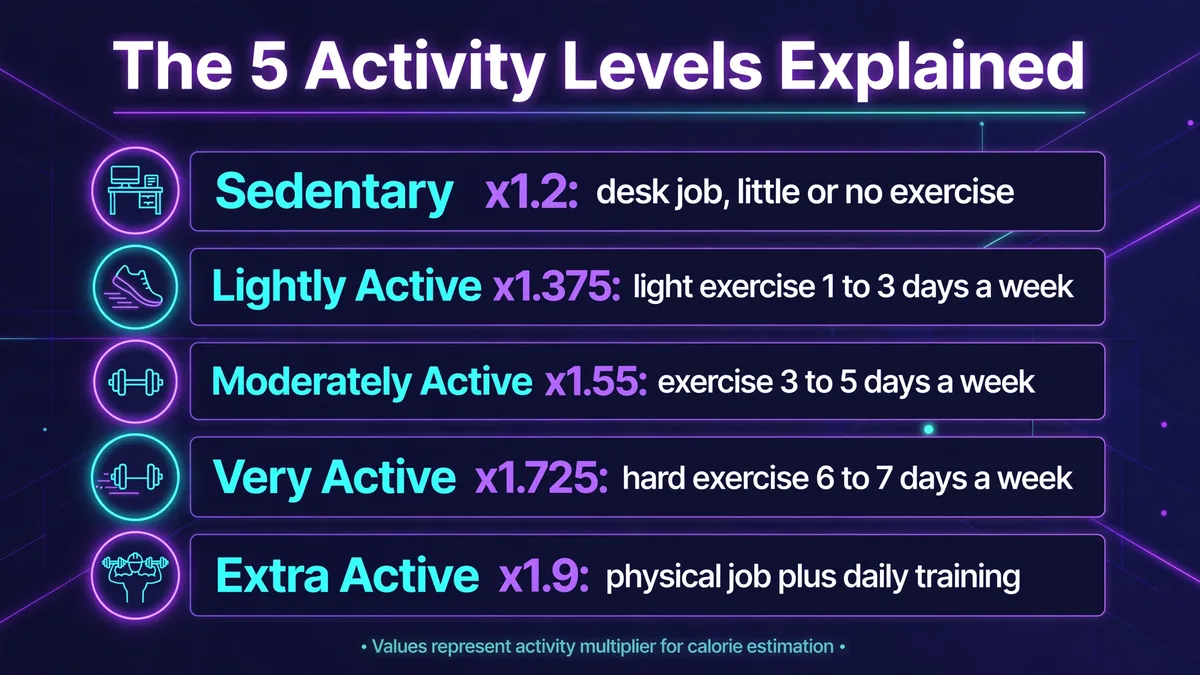
In our TDEE activity level guide, Physical Activity Level (PAL) coefficients reflect standardized metrics originally established by the WHO and the Food and Agriculture Organization (FAO):
| Activity Setting | Multiplier | Daily Steps Benchmark | Weekly Structured Exercise |
|---|---|---|---|
| Sedentary | BMR x 1.2 | Under 5,000 steps | 0 to 1 hours/week (office job, mostly sitting) |
| Lightly Active | BMR x 1.375 | 5,000 to 7,999 steps | 1 to 3 hours/week OR desk job plus 3 gym workouts |
| Moderately Active | BMR x 1.55 | 8,000 to 11,999 steps | 3 to 5 hours/week plus moving on feet throughout the day |
| Very Active | BMR x 1.725 | 12,000 to 15,000 steps | 6 to 7 hours/week strenuous sports or physical trade job |
| Extremely Active | BMR x 1.9 | 15,000+ steps | Competitive athlete, 2-a-day training, heavy labor |
The Core Mistake: The “Desk Job Plus Gym” Paradox
As emphasized in our TDEE activity level guide, the most common trap is assuming that because you lift weights 4 days a week, you must be “Moderately Active”.
Let us examine the arithmetic of your weekly hours:
- Total hours in a week: 168 hours
- Sleeping: 56 hours (8 hours per night)
- Sitting at a desk working: 40 to 50 hours
- Commuting, relaxing on the sofa, eating: 30 to 40 hours
- Working out in the gym: 3 to 4 hours (less than 2.5% of your total week!)
A 45-minute weightlifting session where you rest 2 minutes between sets actually involves only 15 to 20 minutes of active muscular work, burning roughly 150 to 250 calories.
If you spend the remaining 14 hours of your waking day sitting in a chair, your Non-Exercise Activity Thermogenesis (NEAT) is virtually non-existent. In scientific terms, you are sedentary for 97% of your week with brief spikes of exercise.
Key Rule: If you work an office or remote desk job and do not deliberately walk 8,000+ steps every day, you are Lightly Active at most, regardless of whether you hit the gym 3 to 4 times a week.
The Definitive Activity Level Decision Matrix
To eliminate guesswork, our TDEE activity level guide matches your lifestyle across both your day job and exercise habits:
                              EXERCISE FREQUENCY
                    ┌─────────────┬─────────────┬─────────────┐
                    │ 0-1 days/wk │ 2-4 days/wk │ 5-7 days/wk │
┌───────────────────┼─────────────┼─────────────┼─────────────┤
│ Desk / Sedentary  │  Sedentary  │   Lightly   │ Moderately  │
│ (< 5,000 steps)   │ (1.200)     │  (1.375)    │  (1.550)    │
├───────────────────┼─────────────┼─────────────┼─────────────┤
│ On Feet / Active  │   Lightly   │ Moderately  │ Very Active │
│ (7,000-11,000 st) │  (1.375)    │  (1.550)    │  (1.725)    │
├───────────────────┼─────────────┼─────────────┼─────────────┤
│ Heavy Physical Job│ Moderately  │ Very Active │  Extremely  │
│ (12,000+ steps)   │  (1.550)    │  (1.725)    │  (1.900)    │
└───────────────────┴─────────────┴─────────────┴─────────────┘
Real-Life Personas: Which One Matches You?
Profile 1: “The Tech Worker / Accountant”
- Daily Routine: Works from home or in an office 8 hours a day. Drives to work or sits at home desk. Walks 3,200 steps per day.
- Workouts: Lifts weights at the gym on Tuesday, Thursday, and Saturday for 50 minutes.
- Correct Setting: Lightly Active (1.375)
(If they skipped the gym, they would be Sedentary).
Profile 2: “The Registered Nurse / Retail Associate”
- Daily Routine: On feet for 8 to 12 hour shifts, walking corridors, stocking shelves, moving equipment. Averages 10,500 steps per day on workdays.
- Workouts: Attends a 45-minute spin class twice a week and does light yoga on Sundays.
- Correct Setting: Moderately Active (1.55)
(High NEAT from occupational walking elevates their baseline burn significantly).
Profile 3: “The Roofer / Construction Laborer”
- Daily Routine: Hauling lumber, climbing ladders, digging, and manual labor in heat or cold 8 hours a day. Averages 14,000+ steps.
- Workouts: Crossfit 3 days a week.
- Correct Setting: Very Active (1.725)
Profile 4: “The Student / Remote Freelancer”
- Daily Routine: Studies on a laptop, takes classes online, orders food delivery. Daily steps average 2,800.
- Workouts: No structured exercise routine.
- Correct Setting: Sedentary (1.20)
How Daily Step Counts Clarify Everything
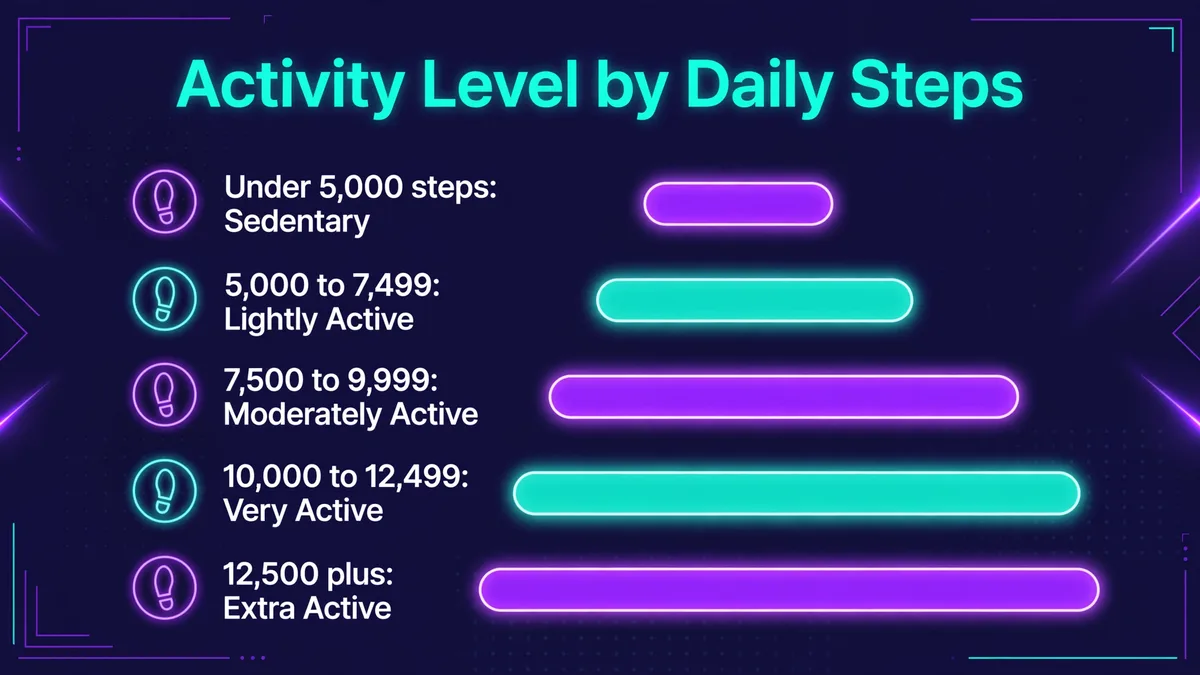
Because step counts directly reflect your non-exercise movement, our TDEE activity level guide considers daily steps the most objective metric for activity level classification:
- Under 5,000 steps per day: Basal sedentary lifestyle. Choose Sedentary.
- 5,000 to 7,499 steps per day: Low active. If you exercise 2 to 3 times per week, choose Lightly Active.
- 7,500 to 11,999 steps per day: Somewhat active to active. If you exercise 3 to 5 times per week, choose Moderately Active.
- 12,000+ steps per day: Highly active lifestyle. Choose Very Active.
To get a customized calculation that factors in your exact wearable step count, check out our Steps-Based TDEE Calculator.
Seasonality, Weather, and Lifestyle Transitions
One often-overlooked factor in activity level selection is seasonality. Clinical accelerometer studies show that urban dwellers average 2,000 to 4,000 fewer daily steps during freezing winter months compared to pleasant spring and summer conditions.
If your daily routine shifts dramatically between summer (hiking, gardening, walking outdoors) and winter (indoor remote desk work), your activity multiplier must shift as well. Remaining on “Moderately Active” during months when your step count drops to sedentary levels is a frequent cause of unexplained winter weight gain.
Similarly, if you transition jobs (for example, moving from a retail floor position to an office desk role), do not assume your previous caloric intake remains appropriate. Recalculate your TDEE with your updated occupational baseline.
Shift Workers and Irregular Schedules: How to Choose Your Activity Level
Managing physical activity multipliers becomes complicated when your working hours rotate, but the biological fundamentals of energy expenditure remain unchanged.
Working night shifts does not automatically increase your metabolic rate or elevate your physical activity factor. Human metabolism responds strictly to mechanical muscular movement and cardiovascular output, regardless of whether your shift occurs at noon or midnight. A security guard observing monitors overnight or a remote customer specialist working graveyard hours remains Sedentary (1.20) or Lightly Active (1.375 at most), even if fatigue makes the shift feel exhausting. Because erratic sleep disruptions frequently disrupt hunger cues, many overnight professionals use an intermittent fasting calculator to structure consistent eating windows around inverted circadian cycles.
For workers with rotating schedules, swing shifts, or variable on-call duties, the primary danger is selecting an activity level based solely on your peak physical week. If you log twelve-hour hospital shifts three days a week but spend four recovery days resting on the couch, your true weekly burn is an average, not a reflection of your hardest workday. Track your ambulatory motion across two to four consecutive weeks, tallying total steps on both intense shifts and quiet off-days. Inputting your empirical daily average into a dedicated TDEE calculator with steps removes subjective guesswork by anchoring your baseline to physical locomotion.
When choosing between two adjacent activity tiers, always implement the tie-break rule: select the lower multiplier first. If your rotating pattern oscillates between Lightly Active and Moderately Active, begin with the lower baseline to avoid accidentally erasing your calorie deficit. Once you establish your initial target, observe your actual body weight response and adjust upward using our 2-week calibration method.
The 2-Week Calibration Rule: How to Verify Your Choice
As emphasized throughout our TDEE activity level guide, any calculator is an educated mathematical estimate (plus or minus 10%). The ultimate ground truth is your actual body weight response over 14 to 21 days:
- Calculate your TDEE and subtract 500 calories for fat loss.
- Track every meal honestly with a food scale for 14 consecutive days.
- Weigh yourself every morning after using the restroom, before eating or drinking. Compute your weekly average weight.
- Evaluate the 2-week trend:
- Losing 0.75 to 1.5 lbs per week: Your activity level choice was accurate. Continue as planned.
- Weight did not change over 2 weeks: Your real TDEE is lower than estimated. Either downgrade your activity level by one step (such as from Moderately to Lightly Active) or reduce intake by 250 calories.
- Losing more than 2.5 lbs per week (after week 1): Your TDEE is higher than estimated. Increase intake by 200 to 300 calories to preserve lean muscle tissue.
By applying the principles in this TDEE activity level guide, you replace subjective confusion with objective nutritional clarity, setting up sustainable long-term success.
This calculator is for informational and educational purposes only and does not constitute medical, nutritional, or health advice. Information presented in this guide is for educational purposes only and should not replace personalized evaluation from a physician or registered dietitian. Always consult your doctor before making substantial changes to your diet or exercise regimen. Read full disclaimer
Calculate Your Accurate Daily Calorie Burn
Stop guessing your metabolic numbers. Use our free, peer-reviewed multi-formula calculator to discover your exact TDEE, BMR, and macronutrient targets in 30 seconds.
🔥 Calculate My TDEE Now →Free Companion Health Calculators
Frequently Asked Questions
If I work a desk job but work out 4 days a week, am I Moderately Active?
Almost certainly no. You are most likely Lightly Active (multiplier 1.375). 4 hours of exercise across a 168-hour week does not offset 50+ hours of sitting. Most desk workers who select Moderately Active overestimate their burn by 300 to 500 calories per day.
What is the best way to choose my activity level without guessing?
Track your average daily step count over 7 to 14 days using your smartphone or fitness tracker. Under 5,000 steps is Sedentary, 5,000 to 7,500 is Lightly Active, 7,500 to 11,000 is Moderately Active, and 12,000+ with intense training is Very Active.
What should I choose if I am unsure between two levels?
If your goal is fat loss, always default to the lower activity level. It is safer to underestimate your daily burn slightly than to overestimate it and inadvertently eliminate your calorie deficit.
I work night shifts. Which activity level should I choose?
Base your activity level selection strictly on physical locomotion rather than your shift label or working hours. Night-shift emergency room nurses, stocking personnel, and warehouse staff frequently qualify as Moderately Active (1.55) due to continuous occupational walking, whereas overnight dispatchers, data analysts, and desk security workers remain Lightly Active (1.375) or Sedentary (1.20). Do not confuse circadian fatigue with caloric expenditure. Track your total daily steps across seven consecutive days, including off-days, to determine your true baseline movement before choosing a multiplier.
My schedule changes every week. How do I pick one activity level?
Calculate your activity level using a two-to-four-week rolling average instead of selecting a multiplier based on your most exhausting shift. Identify your most typical schedule pattern rather than an outlier peak week. If your duties fluctuate between heavy floor labor and stationary administrative weeks, set your baseline to match your average movement and recheck your real-world progress with the 2-week calibration rule. When torn between two activity ratings, always start with the lower tier to prevent overestimating your expenditure.