TDEE vs BMR for Weight Loss: Which Number Do You Eat?
Discover whether to eat at TDEE vs BMR for weight loss. Calculate your ideal calorie target to drop fat safely without metabolic slowdown or weakness.
⚡ Quick Summary and Key Takeaways
Discover whether to eat at TDEE vs BMR for weight loss. Calculate your ideal calorie target to drop fat safely without metabolic slowdown or weakness.
If you have used an online metabolic tool, you likely received two numbers: When evaluating TDEE vs BMR for weight loss, you encounter two numbers:
- Your BMR: for example, 1,520 calories
- Your TDEE (Total Daily Energy Expenditure): for example, 2,150 calories
And you immediately wondered: “Which one do I eat to lose weight? If I eat my BMR, do I starve? If I eat my TDEE, do I stay the same?”
Getting this wrong is the difference between effortless, sustainable fat loss and miserable, sluggish diet failure. Here is the straightforward answer and the exact mathematical rule to follow.
The Core Rule: TDEE vs BMR for Weight Loss
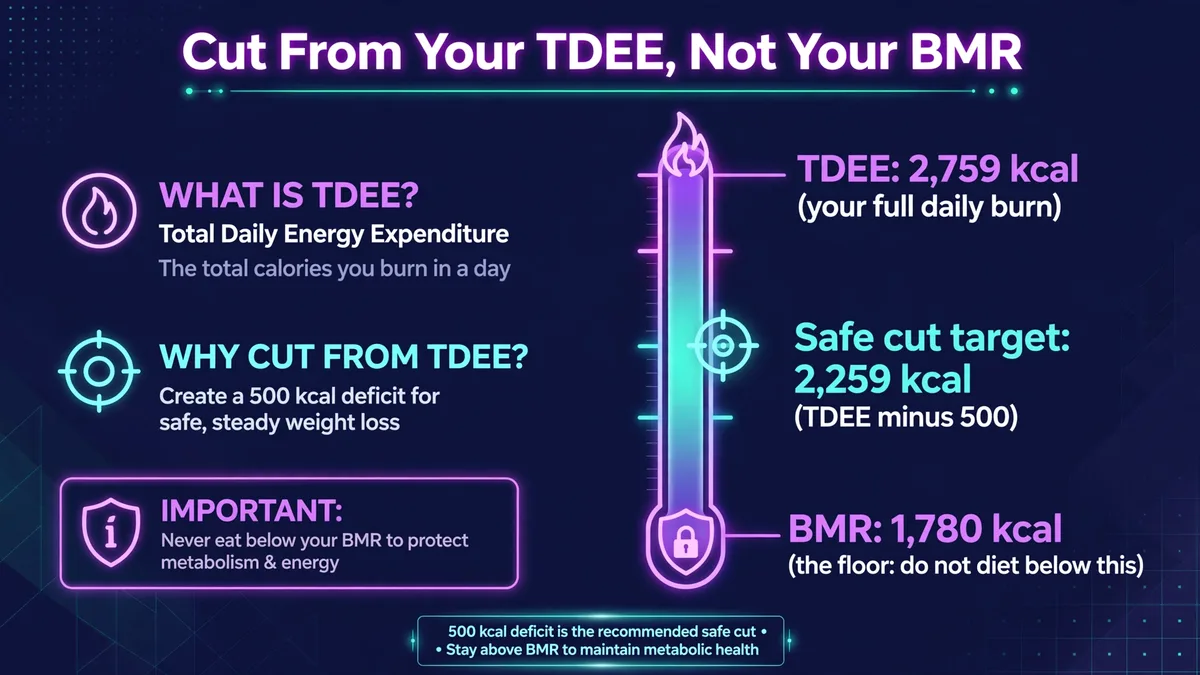
To lose fat without crashing your metabolism, keep this simple visual rule in mind:
┌───────────────────────────────────────────────┐
│  TDEE (e.g. 2,150 kcal)  ---> The CEILING    │
│                                              │
│  ⭐ YOUR FAT LOSS TARGET (e.g. 1,650 kcal)    │
│     (Safe, sustainable 500-calorie deficit)  │
│                                              │
│  BMR (e.g. 1,520 kcal)   ---> The FLOOR      │
└───────────────────────────────────────────────┘
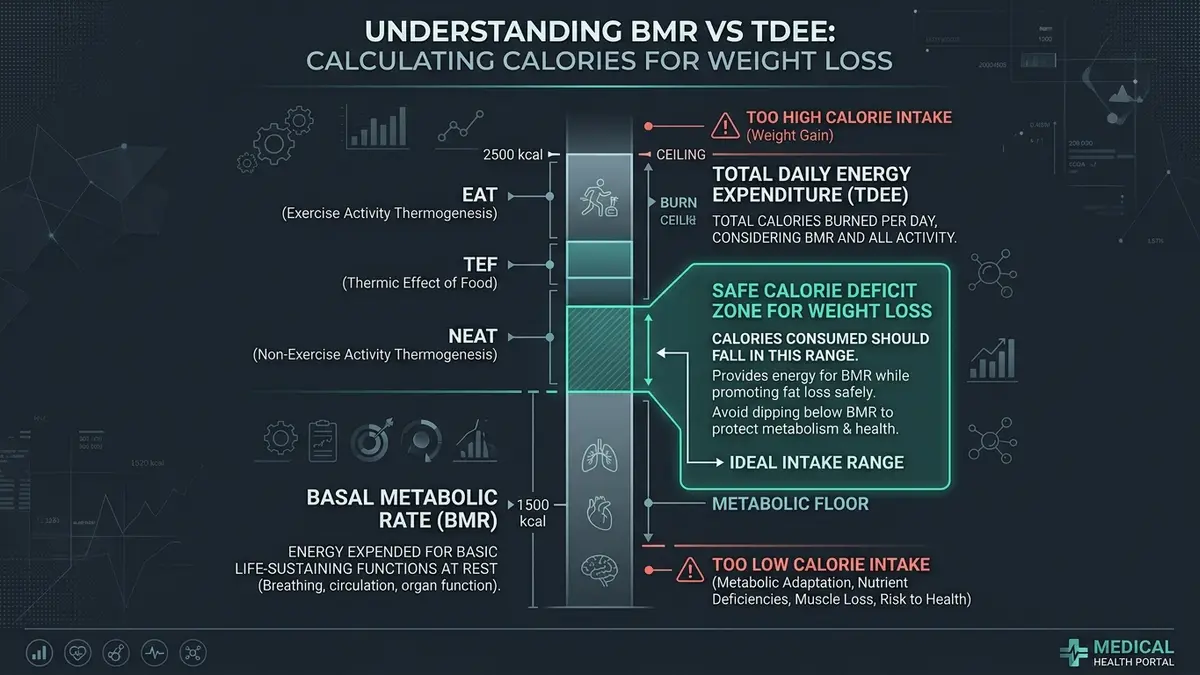
- Your TDEE is your Ceiling: Eating above this causes weight gain. Eating exactly at this maintains your weight.
- Your BMR is your Floor: Chronic intake below this forces your body into severe metabolic compensation, loss of lean tissue, and hormonal dysfunction.
- Your Fat Loss Sweet Spot is in between: You want to eat below your TDEE (creating an energy deficit) while staying at or above your BMR (protecting your organ function and resting metabolism).
What Happens in Each Scenario of TDEE vs BMR for Weight Loss?
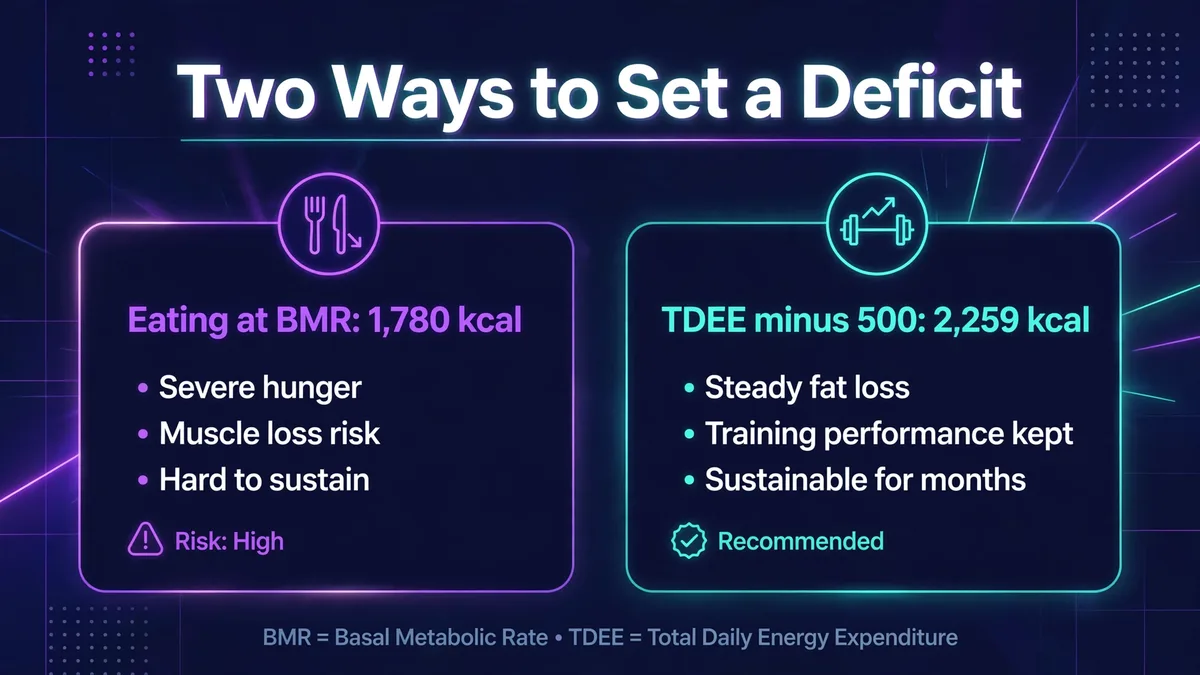
Let us look at what happens biologically across the three possible eating strategies:
Scenario 1: Eating at Your TDEE (Maintenance)
- Calorie Intake: 2,150 kcal (equal to TDEE)
- Net Energy:
2,150 in - 2,150 out = 0 - What happens: Your weight stays constant. Glycogen stores remain replenished, hormone levels (leptin, thyroid, testosterone and estrogen) remain optimal, and workout performance is maximized.
Scenario 2: Eating in the Sweet Spot (Below TDEE, Above BMR)
- Calorie Intake: 1,650 kcal (500 calories below TDEE, 130 calories above BMR)
- Net Energy:
-500 kcal deficit per day - What happens: Your body makes up the 500-calorie deficit by mobilizing and oxidizing stored triglycerides (body fat).
- Over 7 days, a 3,500-calorie cumulative deficit yields approximately 1 pound (0.45 kg) of pure body fat loss per week, with minimal hunger and zero metabolic damage.
Scenario 3: Eating Below Your BMR (Crash Dieting)
- Calorie Intake: 1,100 kcal (420 calories below BMR)
- Net Energy: Severe extreme deficit
- What happens: Your body senses starvation. It downregulates non-essential functions, blunts thyroid hormone production (T3), shuts down spontaneous physical movement (NEAT drops by 300+ calories), breaks down skeletal muscle for gluconeogenesis, and skyrockets the hunger hormone ghrelin.
- Within 3 to 6 weeks, weight loss stalls completely, and severe rebound bingeing almost always follows.
Hormonal Risks in TDEE vs BMR for Weight Loss
When people chronically consume fewer calories than their Basal Metabolic Rate, the body interprets this energy deficit as an existential threat to survival. The endocrine system coordinates a protective shutdown:
- Active Thyroid Downregulation: The peripheral conversion of thyroxine (T4) into active triiodothyronine (T3) slows, shifting metabolism into reverse T3 (rT3). This immediately down-regulates basal cellular oxygen consumption, making you feel cold, sluggish, and constantly fatigued.
- Leptin Collapse and Ghrelin Surge: Adipocytes reduce secretion of leptin, the master satiety hormone that signals fullness to the hypothalamus. Simultaneously, the stomach secretes massive amounts of ghrelin, stimulating intense psychological food cravings and obsessive thoughts about high-calorie foods.
- Elevated Cortisol and Water Retention: Systemic physiological stress drives serum cortisol upward. Cortisol promotes extracellular fluid retention, often causing dieters to retain two to five pounds of water that completely masks fat loss on the bathroom scale.
Step-by-Step Protocol: TDEE vs BMR for Weight Loss
Here is the exact formula to determine your personal sweet spot today:
Step 1: Find Your Numbers
Use our Free TDEE Calculator to generate both your BMR and your TDEE.
Let us assume:
- BMR: 1,600 kcal
- TDEE: 2,250 kcal (Lightly active)
Step 2: Calculate a 20% Deficit
Multiply your TDEE by 0.80 (or subtract 450 calories):
Daily Target = 2,250 x 0.80 = 1,800 calories/day
Step 3: Check Against Your BMR Floor
Check your result against your BMR:
- Is 1,800 calories greater than your BMR of 1,600?
Yes! It is 200 calories above your BMR. This target is safe, highly effective, and sustainable for months.
You can also run this automatically with custom timelines on our Calorie Deficit Calculator.
Two Case Studies: Applying TDEE vs BMR for Weight Loss
Understanding how stature influences the gap between BMR and TDEE prevents dangerous dietary missteps:
Case Study A: The Petite Female (Sarah)
- Age: 34 | Height: 5’2” (157 cm) | Weight: 125 lbs (56.7 kg)
- Calculated BMR: 1,280 kcal
- Calculated TDEE (Sedentary desk job): 1,536 kcal
- The Problem: The difference between her BMR and TDEE is only 256 calories. If Sarah attempts a standard 500-calorie deficit, she would have to eat 1,036 calories per day, falling well below her vital BMR floor.
- The Solution: Rather than slashing food, Sarah should increase her physical activity. By adding 5,000 daily steps and lifting weights twice weekly, her TDEE increases to 1,800 kcal. Now, she can consume 1,400 calories daily, maintaining a healthy 400-calorie deficit while staying comfortably above her BMR floor.
Case Study B: The Heavy Male (David)
- Age: 38 | Height: 6’1” (185 cm) | Weight: 240 lbs (108.8 kg)
- Calculated BMR: 2,050 kcal
- Calculated TDEE (Moderately active): 3,175 kcal
- The Solution: David has a generous 1,125-calorie buffer between his BMR and TDEE. He can safely adopt an aggressive 600 to 750 calorie deficit, eating 2,425 to 2,575 calories per day. Even with a large deficit, he remains several hundred calories above his BMR floor, ensuring optimal hormone production and workout recovery.
What to Expect on the Scale: TDEE vs BMR for Weight Loss
When you establish an evidence-based calorie target in the sweet spot between your BMR and TDEE, understanding scale dynamics prevents premature panic:
- Week 1: You may lose 3 to 5 pounds rapidly. The majority of this initial loss is glycogen-bound water, as reduced food volume depletes liver glycogen stores.
- Weeks 2 to 4: Scale weight loss normalizes to a steady 0.5 to 1.5 pounds per week. This represents genuine adipose tissue oxidation.
- Plateau Rule: If your 7-day average scale weight stays identical for three consecutive weeks, recalculate your TDEE with your new lighter body weight and adjust your daily target downward by 100 to 150 calories.
Start With Confidence
Applying TDEE vs BMR for weight loss ensures you never second-guess your numbers. Find your exact baseline with our Free TDEE Calculator, establish your safe deficit window, and start making steady, predictable progress today.
This calculator is for informational and educational purposes only and does not constitute medical, nutritional, or health advice. Information presented in this guide is for educational purposes only and should not replace personalized evaluation from a physician or registered dietitian. Always consult your doctor before making substantial changes to your diet or exercise regimen. Read full disclaimer
Calculate Your Accurate Daily Calorie Burn
Stop guessing your metabolic numbers. Use our free, peer-reviewed multi-formula calculator to discover your exact TDEE, BMR, and macronutrient targets in 30 seconds.
🔥 Calculate My TDEE Now →Free Companion Health Calculators
Frequently Asked Questions
Should I eat my BMR to lose weight?
Eating at your BMR can be a viable short-term calorie deficit for some active individuals, because your TDEE is higher than your BMR. However, you should NEVER eat BELOW your BMR, as this deprives vital organs of energy and triggers severe metabolic downregulation.
If I eat at my TDEE, will I lose weight?
No. Eating at your TDEE means your calorie intake exactly matches your daily expenditure. You will maintain your current body weight. To lose weight, you must eat BELOW your TDEE.
What is the sweet spot between BMR and TDEE for fat loss?
The optimal fat loss target is typically 15% to 25% below your TDEE, while remaining comfortably above your BMR. For example, if your BMR is 1,500 kcal and your TDEE is 2,100 kcal, eating 1,650 to 1,750 calories creates steady fat loss without intense hunger or metabolic fatigue.