⚡ Quick Summary: What Are Maintenance Calories?
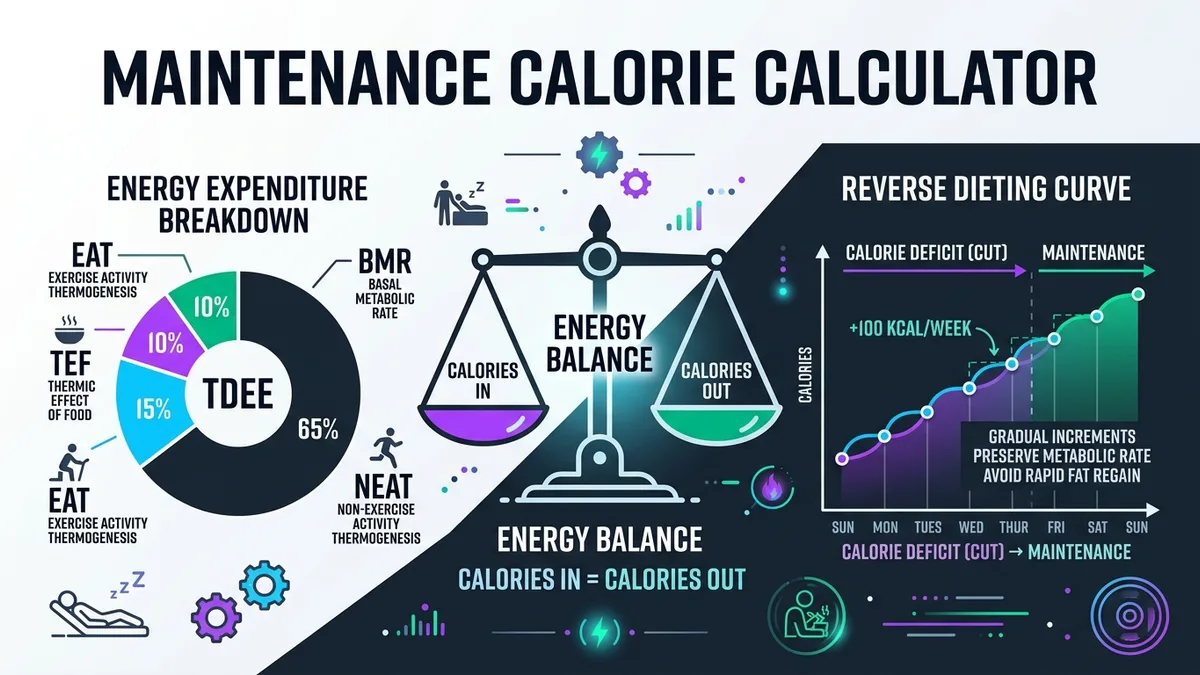
Our maintenance calorie calculator determines the daily caloric intake at which your body remains in perfect thermodynamic energy balance (Calories In = Calories Out). It equals your Total Daily Energy Expenditure (TDEE). Eating at maintenance preserves lean skeletal muscle, restores vital metabolic hormones (leptin and thyroid T3), and sustains athletic strength without gaining body fat. If exiting a prolonged diet, use Reverse Dieting to add 100 to 150 calories weekly to safely normalize metabolism.
The Physiological Science Behind the Maintenance Calorie Calculator
Your maintenance calorie level is the thermodynamic break-even baseline of human metabolism. Every day, your body expends chemical potential energy across four distinct biological compartments: your Basal Metabolic Rate (BMR), Non-Exercise Activity Thermogenesis (NEAT), the Thermic Effect of Food (TEF), and Exercise Activity Thermogenesis (EAT).
When daily food energy matches the aggregate sum of these four components, your net systemic energy flux is zero. Under these steady-state conditions, cellular adipocytes neither release stored triglycerides nor store excess substrate. Your scale weight stabilizes over multi-week measurement periods.
Body oxidizes stored adipose tissue for energy. Over time, adaptive thermogenesis lowers thyroid hormones and daily spontaneous movement.
Perfect biological equilibrium. Optimizes testosterone, leptin, and sleep architecture while supporting peak gym strength.
Supplies surplus energy for muscular hypertrophy. Unused calories are stored as glycogen and adipose lipid reserves.
Maintenance Is a Dynamic Zone, Not a Static Number
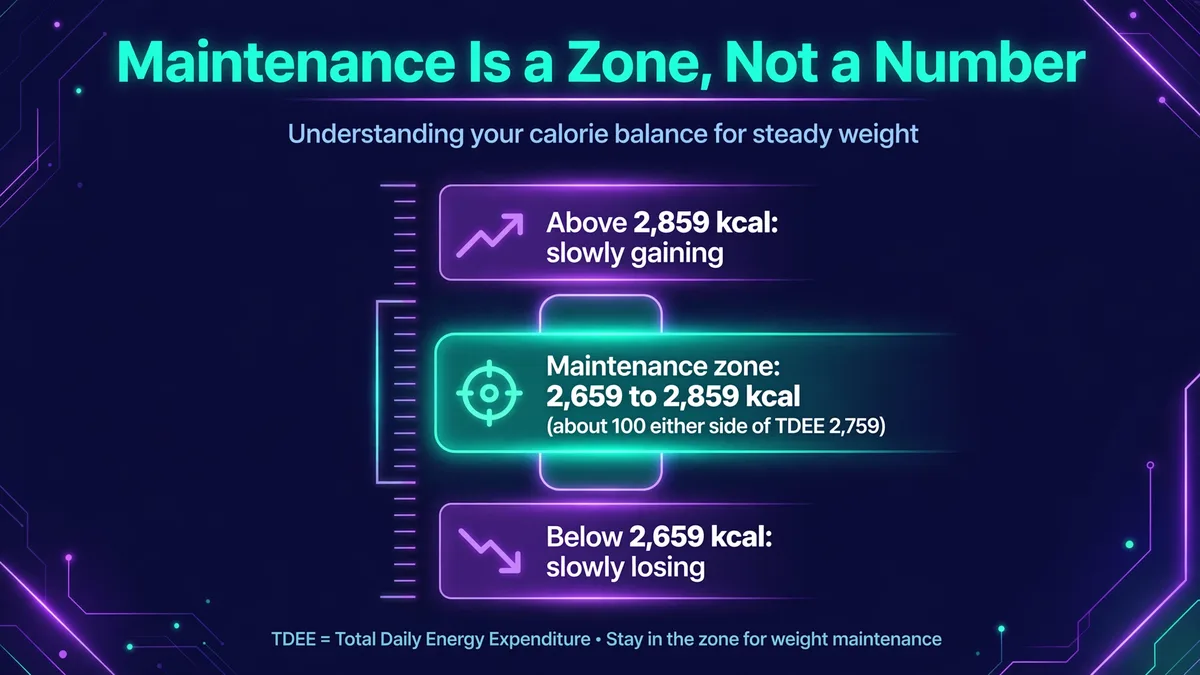
A common misconception in sports nutrition is that maintenance is an unyielding, rigid mathematical figure, such as exactly 2,342 calories. In reality, human physiology is dynamic. Your daily energy expenditure fluctuates naturally by 100 to 200 calories per day based on spontaneous lifestyle factors:
- Spontaneous NEAT Shifts: On busy days with more walking, pacing, or chores, your non-exercise movement burns significantly more energy than quiet resting days.
- Thermic Effect of Food Variations: High-protein meal days expend substantially more energy during digestion (20% to 30% of protein calories) compared to high-fat meal days (0% to 3%).
- Cellular Hydration and Glycogen: Hydration levels and intramuscular glycogen storage expand and contract daily, creating temporary water weight fluctuations of 1 to 3 pounds that do not represent fat gain.
Maintenance Equilibrium Zone = (BMR × PAL) ± 4% Dynamic Metabolic Buffer
If your baseline maintenance calculation is 2,400 kcal, your practical maintenance zone is 2,300 to 2,500 kcal per day. Consuming calories within this buffer will keep your body composition virtually unchanged over multi-week periods.
The Science of Reverse Dieting: Transitioning Out of a Cut
When exiting a diet, using our maintenance calorie calculator prevents the mistake of immediately jumping back to pre-diet eating levels. This abrupt transition frequently triggers rapid, unwanted fat accumulation.
During prolonged caloric restriction, your body downregulates its resting expenditure through adaptive thermogenesis: thyroid hormone T3 drops, circulating leptin plummets, and your sympathetic nervous system reduces spontaneous fidgeting and walking. Consequently, your maintenance level immediately post-diet is temporarily lower than baseline.
Using a maintenance calorie calculator provides the baseline to solve this dilemma through structured reverse dieting:
For a comprehensive, week-by-week walkthrough on pacing your caloric increases, configuring macronutrients, and managing scale water weight, follow our evidence-based reverse dieting guide.
Scheduled Diet Breaks: The MATADOR Study Protocol
Maintenance is not only useful after a diet is finished; it is also one of the most effective tools to use during an ongoing cutting phase.
In the landmark MATADOR clinical trial (Minimising Adaptive Thermogenesis And Deactivating Obesity Rebound), researchers compared dieters on continuous 16-week calorie deficits against dieters who took two-week breaks at maintenance calories every two weeks. The results were striking: the intermittent maintenance group achieved significantly greater total fat loss, preserved more lean muscle tissue, and maintained a higher resting metabolic rate post-diet.
If you have been in a calorie deficit for 8 to 12 consecutive weeks, schedule a 1 to 2 week diet break at maintenance calories. Eat at your maintenance target, keep protein high, and maintain your regular lifting routine. This resets hunger hormones, prevents metabolic fatigue, and makes your next fat loss phase far more effective.
Optimizing Macronutrient Distribution at Maintenance
Applying the macronutrient ratios from our maintenance calorie calculator ensures your daily nutrition supports hormonal health, athletic stamina, and lean muscle retention:
Sustains positive nitrogen balance, supports ongoing muscle protein remodeling, and offers high satiety to prevent inadvertent overeating.
Carbohydrates fully saturate intramuscular glycogen reserves, support thyroid T3 conversion, and fuel high-intensity mechanical training volume.
Essential fatty acids provide the biochemical backbone for steroid hormone synthesis (testosterone and estrogen) and cell membrane fluidity.
How to Empirically Verify Your Maintenance Level
Mathematical formulas provide an exceptionally reliable starting estimate. To verify the numbers from a maintenance calorie calculator with laboratory precision, execute this 14-day calibration protocol:
- Track Caloric Intake Consistently: Weigh all foods, cooking oils, and condiments on a digital gram scale for 14 consecutive days while consuming your calculated maintenance target.
- Take Daily Morning Weigh-Ins: Weigh yourself each morning after using the restroom and before consuming food or fluids. Log the numbers into a spreadsheet.
- Calculate 7-Day Running Averages: Compare the average weight of Week 1 to Week 2. If your 7-day average weight changes by less than 0.5 pounds, your caloric intake represents your true maintenance baseline. If your average weight decreases, add 150 calories; if it increases, subtract 150 calories.
By pairing daily scale weight tracking with our maintenance calorie calculator, you can eliminate guesswork, protect your metabolic health, and maintain your ideal body composition indefinitely.