Reverse Dieting: How to Raise Calories After a Cut Without Regaining Fat
After your cut ends, use this reverse dieting guide to raise calories 50 to 150 per week, track weekly averages, and find maintenance without rapid regain.
⚡ Quick Answer
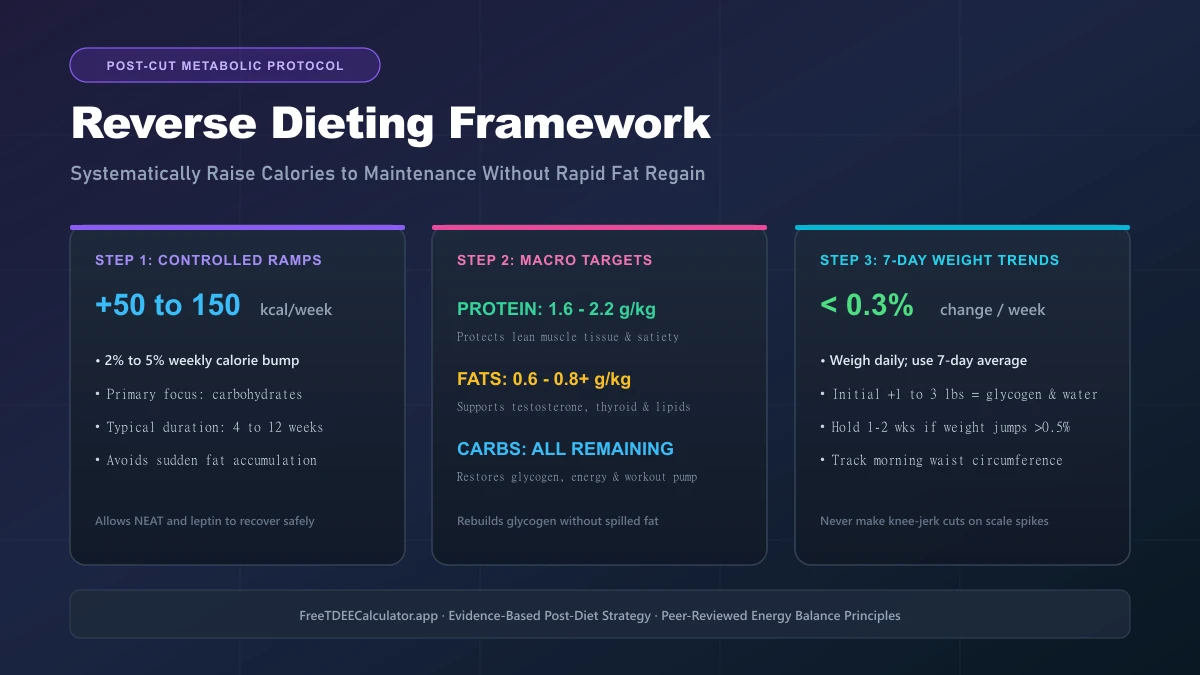
Reverse dieting means raising calories by 50 to 150 per week, mostly from carbohydrates, while tracking the weekly scale weight average until weight stabilizes at maintenance. Over a typical timeline of 4 to 12 weeks, this controlled approach prevents rapid fat regain, restores daily energy, and eases metabolic adaptation after an extended fat loss cut.
Determine how to safely transition out of an extended caloric restriction using reverse dieting, the deliberate, stepwise protocol designed to increase daily calories back to maintenance while minimizing unwanted body fat accrual. After weeks or months of dieting to lose body fat, your digestive system, endocrine glands, and skeletal muscles operate under significant physiological suppression. Simply ending a cut and returning abruptly to pre-diet eating habits almost universally leads to rapid fat regain, fluid retention, and distress.
By implementing structured reverse dieting, you bridge the critical metabolic gap between your depleted dieting intake and your long-term energy balance. This evidence-based guide walks through the exact biological mechanics of post-diet adaptation, provides a clear 7-step execution protocol, outlines an 8-week worked case study, and details how to manage scale fluctuations with confidence.
Why You Cannot Just Go Back to Normal
Completing a successful fat-loss phase is a significant achievement, but the immediate post-diet period represents the most biologically vulnerable window in nutrition. When you restrict food for an extended duration, your body enacts powerful evolutionary defense mechanisms known collectively as adaptive thermogenesis.
During prolonged energy restriction, four primary physiological shifts occur that prevent you from immediately returning to your old intake levels:
1. The Severe Drop in Non-Exercise Activity Thermogenesis (NEAT)
As detailed in our guide on what is NEAT, spontaneous physical movement represents the most variable component of daily calorie expenditure. When calories remain low, your central nervous system conserves energy by reducing subconscious behaviors. You sit more frequently, stop fidgeting, take fewer daily steps, and adopt more sedentary postures. Even if you maintain your gym schedule, total 24-hour physical movement can drop by 300 to 600 calories per day without your conscious awareness. Understanding how reverse dieting counteracts these compensatory decreases in spontaneous daily expenditure is essential for sustaining long-term leanness.
2. Disrupted Appetite and Satiety Hormones
Caloric restriction causes circulating leptin (the primary satiety hormone produced by fat cells) to plummet, while ghrelin (the primary hunger hormone secreted by the stomach) surges. Simultaneously, peptide YY and cholecystokinin decline, blunting the fullness signals that normally terminate a meal. If you jump straight from cut calories back to unrestricted eating, these hormonal signals promote severe hyperphagia, making it nearly impossible to stop eating once you begin.
3. A Reduced Maintenance Baseline
After shedding body weight, your new maintenance requirements are intrinsically lower than when you started. A smaller physical body requires less energy to walk, breathe, pump blood, and move. Furthermore, as explored in our primer on understanding what is TDEE, mitochondrial efficiency improves during a diet, meaning your cells burn fewer calories to perform identical amounts of physical work.
4. Rapid Glycogen and Water Expansion
Each gram of stored muscle and liver glycogen binds approximately 3 to 4 grams of intracellular water. In an energy deficit, glycogen stores remain chronically depleted. If you immediately consume large quantities of carbohydrates and sodium, your intramuscular and extracellular water stores surge overnight, creating alarming scale spikes of 3 to 8 pounds in a matter of days.
Many fitness enthusiasts mistakenly believe they must undergo months of food restriction to “fix metabolism” after dieting. In scientific reality, your metabolic rate was never broken. As documented in peer-reviewed metabolic research published in the National Library of Medicine, adaptive thermogenesis is a healthy, coordinated physiological response to energy scarcity. A structured reverse diet does not magically fix metabolism; rather, it methodically restores energy intake in sync with the recovery of your thyroid, leptin, and spontaneous physical movement.
Who Reverse Dieting Helps, Who Should Skip It, Who Should Get Guidance First
While reverse dieting offers significant structure, it is a specialized nutritional strategy that is not universally required for every single person exiting a diet. Understanding which category you fall into ensures you choose the most effective approach for your physical and mental health.
Trainees Who Benefit Most from Stepwise Recovery
- Physique Athletes and Bodybuilders: Competitors finishing extreme contest preparation who reach very low body fat levels and face intense rebound risks.
- Extended Cut Finishers: Individuals who have dieted continuously for 16 weeks or longer and whose calculated maintenance has dropped considerably.
- Chronic Low-Calorie Trainees: People who have stalled at very low daily calories (such as 1,200 to 1,400 kcal) and need a structured plan to build intake back to a sustainable level.
- Dieters with Scale Anxiety: Individuals who require clear, predictable data points to navigate the transition out of a deficit without panic.
Dieters Who Should Skip This Protocol
- Casual or Short-Term Dieters: Anyone who completed a gentle 4 to 8 week deficit with minimal metabolic slowdown can usually jump straight to their new calculated maintenance in a single step.
- Severe Energy Deficiency and RED-S Trainees: Athletes experiencing Relative Energy Deficiency in Sport, amenorrhea, severe immune suppression, or bone density loss should not slowly trickle in food over months. They require immediate, substantial caloric restoration.
- Non-Trackers: If you do not weigh your food or track daily macronutrients, attempting to add 75 to 100 calories per week is impractical due to daily measurement variance.
Who Should Seek Clinical Guidance First
Certain medical conditions require specialized oversight. You should consult a licensed healthcare professional, endocrinologist, or registered dietitian before modifying calories if you have:
- A documented history of clinical eating disorders or severe orthorexia.
- Insulin-managed Type 1 or Type 2 diabetes, where carbohydrate increases directly alter exogenous insulin dosing.
- Chronic kidney disease requiring precise dietary protein limits.
- Active pregnancy or postpartum lactation, where immediate nutrient adequacy is essential for maternal and infant health.
The Reverse Diet Protocol, Step by Step
Executing an effective transition requires systematic planning rather than arbitrary adjustments. Follow this 7-step protocol to successfully raise your daily calories while keeping fat accumulation negligible.
Step 1: Record Baseline Cut Metrics
Before modifying your food intake by a single calorie, collect complete baseline data across seven consecutive days at the conclusion of your diet:
- Daily weigh-ins taken first thing in the morning after using the restroom.
- Your true 7-day average scale weight.
- Your exact current daily calorie and macronutrient intake.
- Average daily step count from a wearable pedometer.
- Weekly resistance training split and cardio volume.
- Fasted morning waist circumference measured at the narrowest point and at the navel.
Step 2: Re-Estimate Maintenance Targets
Calculate your current post-diet maintenance calories using our free TDEE calculator and cross-reference your deficit with our calorie deficit calculator. Input your newly reduced body weight rather than your starting weight.
Treat this calculated number as a long-term destination target, not a day-one mandate. For example, if your diet ended at 1,750 calories per day and your newly estimated maintenance is 2,350 calories, your objective is to close that 600-calorie gap methodically across the upcoming weeks.
Step 3: Implement Weekly Calorie Increments
Begin increasing your daily food intake by 50 to 150 calories per week, which typically translates to an increase of 2% to 5% over your current baseline:
- Conservative Approach (+50 to +75 kcal/week): Ideal for smaller individuals, dieters with lower total expenditure, or those who carry intense fear of scale increases.
- Moderate Approach (+100 kcal/week): The gold-standard recommendation for most trainees, providing noticeable energy recovery without overflowing energy balance.
- Aggressive Approach (+150 kcal/week): Suited for larger lifters, individuals with high step counts, or trainees exiting severe deficits who feel extreme physical fatigue.
The speed at which you pace your reverse dieting phase determines how smoothly your endocrine system adapts to increasing food volume.
Step 4: Configure Macronutrient Priorities
Calorie increases must be allocated strategically across macronutrient categories to support hormonal health and training performance:
- Protein (1.6 to 2.2 g/kg): Keep protein constant at your established athletic target. There is no need to add protein during a reverse diet; keeping it steady preserves lean tissue and sustains meal satiety.
- Dietary Fat (0.6 to 0.8+ g/kg): If your dietary fat was restricted below 0.6 grams per kilogram (roughly 0.3 g/lb) during the final weeks of your cut, allocate your first two weekly increases to healthy fats to restore sex steroid hormone production.
- Carbohydrates (All Remaining Calories): Direct all subsequent weekly increments into complex carbohydrates. Carbohydrates stimulate insulin, which directly elevates circulating leptin, refills muscle glycogen, and enhances gym performance.
Step 5: Track Daily Weight and Weekly Averages
Daily bathroom scale numbers are notoriously noisy due to hydration, salt intake, digestive transit time, and glycogen storage. Record your weight daily, but calculate your 7-day rolling average at the end of each week.
Compare week-over-week averages rather than individual days. Simultaneously, record your waist circumference every two weeks and check your average step counts to ensure unconscious fatigue is not creeping in.
Step 6: Advance Only When Metrics Are Stable
Add your next scheduled weekly increment only when your body demonstrates metabolic stability:
- If your 7-day weight average change is under 0.3% of your body weight (e.g., less than 0.5 lbs for a 160-lb individual), your body has comfortably assimilated the extra energy. Add the next scheduled increment.
- If your weight remained completely flat or actually dropped slightly, you may advance with confidence.
During well-calibrated reverse dieting, small weekly increases often produce zero scale weight change because your non-exercise activity thermogenesis ramps up proportionally.
Step 7: Apply Strategic Hold Weeks
If your 7-day average scale weight climbs faster than 0.5% of body weight in a single week (more than 0.8 to 1.0 lb for a 160-lb lifter), pause the progression:
- Do not cut calories back down.
- Maintain your current intake level for 1 to 2 consecutive weeks.
- Allow your extracellular fluid to stabilize and your daily movement to catch up.
- Once your 7-day weight average flattens out, resume your regular weekly increments.
Holding calories steady represents an integral safeguard in disciplined reverse dieting, ensuring that water retention subsides before introducing further food.
Reverse Dieting Plan: 8 Week Worked Example
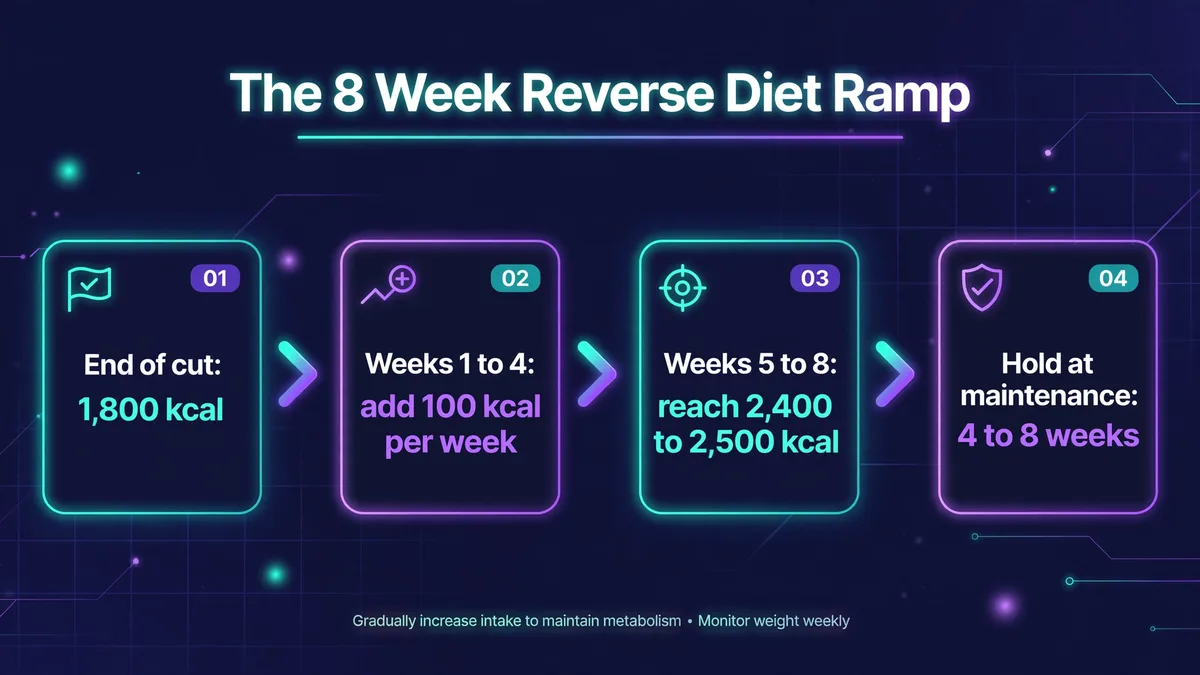
To visualize how this protocol unfolds in the real world, examine the following 8-week worked case study of a resistance-trained lifter transitioning out of a 16-week cut.
Lifter Profile:
- Current Post-Diet Weight: 165 lbs (75 kg)
- End-of-Cut Intake: 1,800 kcal (Protein: 160g, Fat: 50g, Carbs: 177g)
- Estimated Maintenance Target: 2,400 to 2,500 kcal
- Planned Progression: +100 kcal per week
| Phase | Daily Calories | Macro Breakdown (P / F / C) | Scale Weight Response | Protocol Action |
|---|---|---|---|---|
| End of Cut | 1,800 kcal | 160g P / 50g F / 177g C | 165.0 lbs (baseline) | Record complete baseline metrics |
| Week 1 | 1,900 kcal | 160g P / 55g F / 190g C | 165.8 lbs (+0.8 lbs) | Minor water/glycogen bump; normal |
| Week 2 | 2,000 kcal | 160g P / 55g F / 215g C | 166.0 lbs (+0.2 lbs) | Trend stable (<0.3%); advance |
| Week 3 | 2,100 kcal | 160g P / 60g F / 230g C | 167.1 lbs (+1.1 lbs) | Spike exceeds 0.5%; trigger hold week |
| Week 4 (Hold) | 2,100 kcal | 160g P / 60g F / 230g C | 166.7 lbs (-0.4 lbs) | Fluid equalizes; trend stable; advance |
| Week 5 | 2,200 kcal | 160g P / 60g F / 255g C | 167.0 lbs (+0.3 lbs) | Trend stable; energy and gym pump surge |
| Week 6 | 2,300 kcal | 160g P / 65g F / 268g C | 167.2 lbs (+0.2 lbs) | Excellent recovery; sleep improves |
| Week 7 | 2,400 kcal | 160g P / 65g F / 293g C | 167.4 lbs (+0.2 lbs) | Approaching target maintenance |
| Week 8 | 2,500 kcal | 160g P / 70g F / 307g C | 167.6 lbs (+0.2 lbs) | Maintenance achieved; begin consolidation |
Note: The figures displayed in this worked example represent an illustrative scenario rather than a rigid prescription. Individual metabolic responses, body sizes, and training volumes will dictate distinct starting points and rates of progression.
Notice that throughout this worked plan, reverse dieting does not mean reckless eating; it requires measuring portions with identical diligence as the diet itself.
Consolidating at Maintenance (Weeks 9 Through 16)
Once this lifter reached their target intake of 2,500 calories per day with net scale changes under 2.6 pounds across two months, the process was not finished.
Crucially, you must hold steady at your new maintenance intake for 4 to 8 full weeks before attempting another fat loss cut or initiating a dedicated muscle-building surplus. This consolidation phase allows your thyroid hormones, leptin levels, reproductive axis, and psychological relationship with food to normalize completely.
Training and Cardio During a Reverse Diet
Nutrition is only one half of the energy balance equation. Managing your exercise programming is equally vital to ensure that incoming calories are partitioned toward muscle glycogen and cellular recovery rather than stored as fat.
Incoming Caloric Surplus Target = Restored Glycogen + Elevated NEAT + Cellular Repair
Balancing resistance training with strategic reverse dieting creates the optimal nutrient-partitioning environment for building muscle while defending body fat levels.
1. Resistance Training: Maintain Intensity and Progressive Overload
During a calorie deficit, the goal of lifting weights was to preserve existing muscle tissue. As calories rise during a reverse diet, your muscular environment shifts from catabolic defense to anabolic recovery:
- Maintain your regular lifting frequency (typically 3 to 5 sessions per week).
- Focus on progressive overload by adding weight to the bar or completing additional repetitions with excellent technique.
- Avoid the temptation to double your training volume simply because you have more food. Let the extra carbohydrates improve the quality and recovery of your existing training sessions.
2. Cardiovascular Exercise: Taper Down Gradually
Many dieters rely on heavy cardiovascular training (such as 4 to 6 sessions of stairmaster or running each week) to force fat loss at the end of a cut.
- Do not eliminate all cardio overnight: Dropping from 4 hours of weekly cardio to zero on day one abruptly reduces your daily energy expenditure by 300 to 500 calories, creating an artificial surplus.
- Taper systematically: Reduce cardio sessions by 15% to 25% every two weeks. Transition gradually toward a sustainable long-term baseline of 2 to 4 low-impact cardio sessions per week (such as incline walking, cycling, or swimming for 20 to 30 minutes).
3. Protecting Your Daily Steps
As discussed in our activity level guide for TDEE, daily step count is the most reliable proxy for non-exercise activity. Establish a minimum daily step baseline (such as 8,000 to 10,000 steps) and maintain it throughout your period of reverse dieting. As food intake rises, your energy levels will naturally improve, making it easier to sustain your step count without feeling drained.
What to Do When Weight Jumps
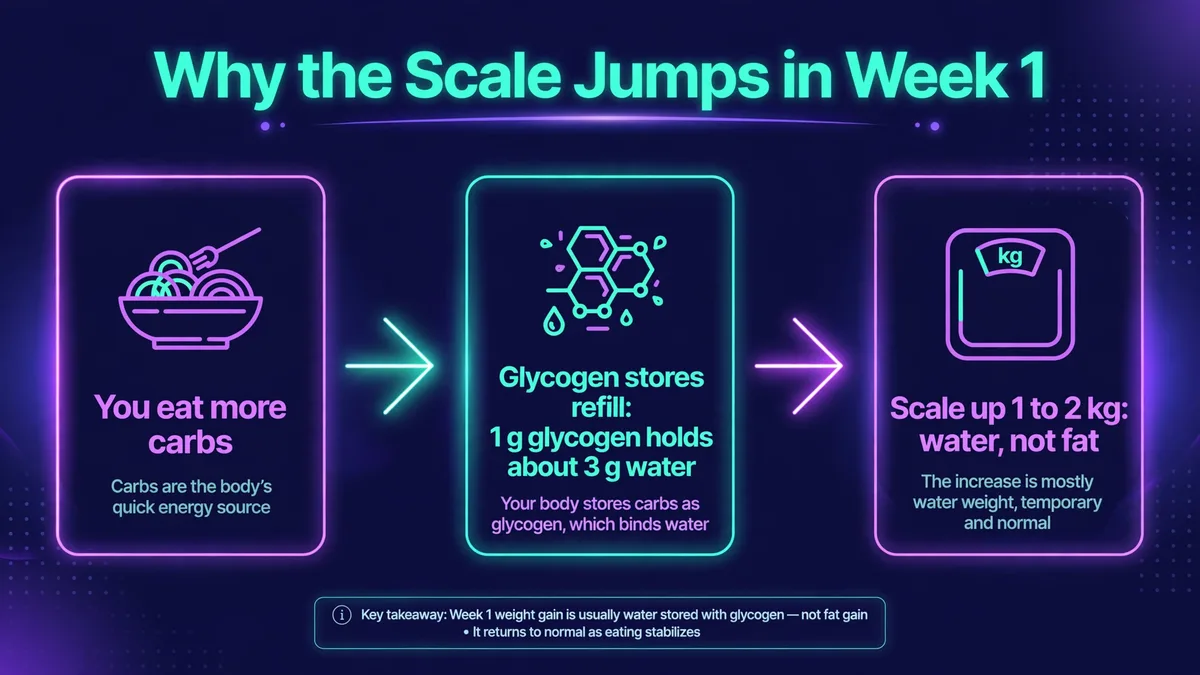
Encountering an abrupt increase on your bathroom scale is the most common reason dieters abandon their plan prematurely. Handling scale jumps effectively requires separating temporary fluid dynamics from actual adipose tissue accretion. A temporary upward scale fluctuation is an expected milestone in successful reverse dieting, signaling that muscle cells are absorbing glycogen and electrolytes.
Why Early Scale Jumps Are Not Body Fat
If you add 100 calories of carbohydrates to your daily intake and wake up two mornings later showing a 2-pound weight gain, it is biologically impossible for that weight to be fat:
- Storing one pound of adipose body fat requires a net caloric surplus of approximately 3,500 calories.
- A 100-calorie daily increase could not physically generate two pounds of fat in 48 hours.
What you are observing is intracellular water and glycogen replenishment. Each gram of carbohydrate stored in skeletal muscle pulls roughly 3 to 4 grams of water with it into the muscle cell. In addition, consuming slightly more food increases the physical weight of food traveling through your gastrointestinal tract.
The Diagnostic Checklist for Scale Spikes
Whenever you observe an unexpected scale jump, review this diagnostic sequence before making any adjustments:
- Sodium and Water Shifts: Did you consume a higher-sodium meal, dine at a restaurant, or drink significantly more water yesterday evening?
- Digestive Transit: Have you had a normal bowel movement prior to weighing in?
- Training Inflammation: Did you perform a strenuous leg workout or introduce new lifting exercises that caused delayed onset muscle soreness (DOMS)? Micro-tears in muscle tissue temporarily draw localized water for cellular repair.
- Hormonal and Menstrual Fluctuations: For female trainees, luteal phase progesterone and estrogen shifts frequently introduce 2 to 5 pounds of cyclical water retention.
Remaining objective and trusting the physiology of reverse dieting keeps you from sabotaging your long-term caloric targets when facing these temporary fluid spikes.
If your scale weight spikes, do not cut your calories back. If you suspect your progress has stalled, refer to our comprehensive guide on why you are not losing weight in a calorie deficit to understand how water masking works. Hold your calories steady for 7 to 14 days and observe the multi-week trend line. In the vast majority of cases, the scale stabilizes on its own as your body reaches fluid equilibrium.
Common Mistakes to Avoid
Avoiding nutritional traps ensures your transition to maintenance remains smooth and predictable. When trainees struggle after a cut, faulty execution during reverse dieting is usually the underlying cause:
1. Jumping Straight to Pre-Diet Calorie Levels
Returning immediately to the calorie intake you consumed before starting your diet is the fastest way to trigger rapid fat regain. Because your body weight is lower and adaptive thermogenesis is still active, your current maintenance level is significantly lower than your pre-diet baseline.
2. Adding Calories Only from Dietary Fats
While healthy fats are crucial for endocrine function, using all your weekly calorie increments on peanut butter, oils, and cheese misses the primary metabolic benefits of post-dieting. Carbohydrates are the specific macronutrient that triggers thyroid hormone conversion (T4 to T3), boosts circulating leptin, and restores glycogen reserves.
3. Reacting Emotionally to Daily Scale Noise
Checking the scale daily and panicking over day-to-day fluctuations leads to knee-jerk decisions. If you reduce your calories every time the scale rises by 0.6 pounds, you remain trapped in a perpetual deficit and never restore your metabolic expenditure.
4. Cutting Cardio to Zero on Day One
Completely eliminating all cardiovascular exercise while simultaneously increasing calories creates a double-sided surplus that outpaces your metabolic recovery. Gradually step down cardio over four to six weeks instead.
5. Ending the Reverse the Moment Scale Weight Stabilizes
Many trainees reach their target calorie number, celebrate, and immediately abandon nutritional tracking. Without an intentional 4 to 8 week consolidation period at maintenance, hormonal recovery remains fragile, increasing the likelihood of unmonitored overconsumption.
Concluding Thoughts on Post-Diet Nutrition
Successfully finishing a fat loss cut requires just as much intentional planning as starting one. By utilizing structured reverse dieting, you regain dietary freedom, restore vital hormonal health, replenish physical training energy, and discover your true biological maintenance intake without sacrificing your hard-earned body composition results.
Ultimately, mastering reverse dieting separates dieters who experience chronic weight cycling from those who maintain a lean, energetic physique year-round. Use the step-by-step methods outlined in this guide to transition safely out of your calorie deficit, elevate your metabolic rate, and enjoy eating at a full maintenance intake without fear.
This calculator is for informational and educational purposes only and does not constitute medical, nutritional, or health advice. Information presented in this guide is for educational purposes only and should not replace personalized evaluation from a physician or registered dietitian. Always consult your doctor before making substantial changes to your diet or exercise regimen. Read full disclaimer
Calculate Your Accurate Daily Calorie Burn
Stop guessing your metabolic numbers. Use our free, peer-reviewed multi-formula calculator to discover your exact TDEE, BMR, and macronutrient targets in 30 seconds.
🔥 Calculate My TDEE Now →Free Companion Health Calculators
Frequently Asked Questions
How fast should calories increase after a cut?
Most individuals achieve optimal results by increasing intake by 50 to 150 calories per week, which corresponds to roughly a 2% to 5% weekly calorie bump. Conservative individuals or those with significant metabolic slowdown may choose 50 to 75 calories weekly, while larger individuals or those recovering from severe deficits can start with 100 to 150 calories weekly.
How long should this controlled calorie ramp take?
A standard protocol typically spans 4 to 12 weeks, depending on the severity of the preceding calorie deficit and the gap between current intake and estimated maintenance. Once scale weight stabilizes within maintenance boundaries, staying at that level for an additional 4 to 8 weeks solidifies your hormonal and metabolic baseline.
Does raising calories gradually cause unwanted fat gain?
Expect a minor initial scale bump of 1 to 3 pounds during the first two weeks, but this represents intramuscular glycogen storage and bound water rather than body fat. When executed with gradual increments, true adipose fat gain remains minimal because metabolic rate and daily movement rise alongside your increased energy intake.
Can you continue losing weight while increasing calories?
Occasionally dieters notice a slight drop in scale weight during early calorie additions. This counterintuitive effect occurs when extra carbohydrate intake lowers elevated cortisol levels, releasing masked water retention while simultaneously stimulating spontaneous non-exercise physical activity.
What foods should you prioritize during this transition?
Keep dietary protein steady at 1.6 to 2.2 grams per kilogram of body weight and ensure dietary fat meets a baseline of at least 0.6 to 0.8 grams per kilogram. Allocate the majority of your weekly calorie increments to quality complex carbohydrates such as oats, rice, potatoes, fruit, and whole grains to replenish glycogen stores.
Is the concept of metabolic recovery after dieting a myth?
Reverse dieting is not magic, nor does it create a superhuman metabolic rate out of thin air. Instead, it is an empirical, disciplined bridge that systematically reverses adaptive thermogenesis, ramps up unconscious movement, and prevents the uncontrolled post-diet binging that causes rapid fat rebound.
Is this stepwise protocol the same as eating at maintenance?
No. Maintenance refers to eating the exact number of daily calories required to keep body weight completely stable. Reverse dieting is the progressive, dynamic transitional process of moving upward from a restricted deficit toward that maintenance target over several weeks.