Why Am I Not Losing Weight in a Calorie Deficit? 7 Hidden Reasons
Stuck and not losing weight in a calorie deficit? Discover 7 scientific reasons your fat loss stalled and how to restart progress safely today.
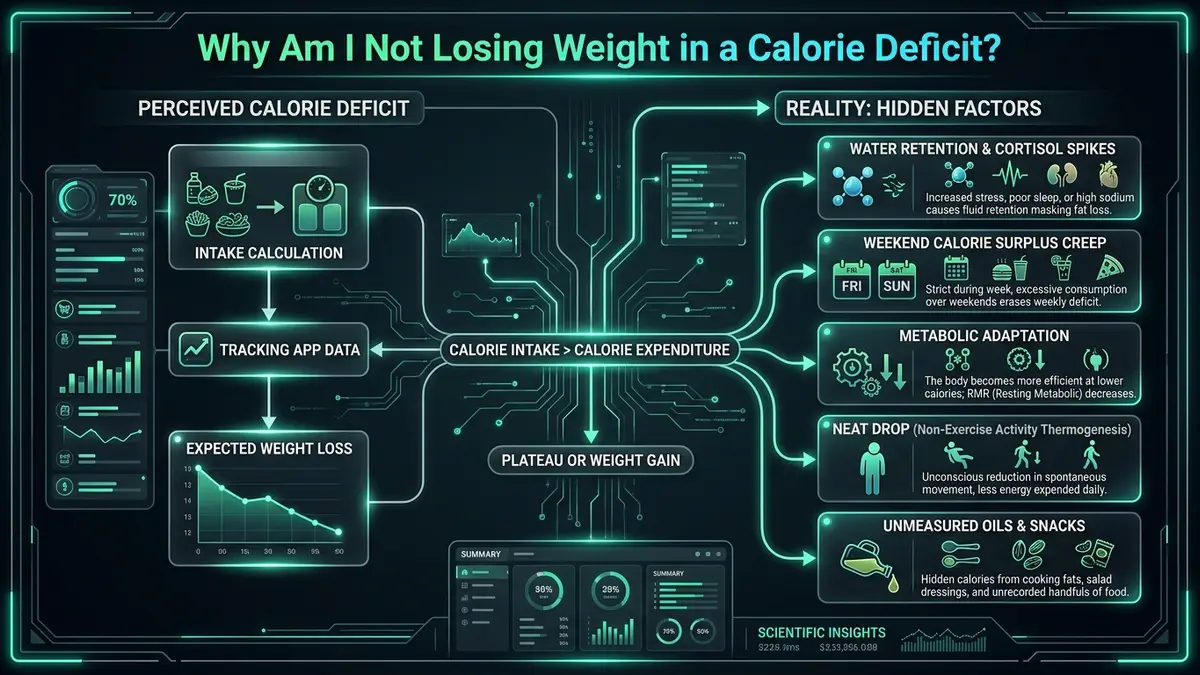
⚡ Quick Summary & Key Takeaways
Stuck and not losing weight in a calorie deficit? Discover 7 scientific reasons your fat loss stalled and how to restart progress safely today.
Few experiences in fitness are more demoralizing than carefully tracking your meals, saying no to office snacks, putting in hours at the gym, and stepping onto the bathroom scale only to see the exact same number staring back at you.
If you find yourself stuck and not losing weight in a calorie deficit, your immediate instinct might be to slash your food intake further or add another hour of grueling cardio.
Before you take drastic measures, take comfort in a fundamental scientific law: the First Law of Thermodynamics cannot be broken. If you are in a genuine caloric deficit over time, your body has no physical choice but to metabolize stored energy.
When the scale refuses to budge for two, three, or even four weeks, the issue almost never stems from a broken metabolism. Instead, one of seven physiological, behavioral, or tracking bottlenecks is quietly undermining your results.
Below, we explore the seven hidden reasons your weight loss has stalled and provide a clear scientific protocol to get the scale moving again.
1. Tracking Inaccuracies and Portion Creep
Human beings are notoriously poor at estimating food volume. Clinical studies published in The New England Journal of Medicine repeatedly demonstrate that individuals, including registered health professionals, underestimate their daily calorie intake by an average of 30% to 50% while simultaneously overestimating their physical activity.
Common tracking blind spots include:
- Eyeballing tablespoons: A leveled tablespoon of peanut butter is roughly 90 calories (16 grams). An overflowing, heaping tablespoon can easily weigh 35 grams, adding an unrecorded 110 calories.
- Cooking oils and butter: Sautéing vegetables with two generous swirls of olive oil adds between 200 and 250 unlogged calories to an otherwise lean dinner.
- Condiments, dressings, and sauces: Creamy salad dressings, barbecue sauces, coffee creamers, and dipping dips pack dense sugar and fat.
- Bites, licks, and tastes: Finishing your child’s leftover chicken nuggets, sampling food while cooking, or grabbing a small handful of almonds from the pantry can quietly add 150 to 300 calories daily.
The Fix
Put away measuring cups and spoons for two weeks. Weigh every single item that enters your mouth using a digital gram scale, including cooking sprays, liquid condiments, and beverages.
2. Water Retention is Masking Actual Fat Loss
One of the most confusing realities of body composition is that fat loss and scale weight loss do not happen on the same timeline.
You could easily burn one pound of adipose tissue over seven days while gaining two pounds of water weight during that exact same window. On the scale, it appears as though you gained a pound, even though you are visibly leaner under the surface.
Extracellular fluid retention is triggered by four primary factors:
A. Cortisol and Dieting Stress
Restricting calories is an evolutionary stressor. Sustained deficits increase circulating cortisol levels, which prompts renal tubules to retain sodium and water.
B. New or Intense Exercise
When you start a new lifting program or increase cardio intensity, your muscle fibers experience microscopic damage. The body rushes fluid and white blood cells to repair the muscle tissue, causing local edema and water retention for up to three weeks.
C. High Sodium Meals
A single high-sodium dinner (such as sushi with soy sauce or restaurant food) can cause your body to hold an extra three to five pounds of water for up to 48 hours without adding a single gram of body fat.
D. Menstrual Cycle Fluctuations
In biological females, progesterone and estrogen shifts during the luteal phase (the week leading up to menstruation) frequently cause three to six pounds of fluid retention.
The Fix
Do not judge fat loss based on day-to-day weigh-ins. Track your weight daily under identical conditions (first thing in the morning after using the bathroom), calculate the weekly average, and compare averages across three to four consecutive weeks.
3. Weekend Surpluses Erasing Weekday Deficits
This pattern, known as the weekday-weekend cycle, is the single most common reason consistent dieters stall.
Consider a typical scenario for a dieter whose maintenance intake is 2,200 calories per day:
- Monday through Friday (5 days): They consume a strict 1,700 calories per day. This creates a solid deficit of 500 calories per day, totaling a 2,500-calorie deficit by Friday afternoon.
- Saturday: They attend a dinner party, have three alcoholic drinks, split an appetizer, and eat dessert, reaching 3,400 calories (+1,200 surplus).
- Sunday: They enjoy a relaxed brunch, snack while watching sports, and order takeout pizza, reaching 3,500 calories (+1,300 surplus).
The Math
Weekday Deficit:  -2,500 kcal
Weekend Surplus:  +2,500 kcal
Net Weekly Balance: 0 kcal (Complete Equilibrium)
Across the full seven-day cycle, their average daily intake was exactly 2,200 calories. They suffered through five days of hunger and restriction, only to erase their entire deficit in 48 hours.
The Fix
Budget your calories across a full seven-day weekly total. If you plan to enjoy higher-calorie meals on weekends, plan a slightly larger weekday buffer or practice mindful portion management when dining out.
4. Unconscious NEAT Reduction (Metabolic Slowdown)
When you consume fewer calories than your body needs, your brain actively defends its energy reserves by lowering Non-Exercise Activity Thermogenesis (NEAT).
NEAT encompasses all energy expended for everything that is not sleeping, eating, or sports-like exercise:
- Pacing while talking on the phone
- Fidgeting and leg bouncing
- Maintaining upright posture
- Taking the stairs instead of the elevator
- Doing household chores and gardening
Without your conscious awareness, a prolonged deficit causes you to sit down more frequently, lean against counters, move your arms less while speaking, and park closer to building entrances.
Research by Dr. James Levine at the Mayo Clinic demonstrated that subconscious NEAT reductions can diminish daily calorie burn by 300 to 800 calories per day between individuals on the exact same diet.
The Fix
Do not rely on willpower to maintain movement. Use a wearable fitness tracker or pedometer to establish a non-negotiable step floor (such as 8,000 to 10,000 steps daily). Check your numbers using our TDEE Calculator Based on Steps to see how daily movement impacts your overall expenditure.
5. Your TDEE Dropped Because You Lost Weight
If you started your diet at 210 pounds and have successfully dropped to 190 pounds, your body requires significantly less fuel to operate today than it did on day one.
A lighter body expends less energy:
- Moving your limbs around requires less mechanical work.
- Your internal organs and skeletal muscle carry lower total mass.
- Your Basal Metabolic Rate (BMR) naturally declines in proportion to your reduced scale weight.
If your original maintenance was 2,400 calories and you began eating 1,900 calories (a 500-calorie deficit), you lost weight smoothly. However, at your new lighter weight, your new maintenance may now be 1,950 calories.
The exact intake that produced steady weight loss three months ago is now your new maintenance level.
The Fix
Recalculate your energy targets every 10 to 15 pounds of weight loss using our Calorie Deficit Calculator to adjust your daily intake to your current body size.
6. Overestimating Exercise Calories on Fitness Watches
Modern smartwatches and gym machines offer valuable biometric feedback, but their caloric expenditure algorithms are notoriously inaccurate.
Multiple university validation studies have confirmed that commercial fitness wearables overestimate calories burned during cardio and resistance training by 27% to 93%. A tracker reporting that a 45-minute gym session burned 600 calories may have only expended 320 actual calories.
If you eat back your exercise calories based on smartwatch feedback, you are almost certainly consuming a caloric surplus that completely neutralizes your diet.
The Fix
Do not add exercise calories back into your daily food budget. When you calculate your baseline using our Free TDEE Calculator, your exercise expenditure is already built directly into your activity factor multiplier.
7. You Chose the Wrong Activity Multiplier
When using an online calculator, picking an activity factor that is even one tier too high will inflate your target calories by 250 to 400 calories per day.
Many dieters who work eight-hour desk jobs select Moderately Active because they lift weights for 45 minutes four days a week. In reality, exercising for four hours out of a 168-hour week while sitting for the remaining 164 hours places you squarely in the Lightly Active category.
The Fix
Review our comprehensive TDEE Activity Level Guide. When choosing between two activity tiers, always default to the lower tier for two weeks to see how your scale weight responds.
Action Plan: The 4-Week Plateau Breaker Protocol
If your weight has stalled for three weeks or longer, follow this four-step scientific reset:
- Conduct a 100% Weighed Food Audit (Week 1): Weigh every single solid food and liquid on a digital scale in grams for seven straight days. Do not estimate restaurant meals.
- Lock In Your Daily Step Floor: Hit at least 8,000 steps every day without fail to prevent subconscious NEAT suppression.
- Audit Your Weekend Habits: Keep weekend food choices structured and limit untracked alcohol and restaurant meals.
- Take a 200-Calorie Step-Down: If your weight average remains identical after two weeks of strict weighing and consistent steps, reduce your daily intake by 150 to 200 calories, or add a daily 20-minute brisk walk.
Calculate Your Accurate Daily Calorie Burn
Stop guessing your metabolic numbers. Use our free, peer-reviewed multi-formula calculator to discover your exact TDEE, BMR, and macronutrient targets in 30 seconds.
🔥 Calculate My TDEE Now →Free Companion Health Calculators
Frequently Asked Questions
Why am I not losing weight even though I eat in a calorie deficit?
The most common reasons are unrecorded liquid calories or cooking oils, water retention caused by elevated cortisol or intense workouts, weekend overeating that erases weekday deficits, or an unconscious drop in daily non-exercise movement (NEAT).
Can water retention hide fat loss on the scale?
Yes. Stress, lack of sleep, high sodium intake, and muscle micro-tears from resistance training cause your body to retain between two and five pounds of extracellular water, completely masking true adipose fat loss for several weeks.
How long should I wait before changing my calorie deficit?
Wait at least three to four full weeks before adjusting your calories. Daily scale weight fluctuations are mostly water, digestive volume, and glycogen rather than body fat.
Does starvation mode stop you from losing weight?
True starvation mode where weight loss completely halts does not occur. What actually happens is metabolic adaptation, where your body slightly reduces basal expenditure and subconscious movement drops significantly.
How do I break a weight loss plateau?
Use a digital food scale to weigh everything you eat for seven consecutive days, ensure you hit 8,000 to 10,000 daily steps, maintain consistent sleep, and recalculate your calorie targets based on your current lower body weight.