⚡ Quick Summary: The Rules of an Optimal Bodybuilding Cut
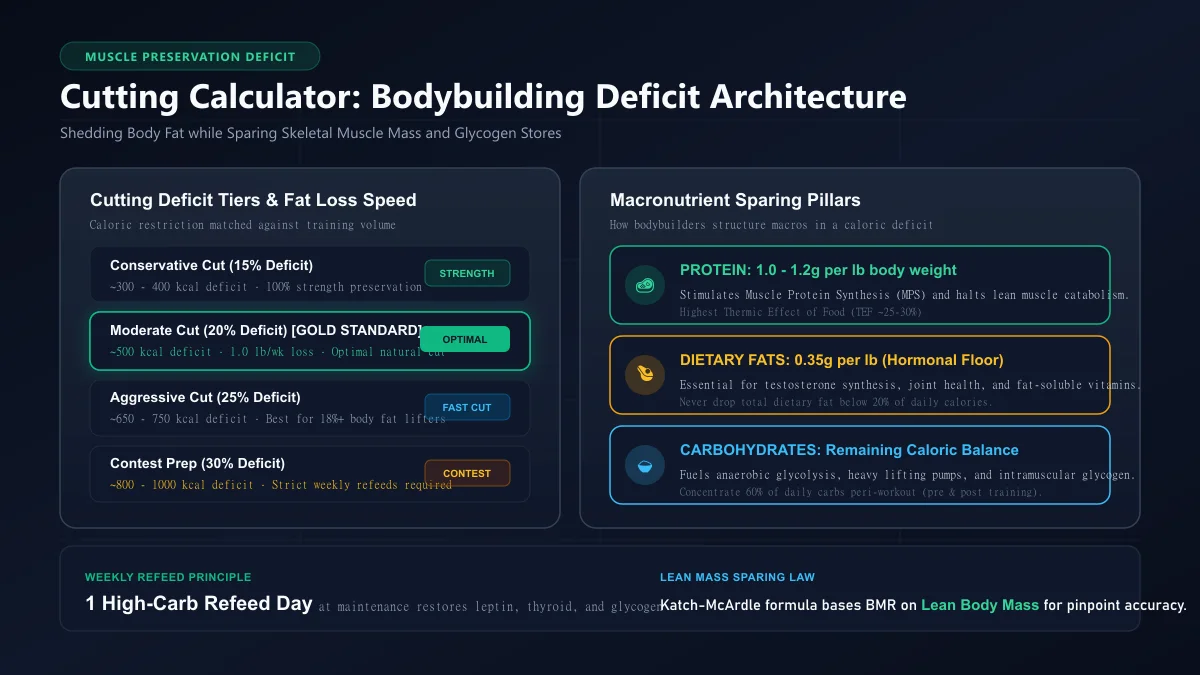
A successful cutting phase requires maintaining a 20% to 25% caloric deficit below your maintenance TDEE while setting dietary protein to 1.0 to 1.2 grams per pound of body weight. Dietary fats must stay at or above 0.35 grams per pound to shield testosterone synthesis, with remaining calories allocated to carbohydrates to preserve anaerobic resistance training intensity.
What is a Cutting Phase? How It Differs from Standard Weight Loss
In competitive bodybuilding and serious strength training, a cutting phase is not simply eating less to make the scale drop. Standard weight loss diets often result in indiscriminate tissue loss, with up to 30% or more of lost weight coming from metabolically active skeletal muscle tissue.
A true bodybuilding cut has a singular, uncompromising objective: maximize the oxidation of subcutaneous and visceral adipose fat while retaining 100% of lean skeletal muscle mass and gym lifting strength. To achieve this, your daily nutrition must be engineered with clinical precision, balancing energy restriction against muscular anti-catabolism.
The Katch-McArdle Equation: Why Lean Body Mass Dictates Cutting Calories
Standard metabolic calculators rely solely on total scale weight, height, age, and sex using the Mifflin-St Jeor formula. While reliable for the general population, this approach fails experienced lifters with substantial muscular development. Two individuals may both weigh 200 pounds, but an athletic lifter at 12% body fat carries 176 pounds of metabolically active muscle, while an untrained individual at 32% body fat carries only 136 pounds of muscle.
Our cutting calculator incorporates the gold standard Katch-McArdle formula, which calculates Basal Metabolic Rate (BMR) directly from Lean Body Mass (LBM):
BMR = 370 + (21.6 x Lean Body Mass in kg)
Where Lean Body Mass (kg) = Total Weight (kg) x (1 - (Body Fat % / 100))
By isolating your metabolically demanding lean tissue, our cutting calculator prevents underestimating your caloric requirements, ensuring you do not crash diet into muscle loss.
The Cutting Deficit Spectrum in Our Cutting Calculator
The optimal depth of your caloric deficit depends on your current body composition. As body fat drops, the body becomes exponentially more protective of remaining fat stores, increasing the risk of muscle cannibalization:
| Cutting Tier | Caloric Deficit | Weekly Fat Loss | Ideal Body Fat Range | Strength Retention |
|---|---|---|---|---|
| Conservative Cut | 15% (~300 - 400 kcal) | 0.5 - 0.75 lb/wk | Sub-12% (Men) / Sub-20% (Women) | Maximum (100%) |
| Moderate Cut (Gold Standard) | 20% (~500 kcal) | ~1.0 lb/wk | 12% - 18% (Men) / 20% - 26% (Women) | Very High (95%+) |
| Aggressive Cut | 25% (~650 - 750 kcal) | 1.5 lb/wk | 18%+ (Men) / 26%+ (Women) | Moderate to High |
| Contest Prep Protocol | 30% (~800 - 1000 kcal) | up to 2.0 lb/wk | Competitive bodybuilders only | Requires strict refeeds |
Macronutrient Distribution: The Three Pillars of an Anti-Catabolic Diet
In our cutting calculator, macronutrient composition determines what tissue your body preserves to bridge the energy gap:
1. Dietary Protein (1.0 to 1.2 g per lb of Body Weight)
Protein is your primary anabolic shield. When you restrict dietary energy, your liver accelerates gluconeogenesis, breaking down amino acids to sustain blood glucose. If dietary protein is insufficient, your body mobilizes contractile muscle proteins from biceps, quadriceps, and lats. Consuming 1.0 to 1.2 grams per pound ensures an abundant circulating pool of Essential Amino Acids (EAAs), maintaining nitrogen balance and maximally stimulating the mTOR pathway for muscle protein synthesis (MPS).
2. Essential Dietary Fats (0.30 to 0.35 g per lb of Body Weight)
Fats are not the enemy during a cut; they are essential for endocrine survival. Cholesterol is the biochemical precursor for testosterone, estrogen, and vitamin D synthesis. Dropping dietary fat below 0.30 grams per pound causes serum luteinizing hormone and free testosterone to drop significantly, leading to lethargy, joint pain, and loss of training drive.
3. Carbohydrates: The Anaerobic Workout Fuel
All remaining calories are allocated to carbohydrates. Heavy resistance training relies almost exclusively on the fast anaerobic glycolytic energy system. Low muscle glycogen impairs cross-bridge cycling in muscle fibers, reducing rep output, pump, and training volume. To maximize results, concentrate 60% of your daily carbohydrate allowance in your peri-workout window (90 minutes before and immediately after lifting).
The Science of Refeed Days: Preventing Leptin Crashes and Thyroid Slump
Prolonged caloric restriction triggers an evolutionary survival cascade known as adaptive thermogenesis:
- Leptin Suppression: Secreted by adipose cells, leptin signals metabolic adequacy to the hypothalamus. In a deficit, circulating leptin drops by 50% within weeks, triggering voracious hunger and cravings.
- Thyroid Down-Regulation: Active triiodothyronine (T3) levels decline, slowing basal cellular respiration to conserve energy.
- NEAT Depression: Spontaneous daily physical movement drops subconsciously, reducing 24-hour calorie expenditure by up to 300 to 500 calories per day.
A structured 24-hour high-carbohydrate refeed at maintenance calories temporarily reverses these adaptive mechanisms. Carbohydrates are the primary macronutrient that triggers pancreatic insulin secretion, which in turn signals the brain to elevate circulating leptin, refill depleted liver and intramuscular glycogen, and restore cellular metabolic signaling.
Once your cutting phase is complete, avoid the temptation to double your intake overnight. Use our detailed reverse dieting protocol to systematically increase calories 50 to 150 kcal per week back to maintenance without regaining body fat.
Frequently Asked Questions About Cutting
What is a cutting calculator and how does it differ from a standard calorie deficit calculator?
A cutting calculator is tailored specifically for resistance training lifters and bodybuilders. While a standard weight loss calculator only calculates generic calorie reduction, a cutting calculator uses Lean Body Mass (via the Katch-McArdle formula) to prescribe precise high-protein targets (1.0 to 1.2 g per lb), establishes an essential fat floor (0.35 g per lb) to protect testosterone, and provides structured high-carb refeed protocols to prevent muscle catabolism.
How much protein should I eat during a bodybuilding cut?
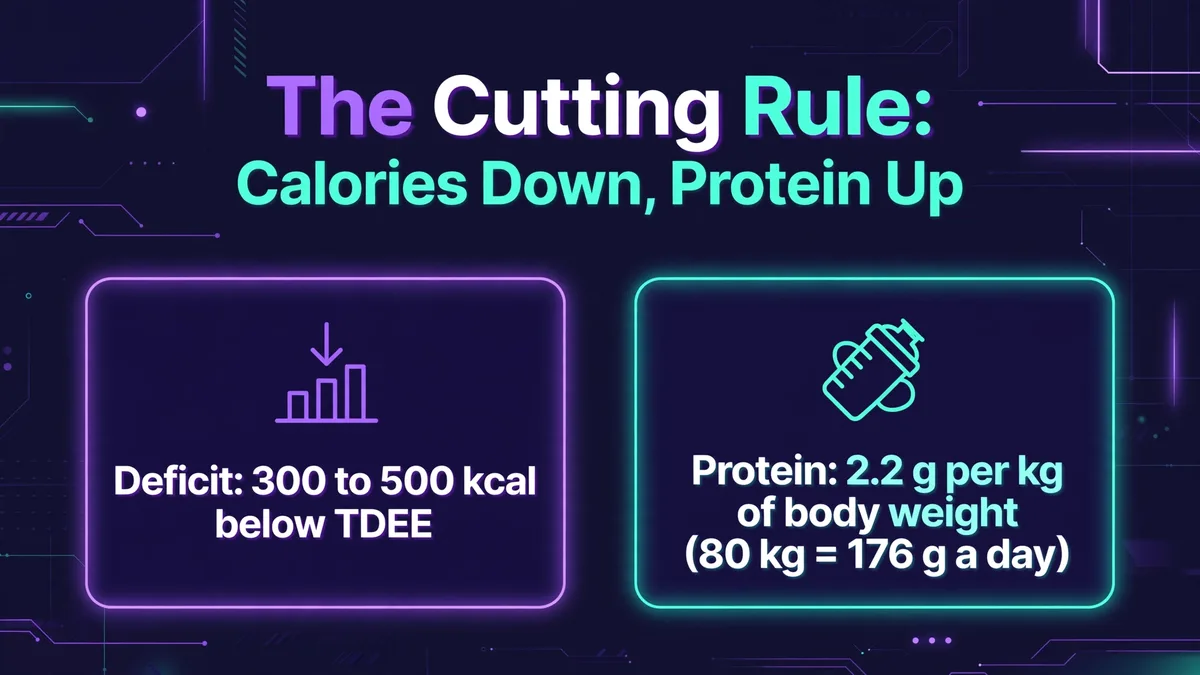
Scientific consensus recommends consuming 1.0 to 1.2 grams of protein per pound of total body weight (2.2 to 2.6 grams per kilogram) or 1.2 to 1.4 grams per pound of Lean Body Mass during an active cut. Higher protein intakes provide greater muscle-sparing nitrogen retention, maximize satiety, and elevate the Thermic Effect of Food (TEF).
What is the best calorie deficit percentage for a cut?
A 20% to 25% caloric deficit below your maintenance TDEE (roughly 500 calories per day) is the clinical gold standard for natural bodybuilders. This deficit produces approximately 1.0 pound of fat loss per week, allowing you to sustain heavy lifting volume, maintain gym strength, and prevent excessive metabolic adaptation.
Why are refeed days important during a prolonged cutting phase?
Continuous caloric restriction causes circulating leptin (the primary satiety and metabolic hormone) to plummet while elevating cortisol and down-regulating thyroid output. A structured 24-hour high-carb refeed day at maintenance calories temporarily replenishes depleted liver and muscle glycogen, restores training intensity, and provides an essential psychological break.
How low can my dietary fat intake go while cutting?
Dietary fat intake should never drop below 0.30 to 0.35 grams per pound of body weight (or 20% of total daily calories). Severe fat restriction impairs lipid-based steroid hormone synthesis, causing testosterone, luteinizing hormone, and thyroid hormone concentrations to decline while exacerbating joint inflammation.