Katch-McArdle Formula: Calculate BMR from Lean Body Mass
Calculate resting calories with the Katch-McArdle formula. Learn how lean body mass determines BMR, compare equations, and find your precise energy burn.
⚡ Quick Summary and Key Takeaways
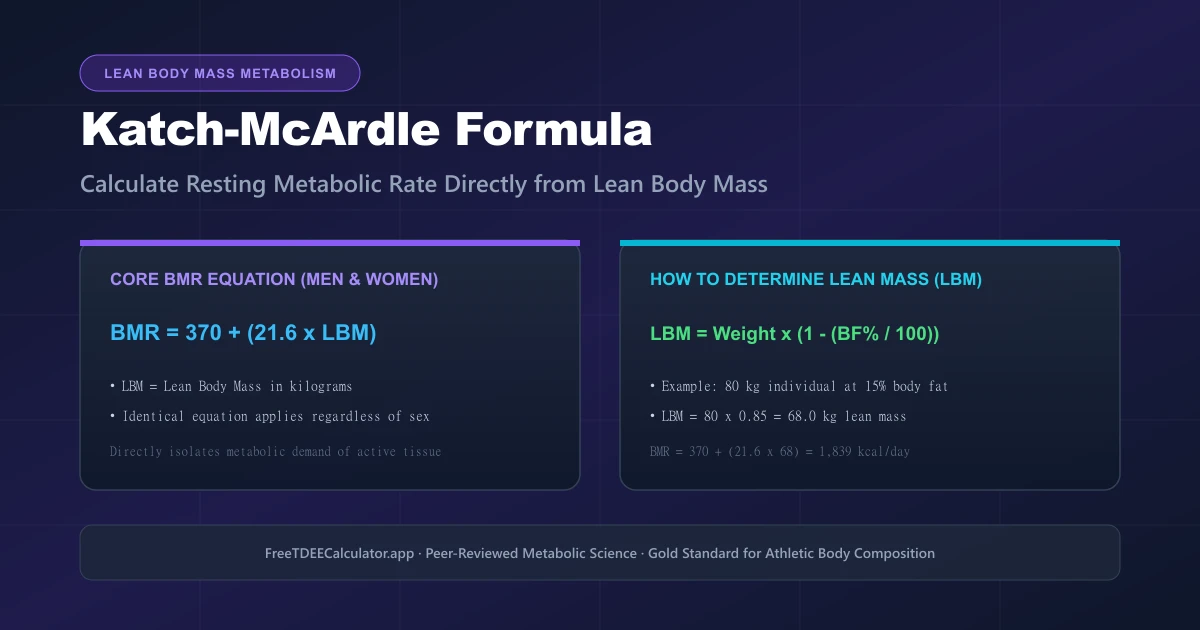
Calculate resting calories with the Katch-McArdle formula. Learn how lean body mass determines BMR, compare equations, and find your precise energy burn.
Calculate baseline metabolic expenditure with clinical precision using the Katch-McArdle formula. While conventional metabolic calculators rely exclusively on gross scale weight, height, age, and biological sex, this equation focuses on the single most metabolically active component of human physiology: your Lean Body Mass (LBM).
Whether you are preparing for a competitive bodybuilding cut, engineering an athletic calorie deficit, or establishing daily maintenance calories, understanding how the Katch-McArdle formula isolates active tissue provides an indispensable advantage over standard generalized formulas.
In this comprehensive guide, you will examine the physiological mechanics of lean tissue thermogenesis, walk through step-by-step mathematical calculations, review real-world reference tables, and discover exactly when to choose this formula over the Mifflin-St Jeor equation.
The Physiological Science Behind Lean Mass Thermogenesis
Most popular metabolic equations (including the 1990 Mifflin-St Jeor formula and the 1984 revised Harris-Benedict equation) treat every pound on your bathroom scale as biologically equivalent. If two individuals stand 5 feet 10 inches tall and weigh 200 pounds, those formulas predict identical caloric requirements.
However, human tissue is not metabolically uniform:
- Visceral Organs (Heart, Liver, Kidneys, Brain): Account for approximately 60% to 70% of resting energy expenditure while making up only 5% to 6% of total body mass.
- Skeletal Muscle Tissue: Consumes roughly 13 calories per kilogram (5.9 kcal/lb) per day purely at rest for cellular repair, glycogen synthesis, and intracellular ion regulation.
- Adipose Fat Tissue: Consumes only 4.5 calories per kilogram (2.0 kcal/lb) per day, serving primarily as passive energy storage.
When an athletic individual with 10% body fat weighs 200 pounds, they possess 180 pounds of metabolically demanding lean tissue. Conversely, a sedentary individual with 35% body fat at the same total weight possesses only 130 pounds of lean tissue. Athletes seeking reliable metrics frequently turn to the Katch-McArdle formula to establish an empirical metabolic baseline.
By bypassing gross scale mass and evaluating lean tissue directly, as validated in a peer-reviewed clinical study published in the National Library of Medicine examining body composition and energy balance, the Katch-McArdle formula avoids the systematic underestimation that athletes encounter with generic calculators.
How to Calculate BMR Using the Katch-McArdle Formula
The mathematical foundation developed by exercise physiologists Frank I. Katch and William D. McArdle utilizes a straightforward, gender-neutral formula. Applying the Katch-McArdle formula requires knowing your body composition rather than relying on generalized age and height estimates:
$$\text{BMR} = 370 + (21.6 \times \text{LBM in kg})$$
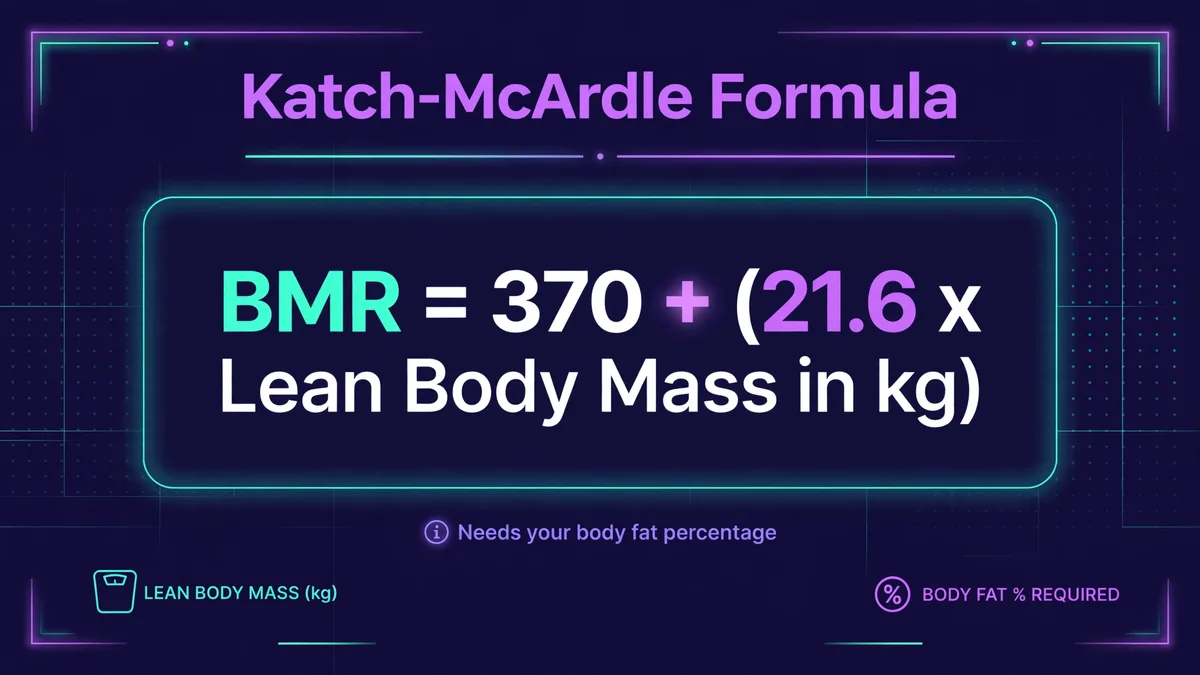
Because cellular respiration inside lean muscle, skeletal structure, and internal organs operates through identical biochemical pathways in both men and women, no separate gender adjustment is required.
Follow these four practical steps to calculate your exact resting energy expenditure:
1. Step One: Determine Total Body Weight and Body Fat Percentage
First, record your total body weight using a calibrated digital scale in the morning after waking and using the restroom. Next, determine your body fat percentage using a validated assessment tool such as a DEXA scan, hydrostatic weighing, or high-grade calipers.
2. Step Two: Compute Lean Body Mass in Kilograms
If your body weight is measured in pounds, convert it to kilograms by dividing by 2.20462. Then subtract your fat mass percentage to reveal your net lean mass:
$$\text{Weight in kg} = \frac{\text{Weight in lbs}}{2.20462}$$
$$\text{LBM (kg)} = \text{Weight in kg} \times \left(1 - \frac{\text{Body Fat } %}{100}\right)$$
3. Step Three: Apply the Lean Tissue Metabolic Coefficient
Multiply your Lean Body Mass in kilograms by the metabolic coefficient of 21.6, then add the clinical baseline constant of 370:
$$\text{BMR} = 370 + (21.6 \times \text{LBM})$$
4. Step Four: Convert Baseline Burn into Total Daily Energy Expenditure
Your Basal Metabolic Rate represents the energy expended during complete physiological rest across 24 hours. To find your complete daily maintenance expenditure, multiply your BMR by your Physical Activity Level (PAL) multiplier:
- Sedentary (Desk work, minimal exercise): $\text{BMR} \times 1.2$
- Lightly Active (Light exercise 1 to 3 days weekly): $\text{BMR} \times 1.375$
- Moderately Active (Moderate exercise 3 to 5 days weekly): $\text{BMR} \times 1.55$
- Very Active (Intense training 6 to 7 days weekly): $\text{BMR} \times 1.725$
- Extremely Active (Heavy daily labor or two-a-day training): $\text{BMR} \times 1.9$
Step-by-Step Calculation Walkthrough: Athlete Case Study
To observe the real-world utility of the Katch-McArdle formula, examine a practical calculation for an athletic individual:
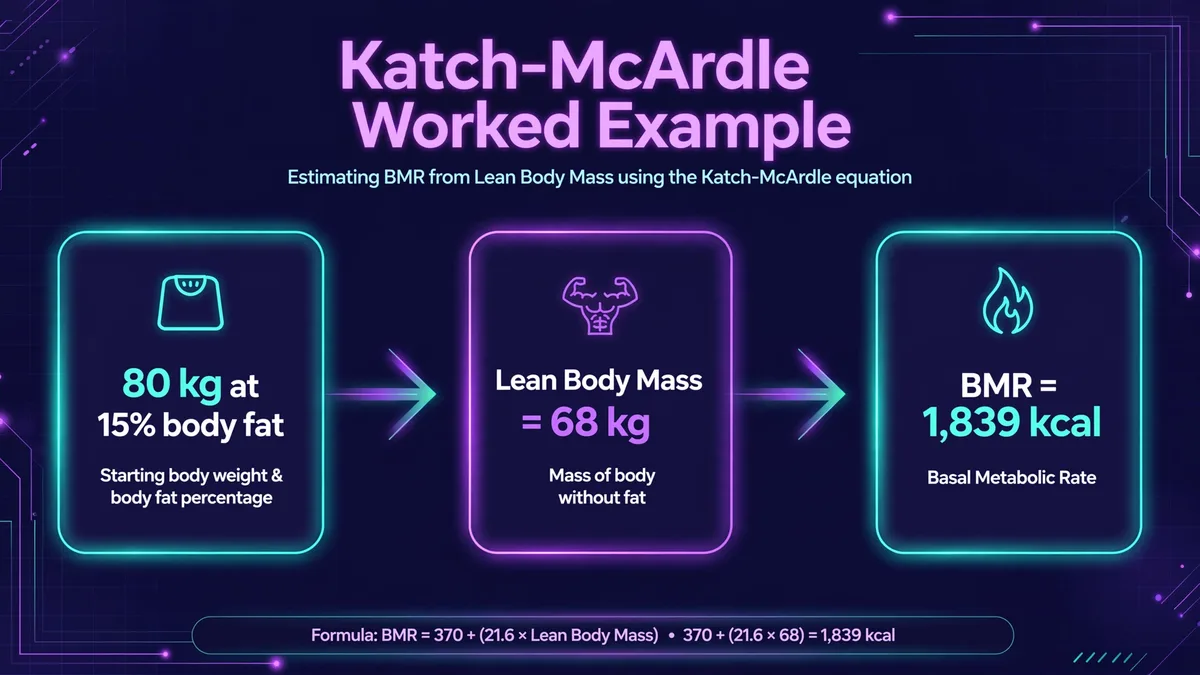
- Athlete Profile: Male powerlifter / bodybuilder
- Total Body Weight: 88.0 kg (194 lbs)
- Verified Body Fat Percentage: 12.0%
- Physical Activity: 5 intense weightlifting sessions weekly (Moderately Active, 1.55 multiplier)
Calculation Walkthrough:
- Calculate Lean Body Mass: $$\text{LBM} = 88.0 \times (1 - 0.12) = 88.0 \times 0.88 = 77.44\text{ kg}$$
- Calculate Resting BMR: $$\text{BMR} = 370 + (21.6 \times 77.44) = 370 + 1,672.7 = 2,043\text{ calories/day}$$
- Calculate Total Daily Energy Expenditure (TDEE): $$\text{TDEE} = 2,043 \times 1.55 = 3,167\text{ calories/day}$$
If this same athlete had used the standard Mifflin-St Jeor equation (assuming age 28 and height 180 cm), their calculated BMR would have yielded roughly 1,885 calories per day, a discrepancy of 158 resting calories. Over a 12-week contest preparation or diet phase, relying on the generic estimate would result in an excessive caloric deficit, elevating the risk of muscle proteolysis and performance decline. By computing energy requirements with the Katch-McArdle formula, athletic individuals avoid unintentional under-fueling.
Lean Body Mass vs BMR Output Across Common Body Compositions
The following reference table illustrates how changes in body composition alter resting metabolic output, holding total body weight constant at 80 kg (176.4 lbs):
| Total Weight (kg) | Body Fat % | Lean Mass (kg) | Resting BMR (kcal) | Moderate TDEE (1.55x) | Primary Metabolic Driver |
|---|---|---|---|---|---|
| 80.0 kg | 8.0% (Contest Lean) | 73.6 kg | 1,960 kcal | 3,038 kcal | High skeletal muscle mass |
| 80.0 kg | 12.0% (Athletic) | 70.4 kg | 1,891 kcal | 2,931 kcal | Elevated muscular tissue |
| 80.0 kg | 16.0% (Fitness Baseline) | 67.2 kg | 1,822 kcal | 2,824 kcal | Balanced body composition |
| 80.0 kg | 22.0% (Average Active) | 62.4 kg | 1,718 kcal | 2,663 kcal | Typical population baseline |
| 80.0 kg | 30.0% (Sedentary Fat) | 56.0 kg | 1,580 kcal | 2,449 kcal | Higher adiposity ratio |
As demonstrated above, an individual carrying 8% body fat expends 380 more calories per day at rest than an individual of identical total weight carrying 30% body fat. The variations highlighted across these profiles demonstrate why the Katch-McArdle formula provides unmatched fidelity for resistance-trained individuals.
Comparing Leading Clinical Metabolic Equations
Selecting the optimal metabolic formula depends entirely on your training background, body composition, and data availability. Compared to weight-only models, the Katch-McArdle formula shines when lean body mass accounts for a substantial proportion of overall body weight:
| Equation | Required Inputs | Best Suited For | Primary Strength | Known Limitation |
|---|---|---|---|---|
| Katch-McArdle | Weight, Body Fat % | Athletes, bodybuilders, lean individuals | Directly scales with lean muscle tissue | Requires accurate body fat data |
| Mifflin-St Jeor | Weight, Height, Age, Sex | General public, non-athletes | Highest statistical accuracy without DEXA | Underestimates muscular lifters |
| Revised Harris-Benedict | Weight, Height, Age, Sex | Clinical nutrition, historical baseline | Time-tested clinical track record | Tends to overestimate modern adults |
| Cunningham (1980) | Lean Body Mass (kg) | High-performance elite athletes | Higher resting organ constant (500 kcal) | Can overshoot recreational trainees |
1. Mifflin-St Jeor Equation
The Mifflin-St Jeor equation remains the gold standard when body fat percentage is unknown. It performs reliably across broad populations because it was validated on large modern cohorts. However, for lifters with notable muscular development, it treats all added weight as average tissue, leading to overly conservative calorie recommendations.
2. Revised Harris-Benedict Equation
The Harris-Benedict equation uses physical stature and age to infer metabolic rate. While clinically historically significant, it lacks direct sensitivity to body composition shifts that occur through dedicated resistance training.
3. Cunningham Equation
The Cunningham formula is another lean-mass model, structured as $\text{BMR} = 500 + (22 \times \text{LBM})$. It was formulated primarily from elite athletic populations undergoing intense daily training loads, making it slightly more aggressive than the standard Katch-McArdle model.
When Should You Use This Formula?
To achieve maximum accuracy in your nutritional programming, apply the following guidelines:
Coaches and sports dietitians frequently recommend the Katch-McArdle formula whenever DEXA or caliper testing yields verified body fat numbers.
Choose This Equation When:
- You have access to a reliable body fat assessment (DEXA scan, hydrostatic tank, or skilled skinfold measurement).
- You are a bodybuilder or physique athlete using our Cutting Calculator to preserve skeletal muscle tissue during aggressive deficits.
- You have undergone significant body recomposition (building muscle while shedding fat) and total scale weight has remained relatively static.
- Your body fat percentage is below 15% for men or below 23% for women.
Choose Mifflin-St Jeor When:
- You do not know your body fat percentage and would have to guess visually.
- You are calculating baseline calories using our standard BMR Calculator or general TDEE Calculator.
- You have higher body fat levels, where subjective errors in body fat estimation could distort target calorie ceilings.
How to Pair Lean Mass Calculations with Daily Nutrition
Using the Katch-McArdle formula as your nutritional anchor ensures that daily deficits are calibrated specifically to your functional lean tissue. Apply your calculated numbers systematically:
- Setting a Fat Loss Calorie Target: For sustainable fat loss, establish a 15% to 25% caloric deficit from your calculated TDEE using our Calorie Deficit Calculator. Staying above your calculated resting BMR helps safeguard thyroid output and resting energy balance.
- Configuring Dietary Protein: Because your metabolic output is anchored to lean tissue, configure protein intake relative to your lean mass. Sports nutrition consensus recommends consuming 1.6 to 2.2 grams of protein per kilogram of total weight (or roughly 2.2 to 2.6 g/kg of lean mass) during dieting phases to defend skeletal muscle.
- Recalculating Milestones: Recalculate your baseline metrics every 8 to 12 weeks or whenever you document a 3% to 5% shift in body composition.
Frequently Asked Questions About Lean Mass Calculations
What is the core equation for resting metabolism?
The formula calculates Basal Metabolic Rate using the mathematical relationship: BMR = 370 + (21.6 x Lean Body Mass in kilograms). Because it evaluates active lean mass rather than total scale weight, it applies identically to both men and women.
Why does lean body mass determine caloric expenditure?
Skeletal muscle, visceral organs, and brain tissue consume significant adenosine triphosphate (ATP) continuously for cellular maintenance, protein turnover, and ion pumping. Fat adipose tissue is comparatively inert metabolically, burning roughly 4.5 calories per kilogram per day compared to roughly 13 calories per kilogram for resting muscle.
Which equation is more accurate for athletes: Mifflin or lean mass formulas?
For muscular athletes and individuals with low body fat (below 12 percent for men or below 20 percent for women), lean mass equations provide superior accuracy. Mifflin-St Jeor relies on statistical population averages that underestimate caloric expenditure in individuals carrying substantial lean muscle.
How do you measure body fat percentage for this equation?
Accurate methods include Dual-Energy X-ray Absorptiometry (DEXA), hydrostatic underwater weighing, multi-frequency bioelectrical impedance analysis (BIA), and calibrated skinfold caliper measurements using 3-site or 7-site Jackson-Pollock protocols.
Does biological sex change the calculation?
No. Unlike the Mifflin-St Jeor or Harris-Benedict formulas that include separate male and female constants, this equation uses a single gender-neutral coefficient because skeletal muscle and internal organs demand identical metabolic energy regardless of biological sex.
Can you use this method if you have obesity?
Yes, provided you have an accurate measurement of your body fat percentage. However, if your body fat percentage is estimated subjectively, Mifflin-St Jeor is generally safer for individuals with higher body fat to prevent overestimating daily caloric expenditure.
Concluding Thoughts on Metabolic Accuracy
Mastering energy balance requires choosing mathematical tools that align with your unique physiological reality. For dedicated lifters, athletes, and fitness enthusiasts carrying above-average muscularity, the Katch-McArdle formula offers unparalleled accuracy by grounding daily energy expenditure in active lean tissue. Use your calculated resting baseline to configure customized nutrition, avoid unnecessary muscle loss, and achieve your physical potential with confidence.
This calculator is for informational and educational purposes only and does not constitute medical, nutritional, or health advice. Information presented in this guide is for educational purposes only and should not replace personalized evaluation from a physician or registered dietitian. Always consult your doctor before making substantial changes to your diet or exercise regimen. Read full disclaimer
Calculate Your Accurate Daily Calorie Burn
Stop guessing your metabolic numbers. Use our free, peer-reviewed multi-formula calculator to discover your exact TDEE, BMR, and macronutrient targets in 30 seconds.
🔥 Calculate My TDEE Now →Free Companion Health Calculators
Frequently Asked Questions
What is the core equation for resting metabolism?
The formula calculates Basal Metabolic Rate using the mathematical relationship: BMR = 370 + (21.6 x Lean Body Mass in kilograms). Because it evaluates active lean mass rather than total scale weight, it applies identically to both men and women.
Why does lean body mass determine caloric expenditure?
Skeletal muscle, visceral organs, and brain tissue consume significant adenosine triphosphate (ATP) continuously for cellular maintenance, protein turnover, and ion pumping. Fat adipose tissue is comparatively inert metabolically, burning roughly 4.5 calories per kilogram per day compared to roughly 13 calories per kilogram for resting muscle.
Which equation is more accurate for athletes: Mifflin or lean mass formulas?
For muscular athletes and individuals with low body fat (below 12 percent for men or below 20 percent for women), lean mass equations provide superior accuracy. Mifflin-St Jeor relies on statistical population averages that underestimate caloric expenditure in individuals carrying substantial lean muscle.
How do you measure body fat percentage for this equation?
Accurate methods include Dual-Energy X-ray Absorptiometry (DEXA), hydrostatic underwater weighing, multi-frequency bioelectrical impedance analysis (BIA), and calibrated skinfold caliper measurements using 3-site or 7-site Jackson-Pollock protocols.
Does biological sex change the calculation?
No. Unlike the Mifflin-St Jeor or Harris-Benedict formulas that include separate male and female constants, this equation uses a single gender-neutral coefficient because skeletal muscle and internal organs demand identical metabolic energy regardless of biological sex.
Can you use this method if you have obesity?
Yes, provided you have an accurate measurement of your body fat percentage. However, if your body fat percentage is estimated subjectively, Mifflin-St Jeor is generally safer for individuals with higher body fat to prevent overestimating daily caloric expenditure.