Harris-Benedict Equation: BMR Formula & Accuracy Guide
Calculate resting calorie burn using the Harris-Benedict equation. Explore the 1984 revised clinical formula, step-by-step examples, and accuracy trials.
⚡ Quick Summary and Key Takeaways
Calculate resting calorie burn using the Harris-Benedict equation. Explore the 1984 revised clinical formula, step-by-step examples, and accuracy trials.
The Harris-Benedict equation is historically the most influential metabolic formula in nutritional medicine. First introduced in 1919 by American biometrician J. Arthur Harris and physiologist Francis G. Benedict, this mathematical model established the foundation for calculating Basal Metabolic Rate (BMR), which represents the daily caloric burn your body expends purely to stay alive at rest.
Whether you configure daily calories for fat loss, sports conditioning, or weight maintenance, understanding how the Harris-Benedict equation estimates your resting energy baseline provides vital context for managing long-term nutritional health.
Below, you will explore the full mathematical formulas for both biological sexes, discover the 1984 Roza-Shizgal clinical revision, follow practical calculation walkthroughs, and examine modern accuracy comparisons against competing clinical models.
The Clinical Science Behind the Harris-Benedict Equation
In the early twentieth century, evaluating a patient’s metabolic expenditure required complex laboratory direct calorimetry, where an individual sat inside an airtight chamber measuring heat radiation. Recognizing that clinicians needed a fast bedside tool, researchers evaluated healthy volunteers to uncover mathematical relationships between biometric variables and caloric expenditure.
Their investigations demonstrated that resting cellular respiration is predominantly driven by four physical characteristics:
- Body Mass (Weight): Heavier individuals possess more metabolically active tissue, requiring higher chemical energy for cellular maintenance.
- Body Surface Area (Height): Taller individuals possess a larger surface area, causing greater heat dissipation to the surrounding environment.
- Biological Age: Cellular turnover, mitochondrial respiration, and organ mass naturally decline with age, decreasing resting caloric requirements.
- Biological Sex: Males typically exhibit greater skeletal muscle volume and lower essential body fat percentages than females of identical weight, generating higher baseline thermogenesis.
The 1984 Revised Harris-Benedict Equation Formulas
While the original 1919 formulas served medicine for decades, twentieth-century epidemiological shifts revealed systematic overestimation. In 1984, researchers A. M. Roza and H. M. Shizgal re-evaluated the original data alongside modern indirect calorimetry, publishing their findings in a clinical re-evaluation indexed in the National Library of Medicine that modern calculators use today.
1. Metric Formula (Kilograms and Centimeters)
For Men:
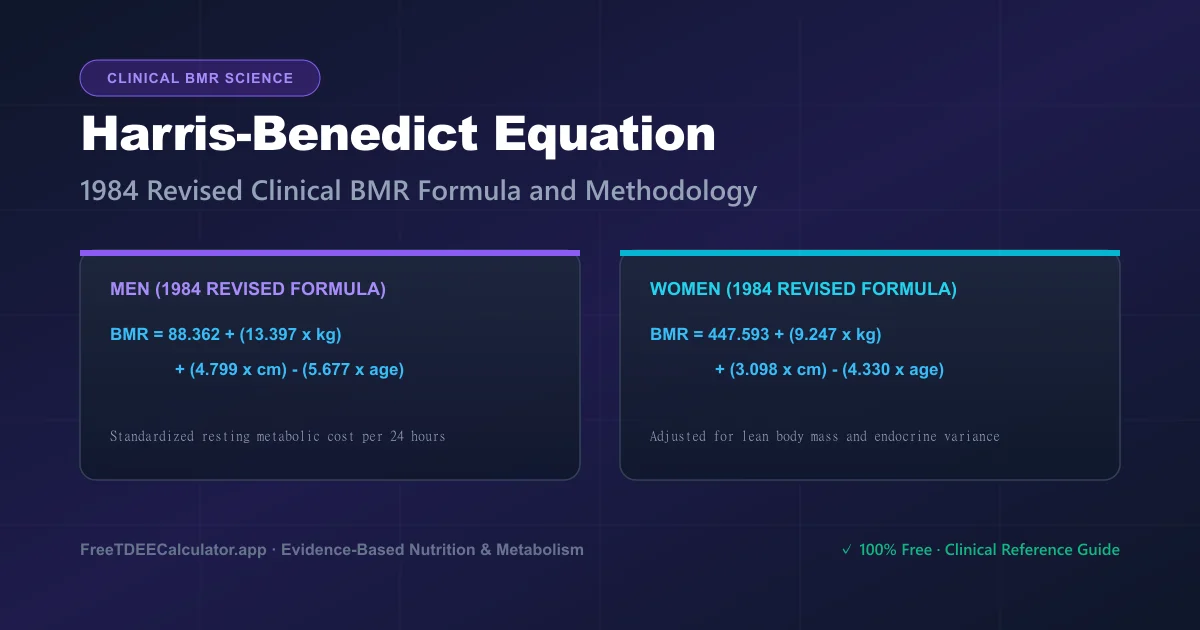
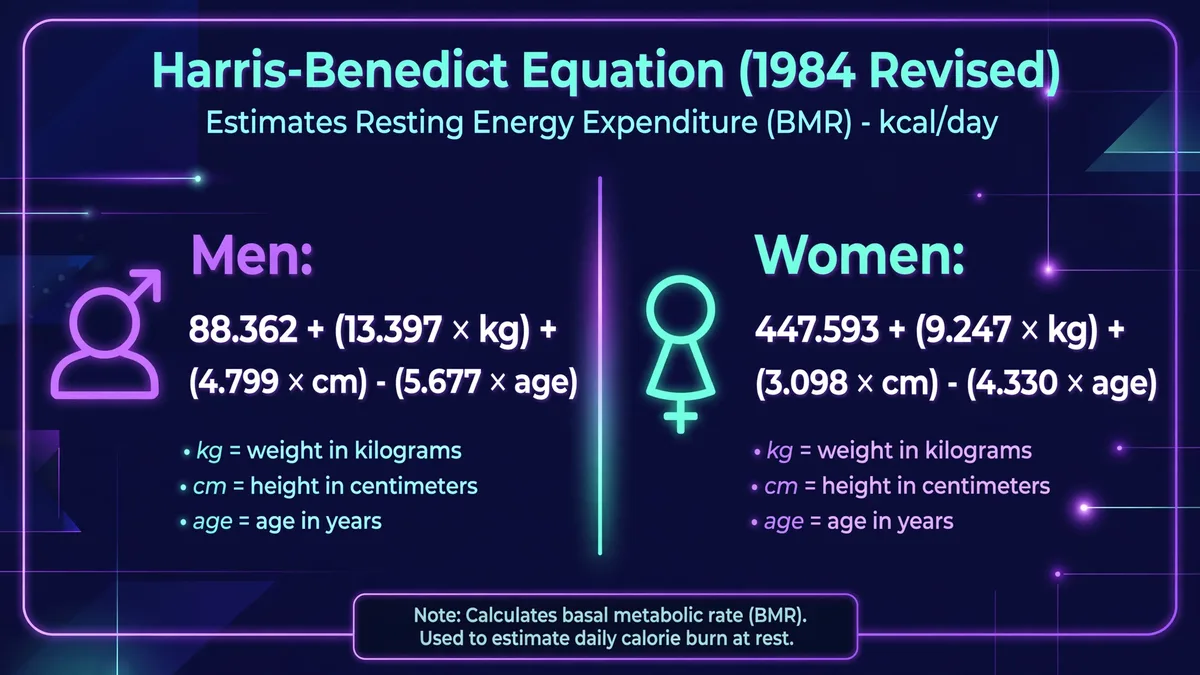
BMR (kcal/day) = 88.362 + (13.397 x weight in kg) + (4.799 x height in cm) - (5.677 x age in years)

For Women:
BMR (kcal/day) = 447.593 + (9.247 x weight in kg) + (3.098 x height in cm) - (4.330 x age in years)
2. Imperial Formula (Pounds and Inches)
For those tracking in pounds and inches, the converted mathematical constants are:
For Men:
BMR (kcal/day) = 88.362 + (6.077 x weight in lbs) + (12.189 x height in inches) - (5.677 x age in years)

For Women:
BMR (kcal/day) = 447.593 + (4.194 x weight in lbs) + (7.869 x height in inches) - (4.330 x age in years)
Step-by-Step Practical Calculation Example
To understand how the formula works in real life, let us walk through a complete step-by-step example for a 35-year-old male:
- Sex: Male
- Age: 35 years
- Weight: 80 kg (176 lbs)
- Height: 180 cm (5 feet 11 inches)
Step 1: Compute Individual Mathematical Components
- Base Constant:
88.362 - Weight Component:
13.397 x 80 = 1071.76 - Height Component:
4.799 x 180 = 863.82 - Age Component:
5.677 x 35 = 198.695
Step 2: Sum the Positive Elements and Subtract Age
BMR = 88.362 + 1071.76 + 863.82 - 198.695
BMR = 2023.942 - 198.695
BMR = 1,825.25 kcal/day
In this clinical scenario, the individual burns approximately 1,825 resting calories each day before factoring in occupational walking, exercise, or digestion.
Converting Resting BMR into Total Daily Energy Expenditure (TDEE)
Basal metabolic rate accounts for 60% to 75% of your total daily burn. To determine actual daily maintenance calories, your calculated BMR must be scaled by a Physical Activity Level (PAL) factor originally established by the World Health Organization:
| Physical Activity Tier | Multiplier | Daily Step Volume | Weekly Exercise Profile |
|---|---|---|---|
| Sedentary | BMR x 1.200 | Under 5,000 steps | Desk occupation with zero planned workouts |
| Lightly Active | BMR x 1.375 | 5,000 to 7,999 steps | Desk occupation with 1 to 3 light exercise sessions |
| Moderately Active | BMR x 1.550 | 8,000 to 11,999 steps | Active lifestyle or 3 to 5 moderate workouts |
| Very Active | BMR x 1.725 | 12,000 to 15,000 steps | Heavy manual labor or 6 to 7 intense workouts |
| Extremely Active | BMR x 1.900 | 15,000+ steps | Competitive athlete with twice-daily training |
Using our 35-year-old example with a BMR of 1,825 calories:
- Sedentary TDEE:
1,825 x 1.200 = 2,190 kcal/day - Moderately Active TDEE:
1,825 x 1.550 = 2,829 kcal/day
You can verify your personal numbers instantly using our interactive TDEE Calculator or check resting rates on our BMR Calculator.
Historical Comparison: 1919 Original vs. 1984 Revision
Why was the original 1919 calculation revised? Over decades of clinical usage, dietitians observed that patients calculated with the original formula were frequently assigned caloric targets that were slightly too high, resulting in slower fat loss than anticipated.
| Factor | Original 1919 Equation | 1984 Roza-Shizgal Revision | Clinical Distinction |
|---|---|---|---|
| Base Constant (Men) | 66.473 | 88.362 | Recalibrated for modern body sizes |
| Weight Coefficient (Men) | 13.752 | 13.397 | Reduces overestimation in heavier adults |
| Base Constant (Women) | 655.096 | 447.593 | Significant overhaul for female metabolism |
| Weight Coefficient (Women) | 9.563 | 9.247 | Tighter fit with modern lean mass norms |
| Typical Error Margin | +5% to +15% high | +2% to +6% variance | Noticeable improvement in clinical accuracy |
Harris-Benedict vs. Mifflin-St Jeor: Which Formula is Superior?
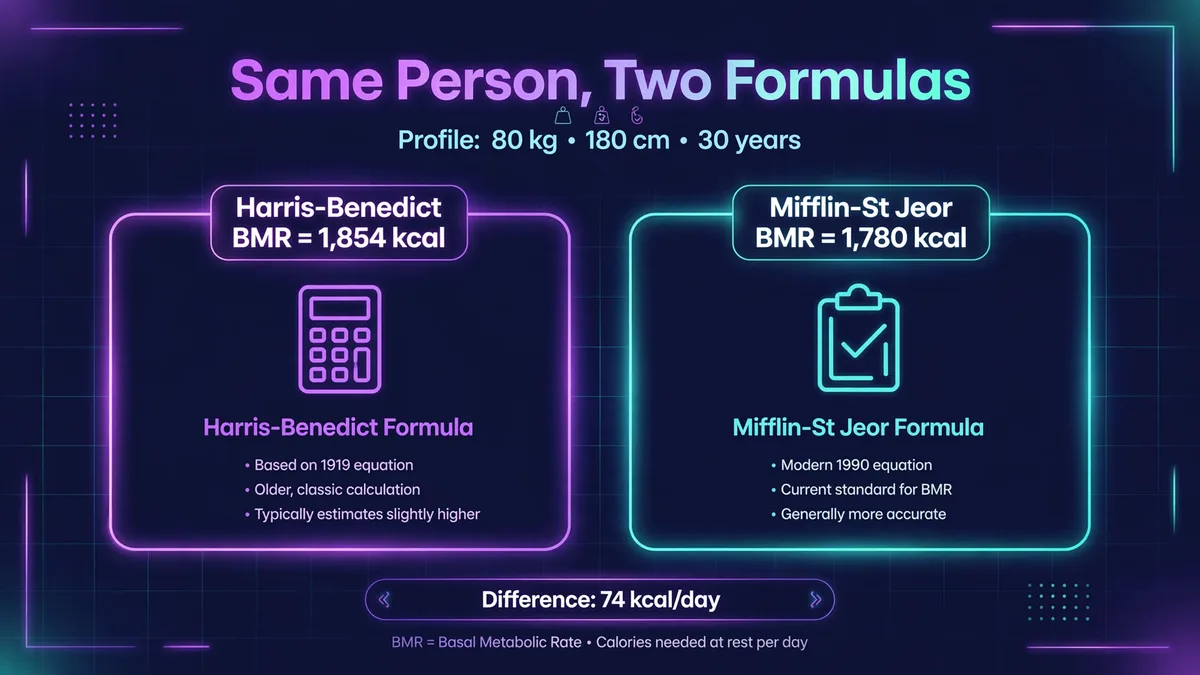
When modern researchers evaluate mathematical formulas against laboratory indirect calorimetry (metabolic carts), the Mifflin-St Jeor equation demonstrates higher statistical accuracy for modern populations:
- Mifflin-St Jeor: Predicts resting metabolic rate within 10% of measured values in 82% of healthy adults.
- Revised Harris-Benedict: Predicts resting metabolic rate within 10% of measured values in roughly 70% of adults, with a slight systematic tendency to overestimate daily energy requirements by 5%.
- Katch-McArdle: For athletic lifters with measured body composition, the Katch-McArdle formula provides specialized precision by isolating active lean tissue.
Because the average modern human carries slightly less physical muscle mass and spends more hours seated than individuals in the early twentieth century, the Mifflin-St Jeor formula serves as our primary calculation engine. However, the Harris-Benedict equation remains a celebrated, peer-reviewed clinical standard widely used across global medical institutions.
Summary and Practical Takeaways
Applying the Harris-Benedict equation offers valuable historical and clinical insight into human metabolic expenditure. While modern lifestyle patterns make newer formulas slightly tighter for sedentary populations, the 1984 revision remains a robust, reliable tool for establishing an initial resting metabolic baseline.
By calculating baseline energy burn with the Harris-Benedict equation, pairing it with an objective activity multiplier, and adjusting intake based on scale trends, you create an evidence-based roadmap for lasting nutritional success.
This calculator is for informational and educational purposes only and does not constitute medical, nutritional, or health advice. Information presented in this guide is for educational purposes only and should not replace personalized evaluation from a physician or registered dietitian. Always consult your doctor before making substantial changes to your diet or exercise regimen. Read full disclaimer
Calculate Your Accurate Daily Calorie Burn
Stop guessing your metabolic numbers. Use our free, peer-reviewed multi-formula calculator to discover your exact TDEE, BMR, and macronutrient targets in 30 seconds.
🔥 Calculate My TDEE Now →Free Companion Health Calculators
Frequently Asked Questions
What is the Harris-Benedict equation?
The Harris-Benedict equation is a classic clinical formula designed to estimate Basal Metabolic Rate (BMR), representing daily caloric burn at complete rest. Originally published in 1919 by J. Arthur Harris and Francis G. Benedict, it was comprehensively revised in 1984 by Roza and Shizgal to improve accuracy.
What is the difference between the 1919 and 1984 formulas?
The original 1919 formula evaluated a smaller sample and tended to overestimate energy expenditure by 5 to 15 percent. The 1984 Roza and Shizgal revision re-analyzed historical metabolic data alongside modern clinical calorimetry to produce significantly tighter coefficients.
Which equation is more accurate: Harris-Benedict or Mifflin-St Jeor?
Clinical trials by the Academy of Nutrition and Dietetics demonstrated that the Mifflin-St Jeor equation predicts resting energy expenditure within 10 percent of measured indirect calorimetry in roughly 82 percent of modern adults, compared to approximately 70 percent for the revised Harris-Benedict equation.
How do you convert Harris-Benedict BMR into TDEE?
Multiply your calculated BMR by an appropriate Physical Activity Level (PAL) coefficient, ranging from 1.2 for sedentary desk routines up to 1.9 for rigorous athletic training.
Does the Harris-Benedict formula account for body fat?
No. The formula relies strictly on total scale weight, height, age, and biological sex. For individuals with high muscularity and confirmed body fat levels below 12 percent, equations like Katch-McArdle that utilize lean body mass may provide superior precision.