⚡ Quick Summary: The Science of a Calorie Deficit
A calorie deficit, as calculated by our free calorie deficit calculator, occurs when you consume fewer calories than your body expends daily (your Total Daily Energy Expenditure, or TDEE). To compensate, your body oxidizes endogenous adipose tissue (stored fat) for biochemical fuel. A safe, sustainable deficit ranges between 300 and 500 calories per day (15% to 25% below TDEE), targeting 0.5 to 1.5 pounds of fat loss weekly while fully preserving lean skeletal muscle tissue.
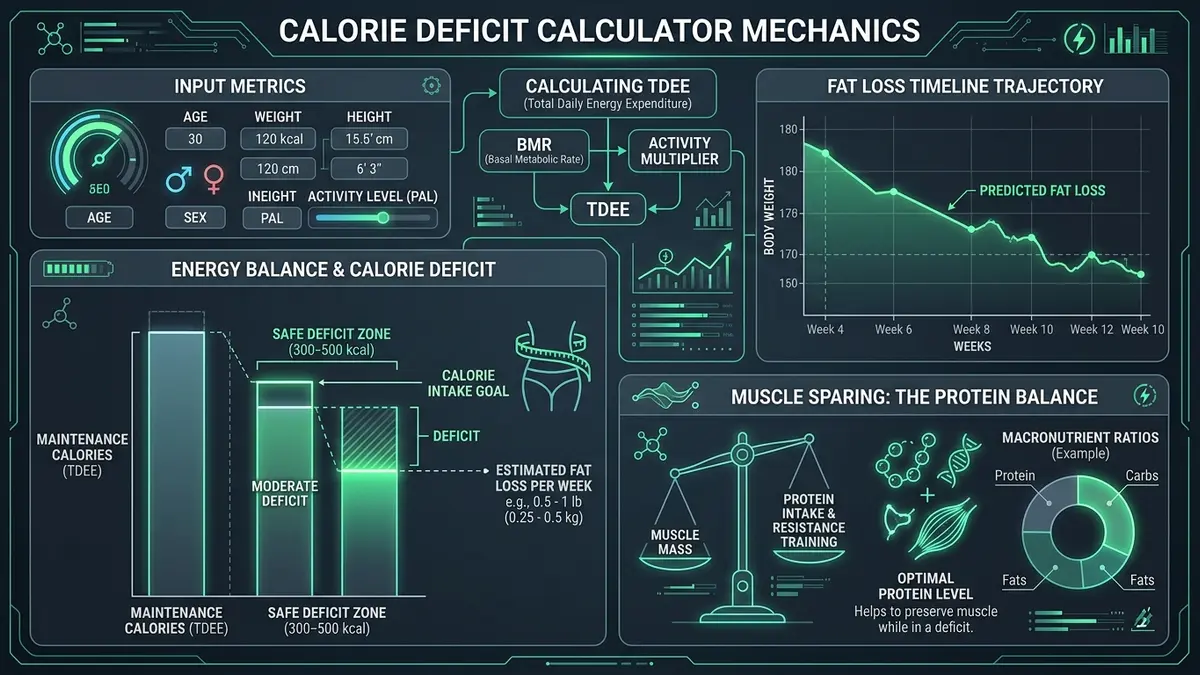
The Thermodynamics Behind the Calorie Deficit Calculator
Weight reduction in our calorie deficit calculator fundamentally obeys the first law of thermodynamics: energy cannot be created or destroyed, only transformed from one state to another. Your body requires a specific quantity of biochemical fuel every single day to sustain basal cellular processes, power muscular contractions, and digest food. This 24-hour total energy requirement is your Total Daily Energy Expenditure (TDEE).
When you consume exactly the number of calories you burn, your body exists in energy balance, and your body weight remains stable. When using a calorie deficit calculator to consume fewer calories than your TDEE, you establish a controlled negative energy balance. Because the human body cannot fabricate energy out of thin air, it is biochemically forced to mobilize stored endogenous substrates: predominantly triglycerides stored in subcutaneous and visceral adipose fat cells.
Body mobilizes stored adipose triglycerides for energy. Results in steady fat loss when accompanied by sufficient dietary protein.
Calories ingested match 24-hour expenditure. Body weight remains completely stable over multi-week tracking windows.
Surplus energy is stored as glycogen, lean muscle tissue (if lifting heavy), or adipose tissue for future survival needs.
The 3,500-Calorie Rule vs Dynamic Energy Balance
For over sixty years, literature relied on the static Wishnofsky rule, but a modern calorie deficit calculator incorporates dynamic metabolic adjustments. published in 1958 by Dr. Max Wishnofsky. The mathematical premise is straightforward:
- One pound of human adipose tissue contains approximately 87% pure lipid along with intracellular water and connective tissue proteins.
- One pound of body fat equates to roughly 3,500 kilocalories of stored potential energy.
- Under this static rule, maintaining a daily deficit of 500 calories (500 x 7 = 3,500 kcal per week) should theoretically yield exactly 1 pound of fat loss per week, indefinitely.
Static Model: Daily Deficit = 500 kcal × 7 Days = 3,500 kcal = 1.0 lb Adipose Mass Lost / Week
While useful as a starting heuristic, human metabolism adjusts dynamically. A 160-pound individual requires far fewer calories to move, breathe, and pump blood than a 200-pound individual.
Modern metabolic research conducted by Dr. Kevin Hall at the National Institutes of Health (NIH) demonstrates that human weight loss is not a linear mathematical function. Instead, weight loss is a dynamic metabolic model:
As you lose body weight, your body becomes lighter. A lighter body expends less kinetic energy during spontaneous ambulation. Furthermore, prolonged caloric restriction triggers subconscious reductions in Non-Exercise Activity Thermogenesis (NEAT) and downregulates thyroid hormone output (T3 conversion). Consequently, a static 500-calorie deficit that produced 1 pound per week in month one may produce 0.6 pounds per week by month four. Understanding this biological reality prevents unnecessary discouragement when weight loss naturally tapers.
Classifying Calorie Deficits: Finding Your Optimal Deficit Tier

Not all calorie deficits are created equal. Our calorie deficit calculator categorizes energy reductions into three clinical tiers based on body fat percentage, training experience, and timeline:
Reduces daily intake by 250 to 350 calories. Produces steady fat loss of 0.5 to 0.75 pounds per week.
- Zero impairment in heavy gym strength or athletic power
- Negligible hormonal disruption or sleep disturbances
- Requires high adherence across several consecutive months
Reduces daily calories by 400 to 600 calories below maintenance. The clinical gold standard for sustainable body recomposition.
- Predictable progress of 1.0 to 1.5 pounds of fat loss weekly
- Easily sustained for 8 to 16 consecutive weeks
- Maintains training volume when protein intake stays elevated
Cuts 750 to 1,000+ calories below maintenance. Strictly reserved for short intervals or clinical supervision.
- High risk of skeletal muscle catabolism and metabolic slowdown
- Disrupted sleep architecture, lethargy, and elevated cortisol
- High probability of rebound binge eating post-diet
Preserving Skeletal Muscle with a Calorie Deficit Calculator
When using our calorie deficit calculator, your biological objective is adipose tissue reduction, not indiscriminate weight reduction. Losing five pounds of skeletal muscle alongside five pounds of fat destroys your physique shape, lowers your Basal Metabolic Rate (BMR), and ruins athletic performance. To force your body to burn fat while sparing lean muscle, implement these three non-negotiable pillars:
Consume 1.6 to 2.4 grams of protein per kilogram of body weight (0.8 to 1.1 g/lb). Protein stimulates muscle protein synthesis, supplies essential branched-chain amino acids, and possesses the highest Thermic Effect of Food (TEF).
Do not switch to high-rep light-weight "toning" workouts. Your skeletal muscles need high mechanical tension in the 6 to 12 rep range to signal to your body that muscle tissue is metabolically essential for survival.
Clinical trials show dieters sleeping under 6 hours per night lose 55% less body fat and 60% more lean muscle mass compared to well-rested dieters consuming the exact same caloric deficit due to elevated cortisol and depressed growth hormone.
Refeed Days and Diet Breaks: Managing Leptin and Metabolic Fatigue
During prolonged weight loss phases, circulating leptin (the key hormone governing satiety and metabolic rate) drops precipitously, while ghrelin (the hunger hormone) skyrockets. To reverse these negative hormonal adaptations without stalling fat loss:
On designated refeed days, increase daily calories back to your maintenance TDEE. Direct virtually all extra calories toward complex carbohydrates while keeping fats low. This acutely replenishes intramuscular glycogen and provides a temporary boost to circulating leptin.
Popularized by the landmark MATADOR clinical study, pausing a deficit for two weeks at maintenance calories every two months prevents adaptive thermogenesis, reduces muscle loss, and significantly boosts long-term fat loss retention.
Troubleshooting Plateaus with Our Calorie Deficit Calculator
If your scale weight has not budged for three consecutive weeks on our calorie deficit calculator, evaluate these three primary biological and tracking factors:
Unmeasured cooking oils, salad dressings, sauces, spoonfuls of nut butters, and weekend alcohol intake can easily erase a 400-calorie daily deficit. Weigh every food item on a digital scale in grams for 7 consecutive days.
When calories drop, dieters subconsciously sit more, take elevators, and stop fidgeting. Use our TDEE Calculator with Steps to maintain an objective movement floor of 8,000 to 10,000 steps daily.
Dietary restriction and rigorous exercise elevate systemic cortisol, causing extracellular water retention. You may lose 2 pounds of pure adipose tissue while retaining 2 pounds of water until a sudden "whoosh" drop occurs.