⚡ Quick Summary: The Rules of Predictable Weight Loss
Healthy weight loss occurs at a rate of 0.5% to 1.0% of total body weight per week (typically 1.0 to 2.0 pounds or 0.45 to 0.9 kg). A daily deficit of 500 calories below maintenance TDEE yields approximately 1.0 pound of weekly fat loss. To prevent muscle wasting during a deficit, consume 0.8 to 1.0 grams of protein per pound of body weight and perform regular resistance training.
The Science of Predictable Weight Loss: How Energy Balance Dictates Progress
Sustainable fat loss is governed by the universal laws of thermodynamics. To decrease body weight, your body must experience a continuous negative energy balance, meaning you consume fewer dietary calories than your metabolism expends across each 24-hour window. This total daily expenditure is known as your Total Daily Energy Expenditure (TDEE).
When you maintain a consistent caloric deficit below your maintenance level, your physiology cannot generate energy out of thin air. Instead, your endocrine system releases stored hormonal signals (such as glucagon and epinephrine) that stimulate intracellular lipolysis in adipose tissue, breaking down stored triglycerides into free fatty acids and glycerol to power cellular functions.
Fat Loss = Total Daily Energy Expenditure (TDEE) - Total Caloric Intake
When intake is strictly lower than expenditure, the energy gap is supplied by the breakdown of stored endogenous adipose tissue.
Wishnofsky's 3,500-Calorie Rule vs. The Modern Dynamic Model
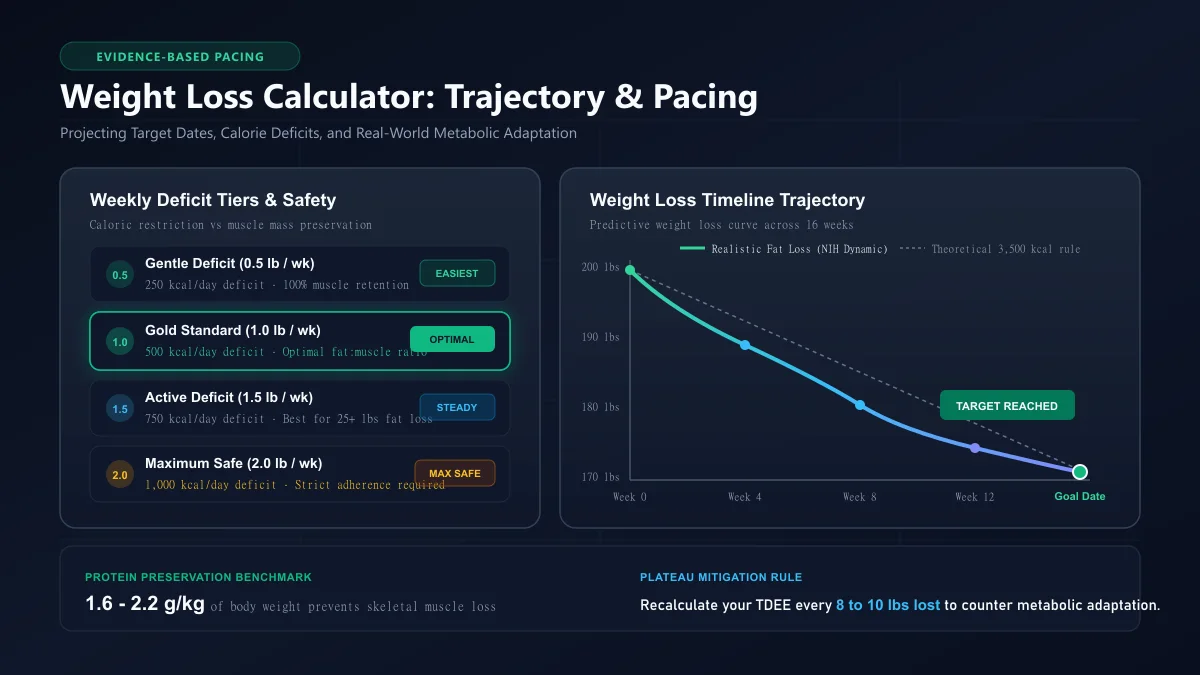
Before the advent of modern software like our weight loss calculator, nutritionists relied on the historical "3,500 Calorie Rule" established in 1958 by Dr. Max Wishnofsky. This linear model assumed that because one pound of human adipose tissue contains approximately 3,500 kilocalories of potential chemical energy:
- A daily calorie deficit of 500 kcal equates to 3,500 kcal per week, theoretically producing exactly 1.0 pound of weight loss every 7 days.
- A daily calorie deficit of 1,000 kcal equates to 7,000 kcal per week, theoretically producing 2.0 pounds of weight loss every 7 days.
While Wishnofsky's mathematical formula provides an outstanding initial baseline, real-world human biology is dynamic rather than linear. Groundbreaking mathematical research conducted by Dr. Kevin Hall at the National Institutes of Health (NIH) demonstrated that human metabolic expenditure constantly adjusts as weight decreases:
A lighter body requires fewer resting calories to sustain life, an adaptation accounted for dynamically in our weight loss calculator.
Moving a lighter body across space burns fewer kinetic calories during walking, climbing stairs, and exercise, a metric tracked in our weight loss calculator.
Prolonged dieting lowers thyroid hormone output and subconscious fidgeting (NEAT) by up to 200 to 300 calories daily.
Our weight loss calculator incorporates these clinical principles, enabling you to set realistic expectations and project milestones that reflect genuine human physiology.
Classifying Weight Loss Pacing: Finding Your Sweet Spot
Selecting the correct rate in our weight loss calculator is the single most important tactical decision determining whether fat loss is sustainable:
| Pacing Tier | Weekly Rate | Daily Deficit | Ideal Candidate & Strategy |
|---|---|---|---|
| Gentle Deficit | 0.5 lb (0.25 kg) | 250 kcal/day | Already lean lifters, strength competitors, or individuals with diet fatigue. Virtually 100% muscle retention. |
| Moderate Pace (Gold Standard) | 1.0 lb (0.45 kg) | 500 kcal/day | The clinical sweet spot for 90% of adults. Highly visible weekly progress with manageable hunger and workout energy. |
| Active Deficit | 1.5 lbs (0.68 kg) | 750 kcal/day | Suitable for individuals with 30+ lbs of fat to lose. Plentiful fat stores protect against lean tissue breakdown. |
| Maximum Safe Ceiling | 2.0 lbs (0.90 kg) | 1,000 kcal/day | Upper safe limit without medical oversight. Exceeding 2 lbs/week sharply increases muscle loss and gallstone risk. |
How the Target Date Feature in Our Weight Loss Calculator Works
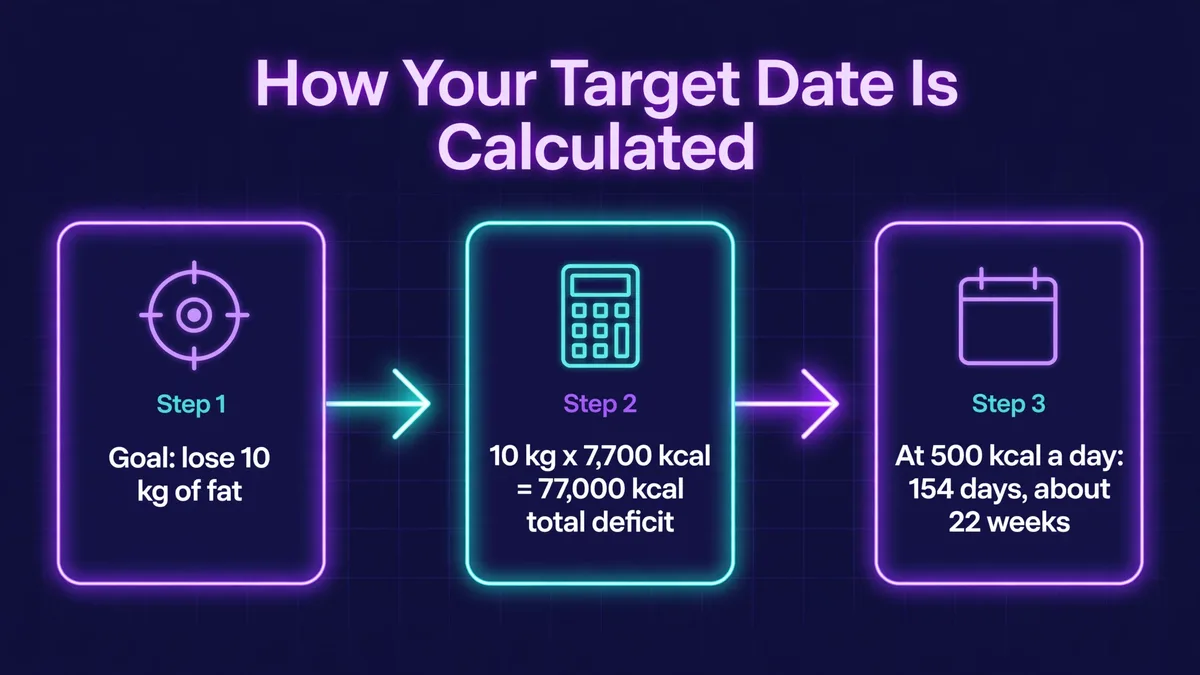
Many individuals approach fitness with a specific milestone on their calendar: an upcoming wedding, athletic competition, beach holiday, or medical checkup. By toggling to "Calculate by Target Date" on our tool, the calculator performs backward mathematical modeling:
- Timeline Calculation: Computes the exact number of days remaining until your specified event date.
- Cumulative Deficit Determination: Calculates the total energy gap needed to eliminate the difference between current and goal weight (3,500 kcal per pound).
- Daily Target Distribution: Divides cumulative calories across available days to set your exact daily caloric ceiling.
- Automated Safety Guardrails: If your selected date requires an aggressive deficit (< 1,200 kcal for women, < 1,500 kcal for men, or > 2.5 lbs/week loss), the calculator displays an active Safety Warning with recommended extensions.
Preserving Muscle Mass with Our Weight Loss Calculator
When you lose scale weight, your objective is adipose tissue reduction, not the loss of functional skeletal muscle mass. Losing muscle slows your resting metabolic rate, makes maintaining your new weight harder, and produces a soft physical appearance. To ensure that 85% to 95% of your weight loss comes strictly from fat:
Consume 0.8 to 1.0 grams of protein per pound of body weight (1.6 to 2.2 g/kg) daily. Protein maximizes muscle protein synthesis and carries the highest thermic cost of digestion (20% to 30%).
Lift weights 3 to 4 times weekly. Muscular tension signals to your body that skeletal muscle is biologically indispensable, directing it to oxidize adipose fat stores for energy.
Structured Diet Breaks in Our Weight Loss Calculator
If you have more than 20 pounds to lose, continuous caloric restriction can trigger adaptive metabolic resistance and diet fatigue. Clinical research from the groundbreaking MATADOR study (Minimising Adaptive Thermogenesis And Deactivating Obesity Rebound) demonstrated that individuals who implemented two-week diet breaks at maintenance calories lost significantly more fat and experienced substantially less metabolic slowdown than those who dieted continuously.
During a diet break, you temporarily increase your daily intake to your maintenance TDEE by adding complex carbohydrates. This temporary surplus restores circulating leptin levels, reduces cortisol, normalizes thyroid output, and provides a powerful psychological reset before resuming your weight loss schedule.