What is TDEE? Total Daily Energy Expenditure Explained
Understand what is TDEE and how your body expends daily energy. Learn how basal metabolism, activity, and digestion shape your metabolic burn rate.
⚡ Quick Summary and Key Takeaways
Understand what is TDEE and how your body expends daily energy. Learn how basal metabolism, activity, and digestion shape your metabolic burn rate.
If you want to know what is TDEE, Total Daily Energy Expenditure (TDEE) is the complete number of calories your body burns across a 24-hour period. Whether you are sleeping, working at a computer, digesting lunch, or completing a high-intensity workout, your body constantly converts chemical energy from food into mechanical work, cellular repair, and heat.
Understanding your TDEE is widely recognized by exercise physiologists, registered dietitians, and sports nutritionists as the single most foundational metric in human energy balance.
If you consume exactly as many calories as your TDEE, your body weight remains constant. This is referred to as maintenance calories. If you consume fewer calories than your TDEE, you force your body to metabolize stored tissue (primarily body fat) for fuel, resulting in weight loss. Conversely, consuming more than your TDEE leads to tissue accretion (muscle mass or fat storage).
What is TDEE Composed Of? The 4 Core Components
When asking what is TDEE, a common misconception is that workouts make up the bulk of daily calorie burn. In reality, structured exercise is often the smallest variable component of your daily energy budget.
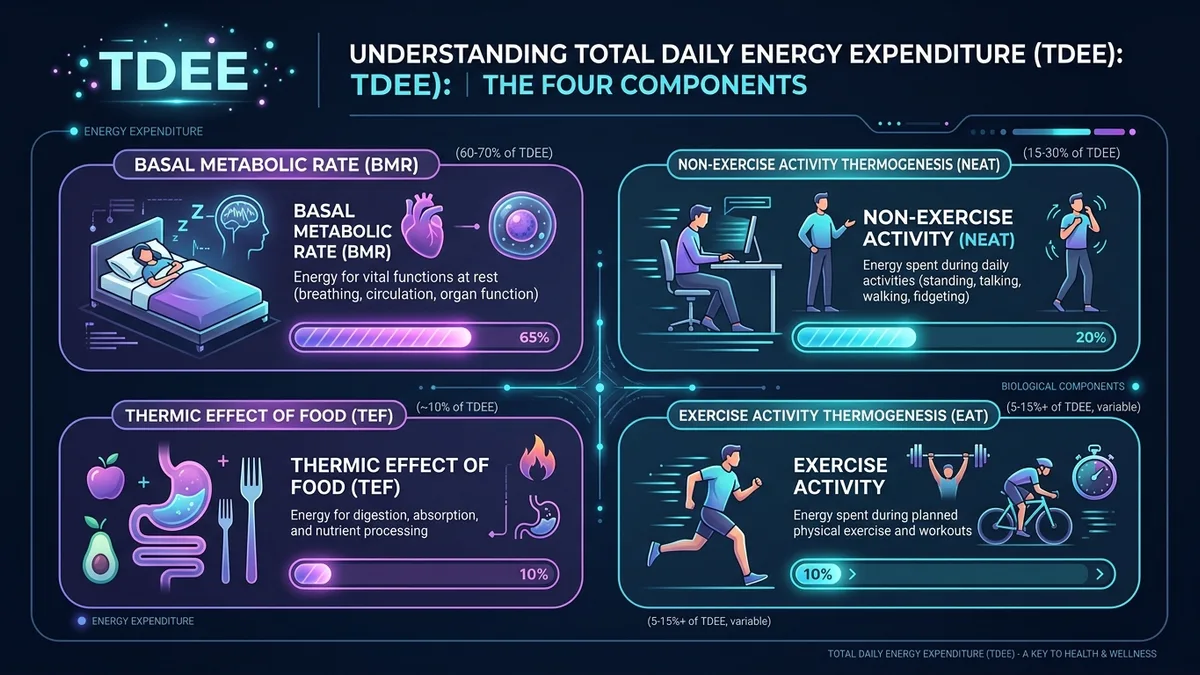
Answering what is TDEE reveals four distinct biological components:

TDEE = BMR + NEAT + TEF + EAT
| Component | Full Name | % of Daily Burn | Predictability | Primary Determinants |
|---|---|---|---|---|
| BMR | Basal Metabolic Rate | 60% to 70% | Highly Stable | Lean body mass, age, sex, height |
| NEAT | Non-Exercise Activity Thermogenesis | 15% to 20% | Highly Variable | Step count, occupation, fidgeting |
| TEF | Thermic Effect of Food | 8% to 10% | Moderate | Total calories, protein intake |
| EAT | Exercise Activity Thermogenesis | 5% to 10% | Voluntary | Workout intensity, duration, modality |
1. Basal Metabolic Rate (BMR): 60% to 70% in What is TDEE
Your Basal Metabolic Rate (BMR) represents the absolute baseline energy requirement necessary to sustain vegetative life while completely at rest in a thermo-neutral environment.
Even if you remained unconscious in bed for 24 hours without eating, your body would burn your BMR calories just keeping your vital organs operating:
- Liver: ~27% of BMR (gluconeogenesis, detoxification, protein synthesis)
- Brain: ~19% of BMR (neurotransmitter turnover, ion pumping)
- Skeletal Muscle: ~18% of BMR (cellular maintenance and tone)
- Kidneys: ~10% of BMR (blood filtration and electrolyte balance)
- Heart: ~7% of BMR (involuntary myocardial contractions)
- Other organs: ~19% of BMR
Because lean body mass (skeletal muscle, bone, and visceral organs) is metabolically active while adipose tissue (fat) is relatively dormant, individuals with higher lean mass possess significantly higher BMRs. You can calculate your specific baseline using our BMR Calculator.
2. Non-Exercise Activity Thermogenesis (NEAT): Key Pillar of What is TDEE
NEAT encompasses all daily physical activity that is not structured athletic exercise or sleeping. This includes:
- Walking to your car, pacing on phone calls, taking the stairs
- Typing on your keyboard, postural adjustments, fidgeting
- Yard work, cooking, cleaning, and carrying groceries
Research conducted by Dr. James Levine at the Mayo Clinic demonstrated that NEAT can vary by up to 2,000 calories per day between two people of identical height, weight, and muscle mass. A construction worker or warehouse employee naturally burns drastically more NEAT than a software engineer seated at a desk for 9 hours.
Tracking daily steps using a wearable is the most reliable way to quantify your NEAT. Learn how your step counts impact your total burn on our Steps-Based TDEE Calculator.
3. Thermic Effect of Food (TEF): Digestion Role in What is TDEE
The Thermic Effect of Food, also called Specific Dynamic Action (SDA), is the metabolic cost of digesting, absorbing, transporting, and storing nutrients from the meals you eat.
Different macronutrients require vastly different amounts of chemical energy to process:
- Protein: 20% to 30% of ingested calories burned during digestion
- Carbohydrates: 5% to 10% burned during digestion
- Dietary Fats: 0% to 3% burned during digestion
If you consume 500 calories of pure lean poultry breast, your body expends approximately 100 to 150 calories just unwinding peptide chains into amino acids. This is why high-protein nutrition programs confer a distinct metabolic advantage during fat loss phases. You can customize your macronutrient ratios with our Macro Calculator.
4. Exercise Activity Thermogenesis (EAT): 5% to 10%
Exercise Activity Thermogenesis accounts for intentional, structured physical training:
- Resistance training (weight lifting, calisthenics)
- Cardiovascular conditioning (running, cycling, rowing, swimming)
- High-intensity interval training (HIIT) and sports
For most recreational exercisers training 3 to 5 hours per week, EAT accounts for only 200 to 500 calories on training days, representing less than 10% of total weekly energy expenditure. Overestimating EAT is the single most common reason why gym-goers fail to lose weight when starting a new exercise routine.
How is TDEE Calculated Mathematically?
Because direct calorimetry (measuring heat dissipation inside an airtight chamber) and doubly labeled water analysis are costly laboratory procedures, scientists rely on predictive equations validated against thousands of human subjects.
The standard calculation proceeds in two sequential steps:
Step 1: Calculate Basal Metabolic Rate (BMR)
The two most widely peer-reviewed predictive equations are:
The Mifflin-St Jeor Equation (Gold Standard)
Formulated in 1990, the Mifflin-St Jeor equation is endorsed by the Academy of Nutrition and Dietetics as the most accurate formula for non-obese and obese adults without body fat measurements:
- For Men:
BMR = (10 x weight in kg) + (6.25 x height in cm) - (5 x age in years) + 5 - For Women:
BMR = (10 x weight in kg) + (6.25 x height in cm) - (5 x age in years) - 161
The Katch-McArdle Formula (For Lean Athletes)
If you have an accurate DEXA scan or hydrostatic weighing measurement of your body fat percentage:
BMR = 370 + (21.6 x Lean Body Mass in kg)
Step 2: Apply the Physical Activity Multiplier (PAL)
Your calculated BMR is subsequently scaled using a standardized Physical Activity Level (PAL) coefficient:
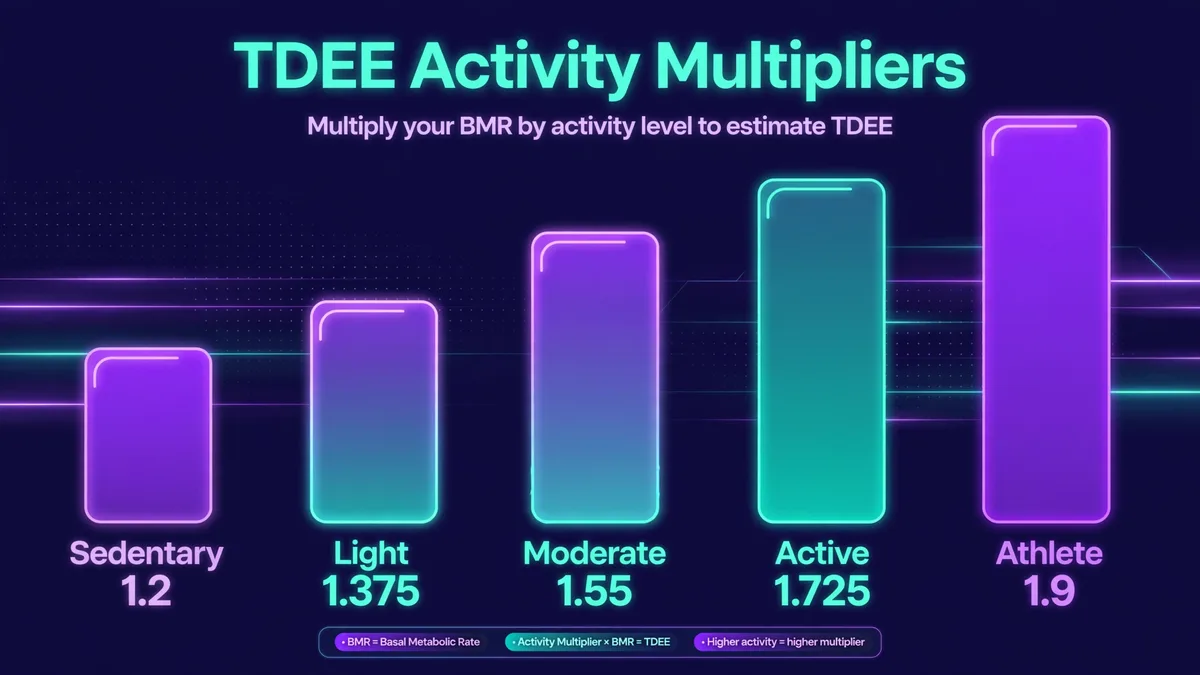
| Activity Level | Multiplier | Typical Weekly Routine |
|---|---|---|
| Sedentary | BMR x 1.2 | Desk job, little or no structured exercise, less than 5,000 steps/day |
| Lightly Active | BMR x 1.375 | Light exercise or sports 1 to 3 days/week, 6,000 to 8,000 steps/day |
| Moderately Active | BMR x 1.55 | Moderate exercise 3 to 5 days/week, 8,000 to 11,000 steps/day |
| Very Active | BMR x 1.725 | Hard exercise 6 to 7 days/week, active physical job |
| Extremely Active | BMR x 1.9 | Endurance athlete, two-a-day training, heavy manual labor |
To discover your exact multiplier with real-world case studies, consult our comprehensive Activity Level Guide.
How to Apply Your TDEE to Reach Your Fitness Goals
Once you establish your baseline TDEE number, you can program your daily nutrition with mathematical clarity:
1. For Fat Loss (Calorie Deficit)
To lose adipose tissue safely without sacrificing lean muscle mass, aim for a moderate 15% to 25% caloric deficit below your TDEE (typically 300 to 600 calories below maintenance).
- Example: If your TDEE is 2,400 kcal/day, an intake of 1,900 kcal/day produces approximately 1 pound (0.45 kg) of fat loss per week.
- Calculate your safe rate of loss with our Calorie Deficit Calculator.
2. For Weight Maintenance
Consuming 100% of your TDEE keeps glycogen stores full, optimizes hormonal output (thyroid hormones T3/T4, leptin, testosterone), and provides consistent daily energy for athletic performance.
3. For Lean Muscle Growth (Calorie Surplus)
Building new skeletal muscle tissue requires positive nitrogen balance and extra energy. Natural trainees should consume a conservative 5% to 10% surplus (200 to 300 calories above TDEE) combined with progressive resistance training to maximize muscle hypertrophy while minimizing fat accumulation.
The Next Step: Calculate Your Numbers in 30 Seconds
Stop wondering what is TDEE for your personal body. Mastering what is TDEE gives you total nutritional control. Use our real-time Free TDEE Calculator to get instant estimates across multiple scientific equations and take total control of your body composition.
This calculator is for informational and educational purposes only and does not constitute medical, nutritional, or health advice. Information presented in this guide is for educational purposes only and should not replace personalized evaluation from a physician or registered dietitian. Always consult your doctor before making substantial changes to your diet or exercise regimen. Read full disclaimer
Calculate Your Accurate Daily Calorie Burn
Stop guessing your metabolic numbers. Use our free, peer-reviewed multi-formula calculator to discover your exact TDEE, BMR, and macronutrient targets in 30 seconds.
🔥 Calculate My TDEE Now →Free Companion Health Calculators
Frequently Asked Questions
What does TDEE stand for?
TDEE stands for Total Daily Energy Expenditure. It is the total number of calories your body burns in a 24-hour window through basic metabolic survival, daily movement, food digestion, and exercise.
What are the four components of TDEE?
The four components of TDEE are Basal Metabolic Rate (BMR, ~60-70%), Non-Exercise Activity Thermogenesis (NEAT, ~15-20%), the Thermic Effect of Food (TEF, ~8-10%), and Exercise Activity Thermogenesis (EAT, ~5-10%).
How does knowing my TDEE help me lose or gain weight?
TDEE represents your caloric break-even point (maintenance). Eating fewer calories than your TDEE creates a caloric deficit causing fat loss, while eating more calories than your TDEE creates a caloric surplus supporting muscle growth or weight gain.