What is NEAT? Non-Exercise Activity Thermogenesis Guide
Discover what is NEAT and how non-exercise activity thermogenesis drives daily calorie burn. Learn clinical strategies to increase spontaneous movement.

⚡ Quick Summary and Key Takeaways
Discover what is NEAT and how non-exercise activity thermogenesis drives daily calorie burn. Learn clinical strategies to increase spontaneous movement.
Understanding what is NEAT unlocks the single largest variable component of human energy expenditure. Short for Non-Exercise Activity Thermogenesis, NEAT represents all the calories you burn throughout the day performing spontaneous physical tasks outside of sleeping, eating, and deliberate athletic workouts. From standing at your workstation and folding laundry to pacing during phone conversations, daily movement habits dictate metabolic variance far more than an isolated hour at the gym.
While most fitness enthusiasts obsess over cardio sessions and weight training, metabolic ward trials prove that spontaneous daily activity creates the largest calorie burn disparity between individuals of identical height and weight. Exploring what is NEAT provides the scientific framework needed to break fat loss plateaus, sustain leanness, and optimize your overall daily calorie expenditure.
Below, you will discover the clinical physiology of non-exercise activity, examine why caloric deficits trigger unconscious metabolic downregulation, and learn actionable methods to elevate your spontaneous energy burn.
The Four Components of Total Daily Energy Expenditure
To contextualize non-exercise thermogenesis, it helps to review the biological architecture of Total Daily Energy Expenditure:
- Basal Metabolic Rate (BMR): Represents 60% to 70% of total daily burn. BMR powers fundamental vegetative functions such as respiration, cardiac output, renal filtration, cellular protein synthesis, and body temperature regulation.
- Thermic Effect of Food (TEF): Represents 8% to 12% of daily burn. TEF reflects the metabolic cost of ingesting, digesting, absorbing, and assimilating dietary macronutrients.
- Exercise Activity Thermogenesis (EAT): Accounts for 5% to 10% of daily expenditure for average individuals. EAT includes structured sports, resistance training sessions, and intentional cardiovascular exercise.
- Non-Exercise Activity Thermogenesis (NEAT): Represents 15% to 50% of total expenditure. NEAT spans every posture shift, spontaneous muscular contraction, occupational task, and leisure movement performed throughout waking hours.
Because BMR remains relatively stable based on lean tissue mass and TEF scales proportionally with food intake, NEAT represents the single most flexible physiological lever for altering daily energy balance.
Clinical Physiology: How Science Discovered NEAT
The foundational concept of non-exercise thermogenesis was spearheaded by endocrinologist Dr. James A. Levine and colleagues at the Mayo Clinic Endocrine Research Unit. In landmark human overfeeding trials, researchers fed participants an identical daily caloric surplus of 1,000 calories above maintenance requirements for eight weeks.
Remarkably, fat accumulation differed by more than tenfold across subjects. Some volunteers gained nearly all excess calories as adipose tissue, whereas other participants gained almost no fat. When investigators measured 24-hour physical activity using high-precision triaxial accelerometers and inclinometers, they discovered that resistance to fat gain was directly correlated with spontaneous increases in non-exercise movement.
According to clinical research published by the National Institutes of Health, evaluating what is NEAT demonstrated that spontaneous physical movement accounted for the vast majority of observed variance in metabolic disposal during positive energy balance. The human body possesses intricate hypothalamic feedback loops that regulate posture and spontaneous muscular tone in response to nutritional energy intake.
How What is NEAT Explains Daily Caloric Variance Between Dieters
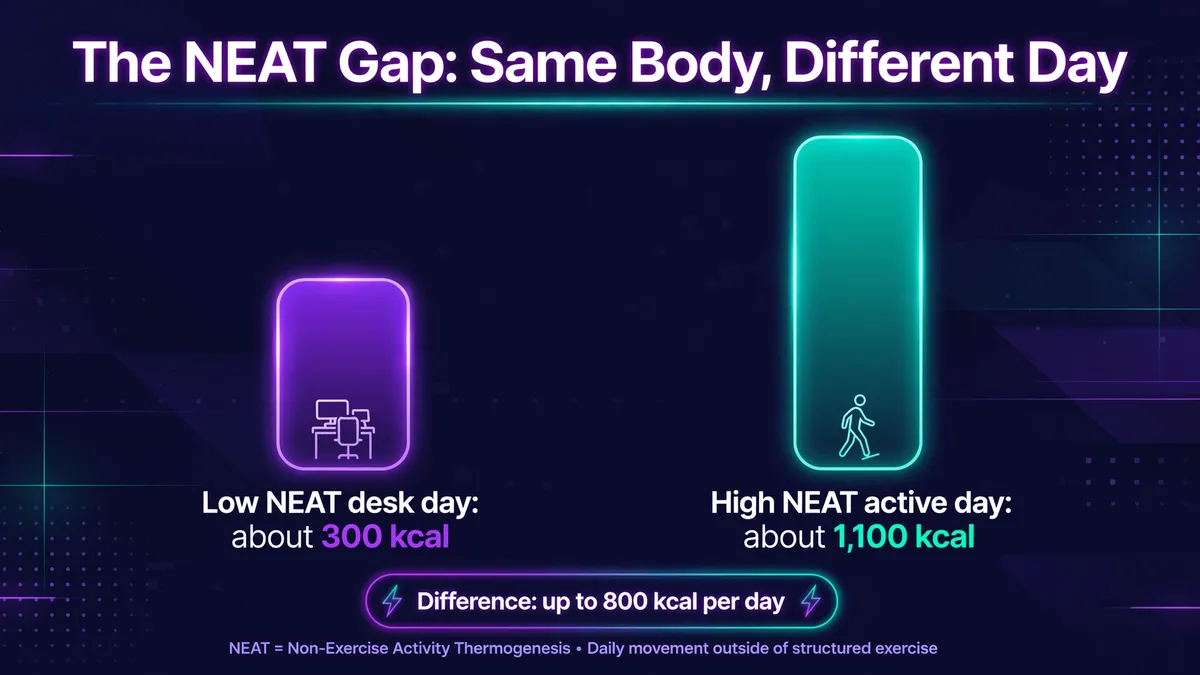
A common frustration among dieters is witnessing two people of equal body dimensions follow the exact same dietary target, yet one loses two pounds per week while the other stays stagnant. Clarifying how what is NEAT influences 24-hour expenditure resolves this mystery.
Consider two hypothetical 35-year-old adults, each weighing 75 kg with identical resting basal metabolic rates of approximately 1,650 calories:
| Metabolic Factor | Sedentary Desk Worker | Active Daily Mover | Caloric Difference |
|---|---|---|---|
| Basal Metabolic Rate (BMR) | 1,650 kcal | 1,650 kcal | 0 kcal |
| Thermic Effect of Food (TEF) | 200 kcal | 200 kcal | 0 kcal |
| Exercise Training (45 min) | 300 kcal | 300 kcal | 0 kcal |
| Daily Step Count | 3,200 steps | 12,500 steps | +9,300 steps |
| Non-Exercise Thermogenesis (NEAT) | 250 kcal | 900 kcal | +650 kcal |
| Total Daily Caloric Expenditure | 2,400 kcal | 3,050 kcal | +650 kcal per day |
Even though both individuals completed an identical 45-minute gym workout, the active daily mover burned an additional 650 calories per day purely through higher spontaneous physical activity. Over the course of a single month, that gap equals roughly 19,500 calories, or more than five pounds of fat tissue.
Why NEAT Plummets During Weight Loss Deficits
When you establish a caloric deficit to shed body fat, your brain perceives prolonged negative energy balance as an existential survival threat. To preserve remaining adipose reserves, the hypothalamus triggers adaptive thermogenesis, initiating an unconscious reduction in spontaneous physical activity.
Dieting individuals often experience this metabolic brake without consciously recognizing the change:
- Sitting down immediately instead of standing while talking on the phone.
- Leaning against walls or kitchen counters instead of standing upright.
- Ceasing spontaneous foot tapping, leg bouncing, and hand gestures.
- Choosing elevators and escalators over stairs automatically.
- Lounging on the couch for longer periods following evening meals.
This biological downregulation can quietly slash daily expenditure by 200 to 500 calories, completely erasing an intended deficit. This is precisely why establishing an objective movement floor with a steps-based calorie calculator is essential for preventing metabolic plateaus.
Practical Protocols to Elevate Your Daily NEAT
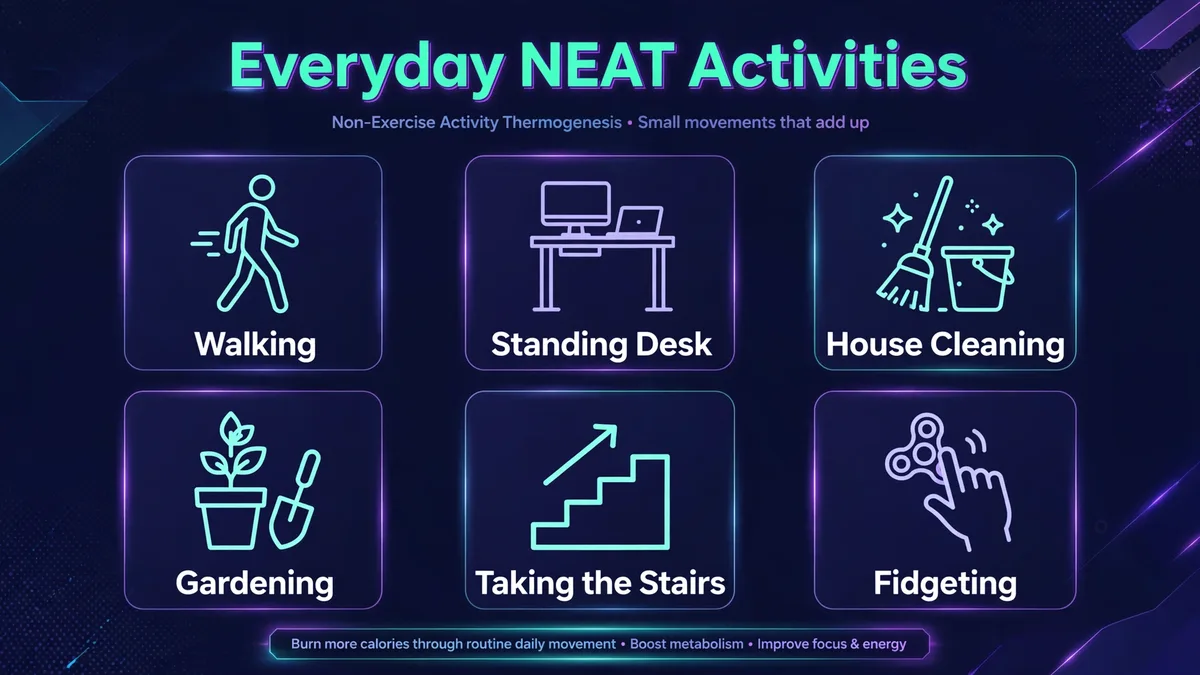
Boosting spontaneous energy expenditure does not require exhausting workouts or hours of grueling exercise. Instead, applying what is NEAT in daily life relies on weaving minor, sustainable movement patterns throughout your normal waking routine:
- Adopt a Non-Negotiable Step Floor: Use a smartwatch or pedometer to establish an absolute minimum daily baseline, such as 8,000 to 10,000 steps. If work keeps you seated, schedule ten-minute walking breaks every two hours.
- Utilize an Active Workstation: Alternating between sitting and standing burns an extra 30 to 50 calories per hour. Introducing an under-desk walking pad at an easy pace (1.5 to 2.0 mph) during video calls can effortlessly generate 4,000 steps.
- Pace During Audio Calls: Whenever speaking on the phone or listening to webinars, stand up and pace across your office or living room.
- Choose Active Transit Options: Park further away in commercial lots, exit transit one stop early, and always choose stairs over elevators when traversing three flights or fewer.
- Engage in Physical Leisure: Replace passive television watching with light active hobbies such as gardening, home organization, or evening neighborhood walks.
Summary and Practical Takeaways
Mastering what is NEAT provides dieters and athletes with an enormous physiological advantage. While deliberate exercise sessions build strength and cardiovascular fitness, non-exercise activity thermogenesis forms the dominant, flexible engine of your 24-hour caloric burn.
By monitoring daily step counts, designing an active home and work environment, and protecting against unconscious diet-induced fatigue, you retain full control over your metabolic balance. Consistently optimizing what is NEAT ensures your fat loss efforts remain sustainable, predictable, and resilient against metabolic adaptation.
This calculator is for informational and educational purposes only and does not constitute medical, nutritional, or health advice. Information presented in this guide is for educational purposes only and should not replace personalized evaluation from a physician or registered dietitian. Always consult your doctor before making substantial changes to your diet or exercise regimen. Read full disclaimer
Calculate Your Accurate Daily Calorie Burn
Stop guessing your metabolic numbers. Use our free, peer-reviewed multi-formula calculator to discover your exact TDEE, BMR, and macronutrient targets in 30 seconds.
🔥 Calculate My TDEE Now →Free Companion Health Calculators
Frequently Asked Questions
What is NEAT in human metabolism?
NEAT stands for Non-Exercise Activity Thermogenesis. It accounts for all energy expended through spontaneous movement, posture maintenance, occupational physical tasks, and fidgeting outside of sleeping, eating, and structured athletic workouts.
How many calories does NEAT burn per day?
NEAT varies dramatically between individuals, ranging from roughly 150 calories per day in highly sedentary desk workers up to 800 to 1,000 or more calories per day in active workers and frequent walkers.
Why does NEAT decrease when dieting?
During sustained caloric deficits, the brain instinctively downregulates spontaneous physical fidgeting and posture changes to conserve stored glycogen and fat tissue. This unconscious slowdown is a core driver of weight loss plateaus.
What is the best way to increase NEAT?
The most effective clinical strategy is establishing a consistent daily step count floor (such as 8,000 to 10,000 steps), utilizing standing or walking desks, taking regular movement breaks, and incorporating active transportation.
Is NEAT more important than structured exercise for fat loss?
For net daily caloric expenditure, yes. Structured exercise typically lasts 45 to 60 minutes and accounts for roughly 5 to 10 percent of daily burn, whereas NEAT spans the remaining 15 to 16 waking hours and can alter daily energy expenditure by several hundred calories.