TDEE Calculator for Women: Your Daily Calories, Adjusted for Your Body
Learn how a TDEE Calculator for Women works; female hormones, cycle phases, and safe deficits explained, then calculate your daily calories free.
⚡ Quick Answer: Female Total Daily Energy Expenditure
A woman's Total Daily Energy Expenditure (TDEE) averages 1,400 to 2,400 kcal daily, calculated via female Mifflin BMR multiplied by activity. Menstrual luteal phases raise burn slightly by 30 to 120 kcal. For safe fat loss, subtract 300 to 500 calories without dipping below 1,200. Calculate your baseline using our free TDEE calculator and resting BMR calculator.
Calculate daily energy requirements with a specialized TDEE Calculator for Women to establish calorie targets that honor female physiology, endocrine rhythms, and metabolic adaptations. While universal calorie calculators apply generalized multipliers across all adult populations, female biology presents distinct metabolic characteristics: higher essential fat requirements, lower baseline skeletal muscle mass per kilogram of scale weight, cyclical hormonal shifts across the menstrual cycle, and sensitive neuroendocrine triggers that regulate reproductive function.
Using a clinical TDEE Calculator for Women ensures that your nutritional roadmap avoids the pitfalls of extreme caloric restriction. Conventional commercial diets frequently push adult females toward arbitrary 1,200-calorie meal plans that suppress thyroid signaling, elevate cortisol, and disrupt regular menstrual cycles. By determining your true Total Daily Energy Expenditure through validated formulas, you can establish sustainable caloric deficits for fat loss, support athletic recovery, and maintain hormonal equilibrium.
How Is a Woman’s TDEE Different From a Man’s?
The physiological differences between male and female metabolism stem primarily from body composition, endocrine profiles, and reproductive biology. When calculating energy expenditure, metabolic scientists rely on predictive equations developed through indirect calorimetry in metabolic chambers.
The clinical benchmark formula utilized by medical practitioners is the Mifflin-St Jeor equation, developed by Mifflin and colleagues in the American Journal of Clinical Nutrition (1990). While the formula applies identical weight, height, and age scaling coefficients to both sexes, it incorporates a critical sex-specific offset constant at the end:
- Male BMR Equation: BMR = (10 x weight in kg) + (6.25 x height in cm) - (5 x age in years) + 5
- Female BMR Equation: BMR = (10 x weight in kg) + (6.25 x height in cm) - (5 x age in years) - 161
Notice the mathematical difference between the two terminal constants: men add 5, while women subtract 161. At identical height, body weight, and age, a woman’s calculated resting metabolic baseline is exactly 166 calories per day lower than a man’s.
Sex Offset Comparison:
Male Constant:   +5 kcal
Female Constant: -161 kcal
Biological Gap:  166 kcal/day at identical physical dimensions
This 166-calorie baseline gap exists because of three fundamental biological realities:
- Higher Essential Body Fat: Biological females require approximately 10% to 13% essential body fat to sustain reproductive health, steroid hormone synthesis, and cellular integrity. In contrast, essential fat for males sits between 2% and 5%. Adipose fat tissue is metabolically inert compared to skeletal muscle, expending only about 4.5 kcal per kilogram per day at rest.
- Lower Average Skeletal Muscle Mass: Testosterone levels in biological males run roughly ten to fifteen times higher than in females, driving greater baseline muscular hypertrophy. Skeletal muscle tissue burns approximately 13 kcal per kilogram per day at rest. Because the average female carries less total lean tissue mass, her aggregate 24-hour resting burn is lower.
- Endocrine Regulators: Estrogen, progesterone, and luteinizing hormone regulate cellular energy partitioning differently than androgenic hormones, prioritizing nutrient storage to support potential gestation and lactation.
For the typical adult female, daily energy expenditure falls within a normal biological spectrum of 1,400 to 2,400 kcal per day, depending on her height, bone frame, muscularity, and daytime physical activity. When calculating numbers through a TDEE Calculator for Women, accounting for this baseline difference prevents chronic overestimation.
How Does Your Menstrual Cycle Change Your TDEE?
A common question among active women is whether fluctuating reproductive hormones dramatically increase calorie burning across the menstrual cycle. Popular fitness culture frequently claims that women burn an extra 100 to 300 calories per day during the pre-menstrual luteal phase, leading many to justify large dietary surpluses.
However, clinical research demands honest, accurate framing. According to comprehensive data from a 2026 systematic review by Hurtova, Gimunova, and Benickova in Frontiers in Physiology examining resting metabolic rate fluctuations across cycle phases, the real-world shift is substantially more modest:
- Follicular Phase (Days 1 to 14): Begins with menses (Day 1) and ends with ovulation. Estrogen progressively rises while progesterone remains low. Resting energy expenditure sits at its baseline level.
- Luteal Phase (Days 15 to 28): Following ovulation, the corpus luteum produces substantial amounts of progesterone. Research indicates a small, statistically measurable rise in resting metabolic rate, typically averaging 30 to 120 calories per day (approximately a 3% to 5% increase). Crucially, several clinical trials reviewed in the literature observed no statistically significant shift at all.
Menstrual Phase Metabolic Reality:
Follicular Phase: Baseline RMR (Lower core body temperature)
Luteal Phase:     +30 to +120 kcal/day (Approx. 3% to 5% rise, thermogenic progesterone)
Oral Contraceptives: No cyclical fluctuation observed (constant synthetic hormone levels)
The underlying mechanism driving this modest calorie increase is progesterone’s thermogenic effect. Progesterone acts directly on the hypothalamic thermoregulatory center in the brain, raising basal body temperature by 0.3 to 0.5 degrees Celsius during the luteal phase. Elevating core body temperature requires additional cellular work, which mildly increases calorie expenditure.
Importantly, appetite shifts in direct harmony with this metabolic increase. Progesterone stimulates appetite centers in the brain, and pre-menstrual dips in serotonin can increase cravings for carbohydrate-dense and sodium-rich foods. Because natural hunger cues expand to match or slightly exceed the 30 to 120 calorie thermogenic rise, scale weight across a complete 28-day cycle remains remarkably stable under normal ad libitum feeding.
A critical challenge during the late luteal phase is distinguishing temporary fluid retention from adipose tissue gain. Rising progesterone combined with aldosterone fluctuations can cause the female body to retain 1.0 to 2.5 kilograms (2 to 5 pounds) of extracellular water in the 3 to 7 days preceding menses. This fluid retention drops away within 48 to 72 hours following the onset of menstruation. Using a TDEE Calculator for Women provides an objective caloric baseline that keeps your nutrition steady rather than reacting to short-term hormonal water weight.
Finally, women utilizing monophasic combined oral contraceptives do not experience these natural phase-based metabolic fluctuations. Because oral contraceptive pills deliver steady, exogenous synthetic hormones without the natural progesterone surge, resting metabolic expenditure remains consistent throughout the active pill cycle.
Why Do Women Burn Fewer Calories Per Kg?
When comparing total energy expenditure per kilogram of body weight, females expend fewer calories per unit of mass than males. This discrepancy is not a metabolic flaw; it is a direct mathematical consequence of body tissue composition.
Every human body consists of two compartments:
- Fat-Free Mass (FFM): Skeletal muscle, internal organs (liver, brain, heart, kidneys), bone mineral content, and intracellular water.
- Fat Mass (FM): Subcutaneous and visceral adipose tissue.
In exercise physiology, fat-free mass is the single strongest predictor of resting metabolic rate. High-metabolism internal organs like the liver, brain, heart, and kidneys burn between 200 and 440 kcal per kilogram per day, while skeletal muscle expends 13 kcal per kilogram. Adipose tissue, by comparison, expends only 4.5 kcal per kilogram.
Tissue Metabolic Rates at Complete Rest:
Heart and Kidneys: ~440 kcal / kg / day
Brain:             ~240 kcal / kg / day
Liver:             ~200 kcal / kg / day
Skeletal Muscle:   ~13 kcal / kg / day
Adipose Fat Mass:  ~4.5 kcal / kg / day
Because women naturally carry a higher percentage of essential and subcutaneous adipose tissue (typically 21% to 32% for healthy adult females versus 12% to 20% for males), a greater fraction of a woman’s total body weight consists of low-energy adipose tissue. Calculating energy expenditure simply as calories per kilogram of gross scale weight artificially depresses female figures. A reliable TDEE Calculator for Women resolves this distortion by scaling energy needs against female anatomical norms.
For female resistance trainers, athletic competitors, and muscular lifters who possess accurate body fat assessments (via DEXA scan or hydrostatic weighing), the standard Mifflin-St Jeor formula can occasionally underestimate daily calorie needs. In these scenarios, the Katch-McArdle equation provides superior individualized accuracy:
$$\text{BMR} = 370 + (21.6 \times \text{Lean Body Mass in kg})$$
Because the Katch-McArdle formula bypasses biological sex and gross scale weight entirely, basing its output purely on metabolically active fat-free mass, lean muscular women receive an expenditure target that accurately reflects their physical conditioning. Review our clinical guide on the Katch-McArdle formula for full equation breakdowns.
What Is a Safe Calorie Deficit for Women?
When planning weight reduction, the margin for error is significantly narrower for females than for males. While aggressive calorie deficits can trigger fatigue in both sexes, severe energy restriction in women directly impacts the hypothalamic-pituitary-ovarian (HPO) axis, disrupting reproductive hormones and bone architecture.
A safe, evidence-based calorie deficit for women sits between 300 and 500 calories per day below maintenance TDEE. This moderate reduction achieves predictable fat loss of approximately 0.25 to 0.45 kilograms (0.5 to 1.0 pound) per week while safeguarding metabolic rate, preserving skeletal muscle, and maintaining stable energy levels throughout the workday.
Recommended Deficit Structure for Women:
Conservative Cut: 200 to 300 kcal/day deficit (Slow, comfortable, hormonal safety)
Standard Cut:     300 to 500 kcal/day deficit (Optimal fat loss pacing, muscle retention)
Safety Floor:     Never below 1,200 kcal/day without direct clinical oversight
The 1,200-Calorie Safety Floor
Under no circumstances should an adult female consume fewer than 1,200 calories per day without ongoing supervision from a qualified medical doctor or registered dietitian.
Your vital organs require continuous caloric energy to maintain cardiac output, pulmonary ventilation, cellular protein synthesis, renal filtration, and neurotransmitter balance. For virtually all adult women, the resting Basal Metabolic Rate alone exceeds 1,200 kcal per day. Eating below this floor forces the body into an emergency survival state, slowing thyroid conversion (T4 to active T3), elevating reverse T3, downregulating spontaneous physical activity, and accelerating muscle catabolism. Configuring your plan through a TDEE Calculator for Women ensures your intake never breaches this threshold.
Understanding RED-S (Relative Energy Deficiency in Sport)
In sports medicine, prolonged under-eating relative to energy expenditure is classified as RED-S (Relative Energy Deficiency in Sport), formerly termed the Female Athlete Triad. RED-S occurs when dietary energy intake is insufficient to support the energy expenditure required for daily health and physical training:
- Hypothalamic Amenorrhea: The hypothalamus stops releasing gonadotropin-releasing hormone (GnRH) in its normal pulsatile fashion. Consequently, luteinizing hormone and follicle-stimulating hormone plummet, estrogen production halts, and menstrual periods stop entirely.
- Loss of Bone Mineral Density: Low circulating estrogen combined with elevated cortisol impairs osteoblast activity and accelerates bone breakdown, increasing the risk of osteopenia, osteoporosis, and stress fractures.
- Metabolic Suppression: Baseline thyroid hormones decline, reducing basal body temperature, slowing pulse rate, and causing chronic cold intolerance.
- Impaired Psychological Wellbeing: Chronic neurochemical depletion manifests as mood swings, irritability, sleep disturbances, anxiety, and obsessive food fixation.
Clinical Red Flags: When to Stop Dieting
If you experience any of the following clinical warning signs while dieting, you must immediately exit your calorie deficit, transition toward maintenance, and seek consultation with a qualified medical professional:
- Missed or irregular menstrual cycles lasting for two consecutive months.
- Persistent, profound lethargy that does not improve after 8 hours of sleep.
- Severe hair thinning, brittle nails, or peeling skin indicating nutrient deprivation.
- Chronic dizziness, lightheadedness upon standing, or resting heart rates dropping below 45 beats per minute.
- Frequent bone stress reactions or lingering musculoskeletal injuries that fail to heal.
Disclaimer: Caloric targets and deficit recommendations presented in this guide represent educational guidelines and must never supersede individualized diagnostic advice from your physician or sports medicine specialist.
How to Use a TDEE Calculator for Women: Step-by-Step Math
To understand exactly how the mathematics work, walk through a realistic, worked physiological profile using a TDEE Calculator for Women.
The Case Study Profile:
- Sex: Female
- Age: 30 years old
- Height: 165 cm (approximately 5 feet 5 inches)
- Weight: 60 kg (approximately 132 pounds)
- Activity Level: Moderately Active (Structured workouts 3 to 5 sessions per week, averaging 8,000 daily steps)
Worked Case Study Metrics:
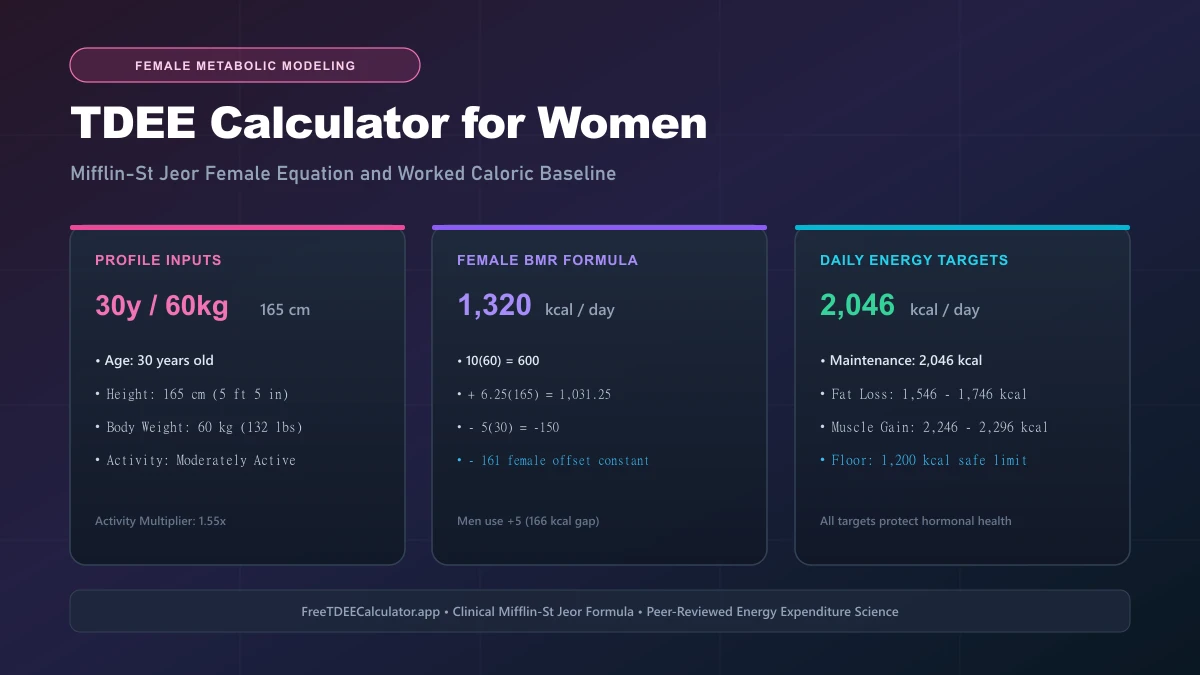
Female: 30 years old | 165 cm | 60 kg | Moderately Active (1.55x)
Step 1: BMR Calculation = 1,320 kcal/day
Step 2: Activity Multiplier = 1.55x
Step 3: Total Daily Maintenance TDEE = 2,046 kcal/day
Step 1: Calculate Resting Basal Metabolic Rate (BMR)
Apply the clinical female Mifflin-St Jeor equation:
$$\text{BMR} = (10 \times \text{weight in kg}) + (6.25 \times \text{height in cm}) - (5 \times \text{age in years}) - 161$$
Insert our subject’s parameters:
- Weight component: $10 \times 60 = 600$
- Height component: $6.25 \times 165 = 1,031.25$
- Age component: $5 \times 30 = 150$
- Female constant: $-161$
Execute the arithmetic:
$$\text{BMR} = 600 + 1,031.25 - 150 - 161$$ $$\text{BMR} = 1,631.25 - 150 - 161$$ $$\text{BMR} = 1,481.25 - 161 = 1,320.25 \text{ kcal}$$
Rounded to the nearest integer, her resting BMR is 1,320 calories per day. This is her absolute biological floor: the energy burned across 24 hours at complete rest.
Step 2: Multiply by the Physical Activity Level (PAL)
To account for movement, digestion, and workouts, multiply resting BMR by the validated activity multiplier. For moderate training 3 to 5 times per week, the standard coefficient is 1.55:
$$\text{TDEE} = \text{BMR} \times \text{Activity Multiplier}$$ $$\text{TDEE} = 1,320 \times 1.55 = 2,046 \text{ kcal/day}$$
Her baseline maintenance TDEE is 2,046 calories per day. At this intake, her scale weight will remain stable over the long term. Running these exact equations through a TDEE Calculator for Women yields identical, reproducible figures.
Step 3: Configure Goal-Specific Calorie Targets
With maintenance established, configure personalized intake targets depending on her primary health goal:
| Nutritional Goal | Calorie Adjustment | Daily Calorie Target | Projected Outcome |
|---|---|---|---|
| Weight Maintenance | $0 \text{ kcal}$ | 2,046 kcal/day | Perfect energy equilibrium; weight stays stable |
| Moderate Fat Loss | $-300 \text{ to } -500 \text{ kcal}$ | 1,546 to 1,746 kcal/day | Steady fat loss of 0.3 to 0.45 kg (0.7 to 1.0 lb) per week |
| Conservative Fat Loss | $-200 \text{ to } -250 \text{ kcal}$ | 1,796 to 1,846 kcal/day | Gentle fat loss; maximum athletic energy and ease |
| Lean Muscle Hypertrophy | $+200 \text{ to } +250 \text{ kcal}$ | 2,246 to 2,296 kcal/day | Controlled muscle building with minimal fat accrual |
Notice that even on her aggressive fat loss target of 1,546 calories per day, her intake remains 226 calories above her resting BMR and 346 calories above the 1,200-calorie safety floor, protecting thyroid health, sleep quality, and menstrual regularity. A tailored TDEE Calculator for Women keeps these essential safety margins visible.
Which Calculators Go With This Guide?
Navigating your metabolic numbers is simple when using our suite of validated tools. Pair this educational guide with our dedicated interactive calculators to fine-tune your nutrition plan:
- TDEE Calculator: Our primary, multi-formula metabolic tool computes your total daily calorie burn in metric or imperial units with real-time dynamic updates. It stands as the best tdee calculator for women seeking instant, accurate maintenance and deficit benchmarks.
- BMR Calculator: Determine your resting metabolic rate across three clinical equations (Mifflin-St Jeor, Harris-Benedict, and Katch-McArdle) to establish your personal metabolic intake floor.
- Macro Calculator: Convert your daily calorie targets into exact gram amounts for dietary protein, complex carbohydrates, and essential fats to optimize satiety and protect lean muscle mass.
- Calorie Deficit Calculator: Model safe fat loss timelines, projected weekly weight drops, and deficit boundaries tailored to your current scale weight.
To explore the clinical science supporting these calculations, read our companion guides on what is TDEE, the history of the Mifflin-St Jeor equation, and how to accurately calibrate daily movement using our activity level guide.
Whether you need a free tdee calculator for women to plan sustainable fat loss or a specialized tdee calculator for women weight loss that adapts to your training regimen, accurate mathematical baselines give you full control over your nutrition. Using a reliable tdee calculator to lose weight eliminates guesswork and ensures your body receives the fuel it needs to thrive. Selecting the best TDEE Calculator for Women ensures that every calculation aligns with evidence-based metabolic standards.
Conclusion
Determining your daily energy expenditure with a clinical TDEE Calculator for Women bridges the critical gap between abstract diet advice and individualized biological reality. By respecting female metabolic formulas, understanding the small thermogenic shifts of the menstrual cycle, and rejecting arbitrary 1,200-calorie restrictions, you build a sustainable relationship with nutrition that supports physical strength, stable energy, and lifelong endocrine health.
Medical Notice: The information, mathematical equations, and guidelines provided in this guide are intended strictly for educational and informational purposes. They do not constitute personal medical diagnosis or clinical nutrition prescriptions. Always seek guidance from a licensed physician, endocrinologist, or registered sports dietitian before initiating significant changes to your caloric intake or training routine.
This calculator is for informational and educational purposes only and does not constitute medical, nutritional, or health advice. Information presented in this guide is for educational purposes only and should not replace personalized evaluation from a physician or registered dietitian. Always consult your doctor before making substantial changes to your diet or exercise regimen. Read full disclaimer
Calculate Your Accurate Daily Calorie Burn
Stop guessing your metabolic numbers. Use our free, peer-reviewed multi-formula calculator to discover your exact TDEE, BMR, and macronutrient targets in 30 seconds.
🔥 Calculate My TDEE Now →Free Companion Health Calculators
Frequently Asked Questions
How do I calculate my TDEE female?
To calculate your female TDEE, first determine your resting Basal Metabolic Rate using the validated female Mifflin-St Jeor equation: BMR = (10 x weight in kg) + (6.25 x height in cm) - (5 x age in years) - 161. Next, multiply your BMR by your physical activity multiplier (1.2 for sedentary desk routines up to 1.725 or 1.9 for intense daily training). You can run this calculation instantly using our free homepage TDEE calculator or check your resting floor with our BMR calculator.
How many calories should a 70 kg woman eat to lose weight?
The exact calorie intake depends on height, age, and activity level. For an illustrative example of a 30-year-old woman weighing 70 kg and measuring 165 cm who is moderately active (multiplier 1.55), her female Mifflin BMR is 1,420 kcal/day (700 + 1,031.25 - 150 - 161). Her maintenance TDEE is 2,201 kcal/day (1,420 x 1.55). To achieve steady fat loss, a safe 300 to 500 calorie deficit puts her daily intake target between 1,701 and 1,901 kcal/day, which remains comfortably above the 1,200 kcal safety floor.
Is 1200 calories per day enough for a woman?
For the vast majority of adult women, 1,200 calories per day is an absolute metabolic floor rather than an appropriate diet target. Consuming 1,200 calories or fewer over prolonged periods risks severe hormonal disruption, menstrual irregularities (amenorrhea), loss of bone mineral density, muscle wasting, and extreme fatigue. Short, petite, sedentary women may occasionally use a 1,200-calorie target under direct clinical supervision, but active women require substantially higher energy intake.
Is 1500 calories enough per day for a woman?
Whether 1,500 calories is sufficient depends entirely on her personal TDEE. For a smaller or sedentary woman whose maintenance expenditure sits around 1,800 to 2,000 kcal/day, 1,500 calories provides an ideal moderate deficit of 300 to 500 kcal/day. However, for a taller, heavier, or highly active female with a TDEE of 2,300 kcal or higher, 1,500 calories represents an aggressive, unsustainable cut. As a golden rule, never remain below your resting BMR for extended periods, and calibrate intake using 2-week scale weight averages.